eBook - ePub
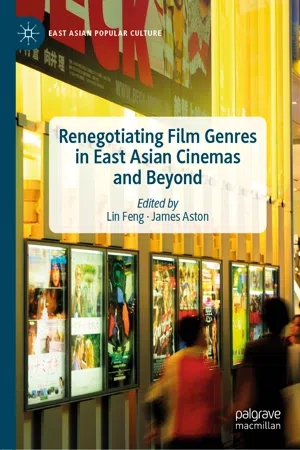
Renegotiating Film Genres in East Asian Cinemas and Beyond
- English
- ePUB (mobile friendly)
- Available on iOS & Android
eBook - ePub
Renegotiating Film Genres in East Asian Cinemas and Beyond
About this book
This book brings together nine original chapters to examine genre agency in East Asian cinema within the transnational context. It addresses several urgent and pertinent issues such as the distribution and exhibition practices of East Asian genre films, intra-regional creative flow of screen culture, and genre's creative response to censorship. The volume expands the scholarly discussion of the rich heritage and fast-changing landscape of filmmaking in East Asian cinemas. Confronting the complex interaction between genres, filmic narrative and aesthetics, film history and politics, and cross-cultural translation, this book not only reevaluates genre's role in film production, distribution, and consumption, but also tackles several under-explored areas in film studies and transnational cinema, such as the history of East Asian commercial cinema, the East Asian film industry, and cross-media and cross-market film dissemination.
Information
Part IEast Asian Film Genre in a Transnational Age
Part I of Renegotiating Genres is titled “East Asian Film Genre in a Transnational Age” and the three chapters included here, by Fraser Elliott and Andy Willis, Caleb Kelso-Marsh, and James Aston, introduce to the reader how East Asian film operates within a transnational perspective that has often been determined through Euro-American scholars, film critics, and festival programmers—a perspective that has provided the tendency to conceal the often complex generic and sociopolitical factors that underline the relationship, with not only East Asian cinema and their Euro-American counterparts but also the inter/intra-Asia dimension, which is an equally fascinating and substantial relationship to incorporate. Thus, all three chapters presented in Part I examine concrete case studies in how they operate within the transnational to highlight it as a wide-ranging concept that encompasses elements of technological development, movement of filmmaking personnel, distribution, exhibition, and marketing along with a “cross fertilisation of concepts of genre, cinematic style, and even subject matter” (Burgoyne 2016) as films move between national cinemas and across different nations.
Elliott and Willis open their chapter with an examination of how Chinese genre films (such as Hong Kong crime and action films along with the Chinese blockbuster Wolf Warrior II) are distributed and exhibited in the UK. The authors base their analysis on two models, the cultural and the commercial, to determine the nuanced ways Chinese films are shown within the independent arthouse circuit and the more commercial multiplex theatre. The chapter tracks the far-reaching changes reflecting contemporary movements to the UK film industry, prevalent ideas surrounding Chinese language films, and the transformations in domestic Chinese cinema. These factors provide a direct correlation to how they are received by audiences in the UK as well as how changing demographics, cultural values, and industry health similarly impacts the type of foreign/Chinese film picked up and released. The future is uncertain, especially concerning collaboration and hybridity between the cultural and commercial exhibition spheres and the chapter offers an insightful testimony into the complex make-up of transnational cinema. In doing so, the authors examine the UK film industry to better understand the changing ways cinema is being reformulated across different nations as part of the complex, dynamic, and multidirectional circulation of genre, commerce, cultural values, and modes of production, exhibition, and marketing.
Similar to how Elliott and Willis highlighted the Chinese-UK circulation of film styles, politics, and economics across cultural borders concerning film exhibition and festival programming, Kelso-Marsh’s chapter also addresses the transnational movement of East Asian genre films. The approach looks at noir cinema as a “pan-Asian phenomenon” as it crosses across the national boundaries of Hong Kong, Japan, and Korea. Thus, Kelso-Marsh provides an inter- and intra-Asia perspective of East Asian genre filmmaking as he tracks the aesthetic and thematic strategies employed in these different, but interconnected national noir cinemas. As they interact with Hollywood noir styles and repack and revision for East Asian audiences, they provide an intra-regional lens with which to examine transnational cinema. For example, the Korean noir of the 1960s was heavily influenced by Japanese noir such as that originating from the Nikkatsu studio. Hong Kong cinema of the 1980s was also heavily informed by Japanese genre developments, especially those connected to the yakuza, which then fed back into Korean noir of the late 1990s and early 2000s. The complex intra-regional flow of noir during these periods attests that although important, Hollywood noir was the sole influence and style for East Asian noir. These confluences and convergences show that regional film industries were more important in the development of an East Asian film noir cinema. In addressing transnational cinema in this way, Kelso-Marsh resituates the focus away from East Asian vs their Euro-American counterparts towards an intra-regional form of film noir.
In the final chapter, Aston picks up Kelso-Marsh’s examination on local and intra-regional influences by looking at the emergence of the East Asian blockbuster. Aston focuses primarily on the rise of commercial cinema in mainland China exemplified by the recent domestic successes of films such as Wolf Warrior II (Wu Jing, 2017) and Operation Red Sea (Dante Lam, 2018). Yet, in doing so accounts for how these films have utilised aesthetic and thematic conventions from US cinema ranging from the 21st century superhero film, 1980s hyper-masculine action cinema, the World War II combat film, and Michael Bay’s “cinema of excess”. These multiple historical, stylistic, and genre influences on China’s recent action/war movies again offer a crucial narrative on how transnational cinema works across nations such as China and the US and the “imitations, adaptations, and transformations of visual style and narrative (genre)” (Bergfelder 2016) that occur. In China, the war genre has been recouped to provide a framework that presents China as a powerful nation, both militarily and diplomatically, and is achieved via the central agency of a powerful masculine hero. Furthermore, the success of the blockbuster war film in China and its connections to a strong national identity and direction have been picked up and replicated in other East Asian countries. For example, in Korea, The Admiral: Roaring Currents (Kim Han-min, 2014), a period war film that similarly stresses the twin themes of a strong nation and male agency has become the most successful film of all time at the domestic box-office. Not only does the chapter show, similar to Kelso-Marsh’s contention that the noir should be seen as transnational rather than solely the domain of Hollywood, that the blockbuster has now been “de-Westernised” but also, like the previous two chapters, the multiplicity of transnational dimensions, which are essential to include in any definitions of the genre in a transnational and global world.
References
Bergfelder, Tim. 2012. “What is your definition of ‘transnational cinema’?”, interview by Austin Fisher and Iain Robert Smith. “Transnational Cinemas: A Critical Roundtable.” Frames Cinema Journal. http://framescinemajournal.com/article/transnational-cinemas-a-critical-roundtable/#tbergfelder, no pagination. Accessed 22 January 2020.
Burgoyne, Robert. 2012. “What is your definition of ‘transnational cinema’?”, interview by Austin Fisher and Iain Robert Smith. “Transnational Cinemas: A Critical Roundtable.” Frames Cinema Journal. http://framescinemajournal.com/article/transnational-cinemas-a-critical-roundtable/#rburgoyne, no pagination. Accessed 22 January 2020.
© The Author(s) 2020
L. Feng, J. Aston (eds.)Renegotiating Film Genres in East Asian Cinemas and BeyondEast Asian Popular Culturehttps://doi.org/10.1007/978-3-030-55077-6_2Rapidly Shifting Landscapes: Two Case Studies in the UK Distribution and Exhibition of Chinese Language Films in the Twenty-First Century
Fraser Elliott1 and Andy Willis1
(1)
University of Salford, Salford, UK
This chapter considers the ways in which the patterns of distribution and exhibition of Chinese language films in the UK have changed in the twenty-first century. Within this analysis, we also articulate the important position genre films have played in the attempts to find space for Chinese language films in the congested world of foreign language films within the UK’s distribution and exhibition networks.
Our analysis is based on two models, which we have labelled the cultural and the commercial drawing on the work of Mark Cosgrove, Head Curator for Film at the Watershed in Bristol, UK. The former is driven by cultural concerns and exists predominantly within what is, in the UK, termed the independent cultural cinema exhibition sector, a label developed relatively recently within that sector to move away from the perceived elitism of the term “art-hou...
Table of contents
- Cover
- Front Matter
- Introduction
- Part I. East Asian Film Genre in a Transnational Age
- Part II. Development of Genre film and Film Genre in East Asia Cinemas
- Part III. The Politics of Genre Space
- Back Matter
Trusted by 375,005 students
Access to over 1.5 million titles for a fair monthly price.
Study more efficiently using our study tools.
Frequently asked questions
Yes, you can cancel anytime from the Subscription tab in your account settings on the Perlego website. Your subscription will stay active until the end of your current billing period. Learn how to cancel your subscription
No, books cannot be downloaded as external files, such as PDFs, for use outside of Perlego. However, you can download books within the Perlego app for offline reading on mobile or tablet. Learn how to download books offline
Perlego offers two plans: Essential and Complete
- Essential is ideal for learners and professionals who enjoy exploring a wide range of subjects. Access the Essential Library with 800,000+ trusted titles and best-sellers across business, personal growth, and the humanities. Includes unlimited reading time and Standard Read Aloud voice.
- Complete: Perfect for advanced learners and researchers needing full, unrestricted access. Unlock 1.5M+ books across hundreds of subjects, including academic and specialized titles. The Complete Plan also includes advanced features like Premium Read Aloud and Research Assistant.
We are an online textbook subscription service, where you can get access to an entire online library for less than the price of a single book per month. With over 1.5 million books across 990+ topics, we’ve got you covered! Learn about our mission
Look out for the read-aloud symbol on your next book to see if you can listen to it. The read-aloud tool reads text aloud for you, highlighting the text as it is being read. You can pause it, speed it up and slow it down. Learn more about Read Aloud
Yes! You can use the Perlego app on both iOS and Android devices to read anytime, anywhere — even offline. Perfect for commutes or when you’re on the go.
Please note we cannot support devices running on iOS 13 and Android 7 or earlier. Learn more about using the app
Please note we cannot support devices running on iOS 13 and Android 7 or earlier. Learn more about using the app
Yes, you can access Renegotiating Film Genres in East Asian Cinemas and Beyond by Lin Feng, James Aston, Lin Feng,James Aston in PDF and/or ePUB format, as well as other popular books in Medios de comunicación y artes escénicas & Películas y vídeos. We have over 1.5 million books available in our catalogue for you to explore.