eBook - ePub
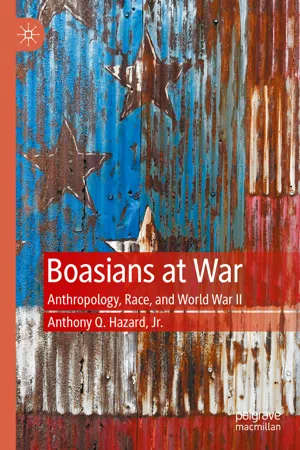
Boasians at War
Anthropology, Race, and World War II
- English
- ePUB (mobile friendly)
- Available on iOS & Android
eBook - ePub
About this book
This volume seeks to recover a specific historical moment within the tradition of anthropologists trained in the United States under Franz Boas, arguably the father of modern American anthropology. Focusing on Boasians Ashley Montagu, Margaret Mead, Melville Herskovits, and Ruth Benedict, Anthony Hazard highlights the extent to which the Boasians offer historicized explanations of racism that move beyond a quest to reshape only the discipline: Boasian war work pointed to the histories of chattel slavery and colonialism to theorize not just race, but the emergence of racism as both systemic and interpersonal. The realities of race that continue to plague the United States have direct ties to the anthropological work of the figures examined here, particularly within the context of the 20th-century black freedom struggle. Ultimately, Boasians at War offers a detailed glimpse of the long troubled history of the concept of race, along with the real-life realities of racism, that have carried on despite the harnessing of scientific knowledge to combat both.
Information
© The Author(s) 2020
A. Q. Hazard, Jr.Boasians at Warhttps://doi.org/10.1007/978-3-030-40882-4_11. Introduction
Anthony Q. HazardJr.1
(1)
Ethnic Studies Department, Santa Clara, CA, USA
“They do not know, or they refuse to know, that the idea of an inferior or superior race has been refuted by the best evidence of the science of anthropology. Great anthropologists, like Ruth Benedict, Margaret Mead, and Melville J. Herskovits, agree,” Martin Luther King Jr. wrote in 1963, “that although there may be inferior and superior individuals within all races, there is no superior or inferior race… they blindly believe in the eternal validity of an evil called segregation and the timeless truth of a myth called white supremacy.”1 This would not be the last time Dr. King referenced Boasian anthropology in a speech, sermon, or writing. In Where Do We Go from Here , published months before his assassination, Dr. King returned to Boasian anthropology, citing Ruth Benedict’s elucidation of the interconnectedness of race theory and racism.2 He among many other black scholars and activists, well understood the centrality of scientific racism to the philosophical basis of imperialism, colonialism, slavery, and Jim Crow segregation, just as the once enslaved James McCune Smith and Frederick Douglass had in the nineteenth century. Their refutations of antebellum phrenologists and polygenicists in the decades leading up to the American Civil War , followed by the work of Douglass’s colleague Haitian anthropologist Antenor Firmin, illuminate an Africana anthropological scholarly activism that predates the legend of Franz Boas, the father of US anthropology.3 In terms of institutionalized academic discipline, Boas did bring to anthropology the methodological standard of participant observation fieldwork, along with the four-field approach to the study of human life (ethnology, physical anthropology, linguistic anthropology, and archaeology). Yet Boas, King, and other twentieth-century luminaries stood to inherit elements of that Africana intellectual tradition as the failures of one Reconstruction emerged and the challenges of a second Reconstruction awaited firmly on the historical horizon. The legend of Franz Boas himself intertwines with that particular struggle.
At the very moment Boas’s life came to an end in 1942, and prior to the emergence of Dr. King as a national figure on the heels of the Montgomery Bus Boycott in 1956, both anthropologists and African American scholars and activists found themselves in the whirlwind of World War II, racialized violence on the streets of Detroit, Harlem, and Los Angeles, the incarceration of 70,000 Japanese American citizens, and physical assaults and shootings of active duty African Americans stationed in the American south.4
African American scholars and activists had a shared stake in exploiting the obvious hypocrisy of the US government upholding segregation in civilian life and in the military, while fighting to defeat Hitler and the Nazi regime. With the sentiments of historian Richard Dalfiume in mind, who in reflection wrote in 1968 that the “forgotten years” of the “Civil Rights revolution” might be found in World War II, this book highlights the role of anthropology in “the struggle for (and against) racial equality” in that specific moment.5 Boasian anthropology in particular I argue, was indeed one of the many aspects of society and politics, in the United States and beyond, that was tied up in the black struggle and the war effort.6 World War II is a historical moment I cast in this book as an epoch of acceleration and contestation within the Long Civil Rights Movement, which preceded the “classical phase” of the movement in the 1950s and 1960s, and embodied a robust diasporic consciousness as well.7
As was the case in the global fight against white supremacy across the twentieth century, the progress of science in refuting classical anthropology and Nazi race theory did not unfold in a neat linear reality. The apparent triumph of anti-racist anthropology in the UNESCO (United Nations, Educational, Scientific, and Cultural Organization) Statements on Race in 1950 and 1951, by no means, relegated racist science to the dustbin of history.8 Indeed, the complexities and inconsistencies of Boasian anthropology leading up to that moment are a central thread in the work that Mead, Benedict, Herskovits, and Ashley Montagu produced during World War II. Although Boasians tended to echo each other’s arguments, frequently cited other Boasian publications, and corresponded constantly, they still produced scholarship as individuals with shared but nuanced goals. After all, Mead had become a famous public intellectual on the basis of her best-selling ethnographies, which exposed American readers to her fieldwork in the South Pacific Islands. Ashley Montagu made his name as a sharp-tongued physical anthropologist and deconstructionist of race in the 1940s. Herskovits rose to prominence on his respected fieldwork in West Africa and the Caribbean in the 1920s and 1930s, becoming the founder of African Studies at Northwestern University in the late 1940s. And Ruth Benedict, emerged in the anthropological profession with multiple publications in the 1930s based on fieldwork among Indigenous communities in the American Southwest and Pacific Northwest.
Mead , Benedict, and Herskovits also worked for the US government in official capacities that supported the US war effort. Motivated to both win the war and win the peace to follow, they worked within a complex space of anti-racist activism and wartime patriotism that at times challenged their sensibilities as “progressives” in matters of race. In what follows I explore how those complexities manifested in their scholarship, activism, and work for the US government. Central to excavating that complex wartime space, I explore the aforementioned anthropologists’ wartime work, both scholarly and in government service, along with their engagements with black activists, labor leaders, and scholars.
In Boasians at War I recover a specific historical moment within the tradition of anthropologists trained under Franz Boas and later Ruth Benedict at Columbia University, which builds on the many reconstructions of the Boasian tradition in US anthropology that focus primarily on the first three decades of the twentieth century. The apparent triumph of anti-racist anthropology in the United States was an incomplete and therefore ongoing project as Nazi Germany and Imperial Japan embarked upon efforts to conquer Europe and Asia, and Jim Crow remained the order of the day in the United States.9
Scholarly works that focus on Boasians and the anthropological profession more broadly from that war era on offer useful accounts of the wartime work of Mead, Benedict, and Herskovits, yet these treatments of wartime Boasian anthropology are not framed by the central questions of “race” that thematically drive Boasians at War.10 Adding to recent works that do offer more focused coverage of Boasian anthropology during the middle decades of the twentieth century overlap temporally and thematically with this project, I center the global black freedom movement during the war not simply as a potent moment of scholarly activism, but as a moment that challenged the Boasians to think seriously and deeply about their own racialized identities and political commitments.11
This project also places the work of this cadre of white (Mead and Benedict) and Jewish (Boas , Herskovits, and Montagu) scholarly activists within the framework of the contemporary field of Whiteness Studies, which as an intellectual project owes its foundational theories and approaches not to scholars of the 1990s but rather to the historical scholarship of W.E.B. Du Bois.12 Du Bois’s Black Reconstruction (1935) and Dusk of Dawn (1940) offered interrogations of whiteness at the very moment in which the boundaries of whiteness in the United States began to shift under the weight of the global war, Nazi race theory, and the ensuing Holocaust. To that end I situate this work within what historian Nell Irvin Painter refers to as “the third enlargement of whiteness” in the 1940s, by exploring how the Boasians grapple with their own identities, and broader constructions of whiteness.13 I uncover the extent to which their individual wartime work posits critiques of whiteness within a larger deconstruction of race, and if and how that work prefigures analyses central to late twentieth and early twenty-first century interrogations of whiteness.14 In laying bare t...
Table of contents
- Cover
- Front Matter
- 1. Introduction
- 2. Papa Franz: “The Most Grotesque Fictions”
- 3. Ashley Montagu: The Negro Question and the Myth of Race
- 4. Margaret Mead: “A Fairly Typical Old American” on Race and Racism
- 5. Melville Herskovits: The Negro Past and Present
- 6. Ruth Benedict: The “Darker Side of America” and Scientific Absurdities
- 7. Epilogue
- Back Matter
Trusted by 375,005 students
Access to over 1.5 million titles for a fair monthly price.
Study more efficiently using our study tools.
Frequently asked questions
Yes, you can cancel anytime from the Subscription tab in your account settings on the Perlego website. Your subscription will stay active until the end of your current billing period. Learn how to cancel your subscription
No, books cannot be downloaded as external files, such as PDFs, for use outside of Perlego. However, you can download books within the Perlego app for offline reading on mobile or tablet. Learn how to download books offline
Perlego offers two plans: Essential and Complete
- Essential is ideal for learners and professionals who enjoy exploring a wide range of subjects. Access the Essential Library with 800,000+ trusted titles and best-sellers across business, personal growth, and the humanities. Includes unlimited reading time and Standard Read Aloud voice.
- Complete: Perfect for advanced learners and researchers needing full, unrestricted access. Unlock 1.5M+ books across hundreds of subjects, including academic and specialized titles. The Complete Plan also includes advanced features like Premium Read Aloud and Research Assistant.
We are an online textbook subscription service, where you can get access to an entire online library for less than the price of a single book per month. With over 1.5 million books across 990+ topics, we’ve got you covered! Learn about our mission
Look out for the read-aloud symbol on your next book to see if you can listen to it. The read-aloud tool reads text aloud for you, highlighting the text as it is being read. You can pause it, speed it up and slow it down. Learn more about Read Aloud
Yes! You can use the Perlego app on both iOS and Android devices to read anytime, anywhere — even offline. Perfect for commutes or when you’re on the go.
Please note we cannot support devices running on iOS 13 and Android 7 or earlier. Learn more about using the app
Please note we cannot support devices running on iOS 13 and Android 7 or earlier. Learn more about using the app
Yes, you can access Boasians at War by Anthony Q. Hazard, Jr.,Anthony Q. Hazard Jr. in PDF and/or ePUB format, as well as other popular books in Social Sciences & World History. We have over 1.5 million books available in our catalogue for you to explore.