- English
- ePUB (mobile friendly)
- Available on iOS & Android
eBook - ePub
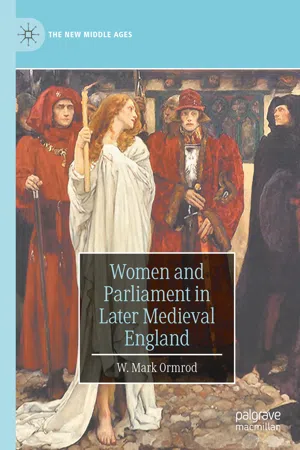
Women and Parliament in Later Medieval England
About this book
This Palgrave Pivot provides the first ever comprehensive consideration of the part played by women in the workings and business of the English Parliament in the later Middle Ages. Breaking new ground, this book considers all aspects of women's access to the highest court of medieval England. Women were active supplicants to the Crown in Parliament, and sometimes appeared there in person to prosecute cases or make political demands. It explores the positions of women of varying rank, from queens to peasants, vis-à-vis this male institution, where they very occasionally appeared in person but were more usually represented by written petitions. A full analysis of these petitions and of the official records of parliament reveals that there were a number of issues on which women consistently pressed for changes in the law and its administration, and where the Commons and the Crown either championed or refused to support reform. Such is the concentration of petitions on the subjects of dower and rape that these may justifiably be termed 'women's issues' in the medieval Parliament.
Information
© The Author(s) 2020
W. M. OrmrodWomen and Parliament in Later Medieval EnglandThe New Middle Ageshttps://doi.org/10.1007/978-3-030-45220-9_11. Introduction: Debates and Sources
Abstract
The history of Parliament is almost always written as the history of men, and especially for the Middle Ages when women were so often excluded, formally or informally, from political institutions. Yet there was a long history during the later medieval period of women (like men) petitioning the Crown in Parliament for the redress of grievances. The best evidence for this comes from the first 7910 petitions in the National Archives series SC 8, whose parliamentary provenance is well established. Some 12% of this sample comprises petitions by women, acting either as femme sole (that is, independently) or in conjunction with husbands, as well as smaller numbers of petitions from female collectives (mainly houses of nuns). This book offers a sustained analysis of this material, set within a number of modern theoretical positions on medieval women, especially the question of women’s power and agency.
Keywords
AgencyGenderParliamentPetitionsPowerWomenThe History of Parliament
The year 2018 was the centenary of the Representation of the People Act 1918, by which some women over the age of thirty were permitted to vote, for the first time, in elections to the British Parliament. The anniversary was marked with a good deal of activity both in Parliament itself and in academic circles, which evaluated and celebrated the work of suffragists, suffragettes and male politicians in bringing about the great sea-change in women’s role in politics over the course of the twentieth century. Much less attention was given to the fact that women had been participants in the wider political culture of Parliament for a long time before 1918. In an important article published in 2019, Sarah Richardson has drawn attention to the role of women as wives and servants in the Palace of Westminster before and after the great fire of 1834. In particular, she has elucidated women’s access to the Commons, before 1834 via the ‘Ventilator’ air shaft running out of the Commons Chamber and after 1852 in the Ladies’ Gallery of the (then newly built) House of Commons.1 Richardson’s study naturally prompts the medievalist to the question: What role did women play in the life of Parliament during the earliest centuries of the institution’s existence? This study aims to address that question in relation to the late thirteenth, fourteenth and fifteenth centuries.
The English Parliament had many antecedents stretching back into the pre-Conquest and Norman eras, but it was in the thirteenth century that a recognisable institution with the actual name of Parliament—from the Latin and French terms for ‘talking’ or ‘debating’—first emerged.2 Its functions, as they developed through the reigns of Henry III, Edward I and Edward II, were three-fold: to discuss and advise the king on the great affairs of state, such as the making of new laws and the pursuit of foreign policy; to provide a forum in which the king’s subjects could approach him directly for the redress of their individual grievances, expressed in the form of ‘private’ petitions; and to obtain formal consent for the levying of extraordinary taxes needed for the prosecution of war. In order to be accepted, private petitions had to meet certain criteria, the most important of which was that the matter in hand could not be dealt with adequately by the common law courts but needed to be resolved either by the dispensation of the king’s grace or by the delegation of the matter to a special judicial commission of oyer and terminer (literally ‘to hear and determine’).
Early in Edward III’s reign, the composition of Parliament settled down into the characteristic two orders or, as they were often later known, ‘houses’, the Lords and the Commons. The former was a group of fifty to a hundred titled nobles and barons who were summoned to Parliament in their own right as the successors to the members of older Great Councils. The Commons was made up of two groups: the knights of the shires, who were elected in the county courts by the substantial freeholders of the relevant counties; and the citizens and burgesses, who were chosen by the local elites in up to a hundred self-governing cities and towns. The knights of the shires, numbering seventy or so men (two from each county) tended to be drawn from landed society below the ranks of the Lords, often referred to today as the gentry. The citizens and burgesses, who numbered around a hundred and fifty (again, two from each constituency), were normally from mercantile stock. In the fifteenth century, some of the parliamentary boroughs preferred to elect members of the gentry to represent them in Parliament, and throughout the later Middle Ages the landed interest always tended to prevail, though merchants’ voices were sometimes loudly expressed in the common petitions. There were also potentially a hundred and fifty clerical proctors, representing the diocesan clergy and cathedral chapters; although we know the names of these men, they are almost entirely invisible in the records of Parliament, and it remains uncertain whether they attended or what role they had.
There was a perennial problem about attendance among the lay members, too: a number of the Lords, and even some of those elected to the Commons and in receipt of expenses from their constituencies, did not bother to turn up at certain Parliaments over the fourteenth and fifteenth centuries. Sometimes this was to do with the inconvenience of the venue. In its earlier years, Parliament met wherever the king planned to be at the allotted time: the use of the northern capital of York as a frequent meeting-place for Parliament from the 1290s to the 1330s reflected the preoccupation of successive monarchs with war against the Scots. Gradually, however, Westminster prevailed, though other places such as Gloucester, Cambridge, Leicester and Coventry were used as ‘one-offs’ for sessions of Parliament in the later fourteenth and fifteenth centuries.
It was in Edward III’s time that Parliament gained exclusive control not only over the direct taxes granted in time of war but also over the range of subsidies on exports and imports which, together with the older customs duties levied in the ports, represented by far the largest single element in the Crown’s fiscal armoury. Parliament found a number of ways to link the granting of taxation with the redress of grievances expressed in so-called ‘common’ petitions. Thus, from the middle of the fourteenth century the great majority of royal statutes represented measures that had been agreed in Parliament by the king with the consent of the Lords and Commons.
Parliament did not sit permanently—some medieval historians have preferred to regard it as an ‘occasion’ rather than an institution—and the frequency of assemblies varied. Under Edward I, it was common to hold three Parliaments a year; under Edward III, it was more usual to have just one; and by the time of Henry VI and Edward IV, several years could sometimes go by without any Parliaments being summoned. The decline in frequency partly accounts for the dropping away of the individual or ‘private’ petitions that had been so important an element of parliamentary business under Edward I and Edward II. The growth in the equitable jurisdiction of the court of Chancery during the fourteenth century was in part a response to the need of petitioners to have regular access to a tribunal outside and beyond the common law.3 But with the decline in the number of Parliaments went a concomitant increase in the amount of public business done there. Whereas individual Parliaments under Edward I had often met for just a week or two, by the fifteenth century they were often in session for several months, and might be prorogued and re-convened multiple times.
When it was in session, then, Parliament as a body comprised up to a hundred members of the Lords and around two hundred and fifty members of the Commons, not to mention the proctors of the clergy and the various royal officials in attendance ex officio or as providers of administrative support. All of these were men: whereas women have been identified as holding some public offices, such as sheriff, under exceptional circumstances during the later Middle Ages, no-one has ever discovered a woman summoned in her own right to the Lords or returned by the counties or towns to the Commons.4 It is reasonable to suppose that women were sometimes present on the fringes of Parliament. The wives of at least some parliamentarians may have accompanied their husbands to the venue for assembly and spent part of their time there observing the debates held in the Lords’ and Commons’ chambers, either first-hand or, more probably, second-hand via men’s oral summaries. The social side of Parliament is poorly studied, however, and we know very little about whether women ever joined even in the ceremonial aspects of such political assemblies.5 In this respect, the records are remarkably unyielding as to the possible presence of women at the various meeting-places of Parliament during the later Middle Ages.
It is easy and tempting to take silence as absence, and to suppose that women were not present at all durin...
Table of contents
- Cover
- Front Matter
- 1. Introduction: Debates and Sources
- 2. Queens and Noblewomen in Parliament
- 3. Women of the Gentry and Lesser Social Status
- 4. Women on Trial in Parliament
- 5. Female Institutions and Collectives as Petitioners in Parliament
- 6. Women’s Issues in Parliament: Dower
- 7. Women’s Issues in Parliament: Rape
- 8. Women, Parliament and the Public Sphere
- 9. Conclusion: Women Speaking Out in the Medieval Parliament
- Back Matter
Trusted by 375,005 students
Access to over 1.5 million titles for a fair monthly price.
Study more efficiently using our study tools.
Frequently asked questions
Yes, you can cancel anytime from the Subscription tab in your account settings on the Perlego website. Your subscription will stay active until the end of your current billing period. Learn how to cancel your subscription
No, books cannot be downloaded as external files, such as PDFs, for use outside of Perlego. However, you can download books within the Perlego app for offline reading on mobile or tablet. Learn how to download books offline
Perlego offers two plans: Essential and Complete
- Essential is ideal for learners and professionals who enjoy exploring a wide range of subjects. Access the Essential Library with 800,000+ trusted titles and best-sellers across business, personal growth, and the humanities. Includes unlimited reading time and Standard Read Aloud voice.
- Complete: Perfect for advanced learners and researchers needing full, unrestricted access. Unlock 1.5M+ books across hundreds of subjects, including academic and specialized titles. The Complete Plan also includes advanced features like Premium Read Aloud and Research Assistant.
We are an online textbook subscription service, where you can get access to an entire online library for less than the price of a single book per month. With over 1.5 million books across 990+ topics, we’ve got you covered! Learn about our mission
Look out for the read-aloud symbol on your next book to see if you can listen to it. The read-aloud tool reads text aloud for you, highlighting the text as it is being read. You can pause it, speed it up and slow it down. Learn more about Read Aloud
Yes! You can use the Perlego app on both iOS and Android devices to read anytime, anywhere — even offline. Perfect for commutes or when you’re on the go.
Please note we cannot support devices running on iOS 13 and Android 7 or earlier. Learn more about using the app
Please note we cannot support devices running on iOS 13 and Android 7 or earlier. Learn more about using the app
Yes, you can access Women and Parliament in Later Medieval England by W. Mark Ormrod in PDF and/or ePUB format, as well as other popular books in History & European Medieval History. We have over 1.5 million books available in our catalogue for you to explore.