This book provides the first comprehensive overview of the global landscape of documentary film festivals. Contributors from across the globe offer in-depth analysis of both internationally renowned and more alternative festivals, including Hot Docs (Canada), Nyon (Switcherland), Yamagata (Japan), DocChina, Full Frame (US), Belgrade (former Yugoslavia), Vikalp (India), and DocsBarcelona (Catalonia, Spain), among others. With a special focus on historical and political developments, this first volume draws a map of documentary festivals operating today, and then looks at their origins and evolution.
This volume is organized in three sections: the first addresses methodological problems film historians and social scientists face when researching documentary film festivals, the second looks at the historical development of this circuit within the wider frame of history of world and national cinemas, and the third reflects on how politics find their way through festival programs and actions. Curatorial, organizational, industrial and political changes occurred in the festival realm addressed in this book help better understand how these affected documentary production, distribution, curation, exhibition and reception up to this day.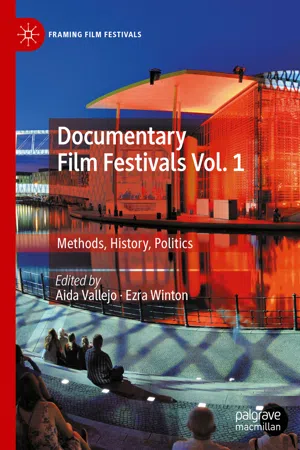
eBook - ePub
Documentary Film Festivals Vol. 1
Methods, History, Politics
- English
- ePUB (mobile friendly)
- Available on iOS & Android
eBook - ePub
Documentary Film Festivals Vol. 1
Methods, History, Politics
About this book
Information
© The Author(s) 2020
A. Vallejo, E. Winton (eds.)Documentary Film Festivals Vol. 1Framing Film Festivalshttps://doi.org/10.1007/978-3-030-17320-3_1Introduction—Volume 1: Documentary Film Festivals: Methods, History, Politics
Aida Vallejo1 and Ezra Winton2
(1)
University of the Basque Country (UPV/EHU), Leioa, Spain
(2)
Lakehead University, Thunder Bay, ON, Canada
Ezra Winton
Documentary cinema has experienced growing cultural visibility, commercial distribution and academic recognition in the last two decades. While technological changes and digitization certainly have had a role in bolstering the genre, the steadily increasing number of exhibition sites has been paramount to non-fiction film’s ascent. From Beijing to Toronto, Amsterdam to Kerala, Maputo to Doha and beyond, documentary film festivals have proliferated as a composite component of the massive spread of film festivals in general (estimated to have grown to somewhere between 4000 and 5000 in just six decades). Today these documentary art, culture and business platforms make up a vast circulation and exhibition circuit that wields ever-increasing power over documentary cultures at the beginning of the twenty-first century.
Even if documentary festivals have served as a fundamental source for researchers to discover and explore the films that today form (and challenge) the canon, focused academic studies on documentary festivals are scarce. Moreover, appraisal of their historical evolution, political role, economic influence, cultural value and social significance is a necessary step towards a broad understanding of this alternative circulation and exhibition circuit. The chapters and interviews in our two volumes address these lacunae, while approaching the various aspects of documentary festivals through different lenses and from disparate disciplines, thus interrogating a wide range of topics that will interest readers focused on both documentary and festivals. Furthermore, the authors in this collection not only analyze the international network of documentary festivals, identifying relevant events from both historical and contemporary perspectives, but together they expand research carried out within the relatively young field of Film Festival Studies, while linking with academics working in other fields and disciplines such as documentary, anthropology, history, cultural and media studies, arts management , minoritized languages and, from a wider perspective, film literacy and the creative industries.
While Bill Nichols notes at the beginning of this volume that the influence of documentary film festivals over the documentary form should not be overestimated, we cannot ignore Marijke de Valck’s sapient take on the enduring importance of (researching) film festivals as obligatory points of passage “because they are events—actors —that have become so important to the production, distribution and consumption of many films that, without them, an entire network of practices, places, people, etc. would fall apart” (2007, 36). With de Valck’s observation in mind, this collection explores the nature, dynamics and impact of documentary film festivals worldwide, offering a focused, collective effort to understand the context in which contemporary documentary practices and exhibition modes develop. We believe this publication is a first step into a fascinating world of globalized and globalizing events that have become privileged (and often contested) spaces for the celebration, negotiation, discussion and, above all, curation, exhibition and reception of documentary cinema.
In what follows, we start by offering a review of the points of convergence of Film Festival Studies and Documentary Studies. Then, we propose a definition of the documentary festival. Drawing on concepts developed by Nichols, we deepen epistemological, socio-political and aesthetic concerns to analyze the specificities of documentary festivals. Finally, we summarize the contents of the three parts of this volume, which focus on research, history and politics, respectively.
Bringing Together Film Festival and Documentary Studies
This book —which is the first in a two-volume set—brings together two fields evolving within Film Studies: documentary and film festivals. While the latter is a more recent development with an exponential increase in literature appearing since 2007, following the publication of the ground-breaking book Film Festivals: From European Geopolitics to Global Cinephilia (de Valck 2007), documentary has deeper scholarly roots, punctuated and bolstered by academics like Thomas Waugh (1984) in the 1980s, Bill Nichols (1991), Michael Renov (1993) and Brian Winston (1995) in the 1990s and writers at Jump Cut since its launch in 1974.1 The genre’s more established tradition, which has attracted increasing academic attention since the 1990s, was elevated by Nichols’s seminal Representing Reality: Issues and Concepts in Documentary (1991) and the launch of the University of Minnesota Press’s Visible Evidence series in 1997.2 Recent trends in documentary scholarship in the English language show an ever-growing number of publications that expand the documentary canon towards new geographical areas, identity and ethics issues and aesthetic trends. We see this as a decentralizing tendency that contributes to a diversity of approaches as well as scholars’ profiles.
On the other hand, Film Festival Studies is in a moment of wider concentration of core-academics and research works, partly due to its much younger trajectory. The study of film festivals has grown parallel to the proliferation of festival events worldwide, attracting the interest of academics such as de Valck, who laid the foundation for this research area in her comprehensive study that positioned the festival circuit as a globally connected phenomenon (2007). de Valck (together with Skadi Loist) further developed the field with the creation of the Film Festival Research Network and (with Tamara Falicov in 2015) Palgrave Macmillan’s Framing Film Festivals Series, of which these two volumes are a part. Equally so, the work of Dina Iordanova, as general editor of the Film Festival Yearbook Series (2009–2014) and the Films Need Festivals, Festivals Need Films Series (since 2013), at St Andrews Film Studies publishing house, has been instrumental in advancing the field.
The study of film festivals can be framed by a general trend towards interdisciplinary approaches to film history, but also by a growing interest in transnational and world cinema, after the fall of the big national studios that had initially produced and defined “national cinemas.” Film festivals have therefore attracted the interests of researchers who study the global dynamics of film circulation, theoreticians who seek to redress the colonial excesses of classic film history and scholars interested in minority film practices that operate alongside commercial distribution channels. Documentary certainly comprises film practices that work at the margins of commercial cinema, that are characterized by affordable means of production for peripheral cinemas and, at the same time, that contest established power dynamics.
Within Film Festival Studies, the literature devoted to documentary festivals is quite scarce. Sporadic contributions have appeared in academic journals and books in the past few years, but these are dispersed from divergent disciplines and lack common referents (see de Valck and Soeteman 2010; Nornes 2009). Documentary festivals have been the subject of recent research, including doctoral theses developed by contributors of these two volumes. In addition, a smattering of book-length studies approach festivals of social concern, including documentary festivals. The Film Festival Yearbook 4: Film Festivals and Activism (Iordanova and Torchin 2012) tackles activist documentary festivals but focuses mainly on human rights film festivals and the social concerns associated with their programmes. In this line, new publications by social scientists have looked at small Canadian documentary festivals (Roy 2014), the human rights film festival circuit (Tascón 2015) and activist film festivals (Tascón and Wil...
Table of contents
- Cover
- Front Matter
- Introduction—Volume 1: Documentary Film Festivals: Methods, History, Politics
- Defining Documentary in the Festival Circuit: A Conversation with Bill Nichols
- Part I. Research and Methods
- Part II. Histories and Origins
- Part III. Politics and Policies
- Back Matter
Trusted by 375,005 students
Access to over 1.5 million titles for a fair monthly price.
Study more efficiently using our study tools.
Frequently asked questions
Yes, you can cancel anytime from the Subscription tab in your account settings on the Perlego website. Your subscription will stay active until the end of your current billing period. Learn how to cancel your subscription
No, books cannot be downloaded as external files, such as PDFs, for use outside of Perlego. However, you can download books within the Perlego app for offline reading on mobile or tablet. Learn how to download books offline
Perlego offers two plans: Essential and Complete
- Essential is ideal for learners and professionals who enjoy exploring a wide range of subjects. Access the Essential Library with 800,000+ trusted titles and best-sellers across business, personal growth, and the humanities. Includes unlimited reading time and Standard Read Aloud voice.
- Complete: Perfect for advanced learners and researchers needing full, unrestricted access. Unlock 1.5M+ books across hundreds of subjects, including academic and specialized titles. The Complete Plan also includes advanced features like Premium Read Aloud and Research Assistant.
We are an online textbook subscription service, where you can get access to an entire online library for less than the price of a single book per month. With over 1.5 million books across 990+ topics, we’ve got you covered! Learn about our mission
Look out for the read-aloud symbol on your next book to see if you can listen to it. The read-aloud tool reads text aloud for you, highlighting the text as it is being read. You can pause it, speed it up and slow it down. Learn more about Read Aloud
Yes! You can use the Perlego app on both iOS and Android devices to read anytime, anywhere — even offline. Perfect for commutes or when you’re on the go.
Please note we cannot support devices running on iOS 13 and Android 7 or earlier. Learn more about using the app
Please note we cannot support devices running on iOS 13 and Android 7 or earlier. Learn more about using the app
Yes, you can access Documentary Film Festivals Vol. 1 by Aida Vallejo, Ezra Winton, Aida Vallejo,Ezra Winton in PDF and/or ePUB format, as well as other popular books in Mezzi di comunicazione e arti performative & Film e video. We have over 1.5 million books available in our catalogue for you to explore.