eBook - ePub
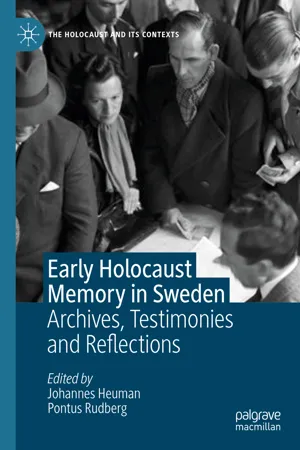
Early Holocaust Memory in Sweden
Archives, Testimonies and Reflections
- English
- ePUB (mobile friendly)
- Available on iOS & Android
eBook - ePub
Early Holocaust Memory in Sweden
Archives, Testimonies and Reflections
About this book
This book investigates the memory of the Holocaust in Sweden and concentrates on early initiatives to document and disseminate information about the genocide during the late 1940s until the early 1960s. As the first collection of testimonies and efforts to acknowledge the Holocaust contributed to historical research, judicial processes, public discussion, and commemorations in the universalistic Swedish welfare state, the chapters analyse how and in what ways the memory of the Holocaust began to take shape, showing the challenges and opportunities that were faced in addressing the traumatic experiences of a minority. In Sweden, the Jewish trauma could be linked to positive rescue actions instead of disturbing politics of collaboration, suggesting that the Holocaust memory was less controversial than in several European nations following the war. This book seeks to understand how and in what ways the memory of the Holocaust began to take shape in the developing Swedish welfare state andemphasises the role of transnational Jewish networks for the developing Holocaust memory in Sweden.
Information
© The Author(s) 2021
J. Heuman, P. Rudberg (eds.)Early Holocaust Memory in SwedenThe Holocaust and its Contextshttps://doi.org/10.1007/978-3-030-55532-0_11. Holocaust Memory in Sweden: A Re-evaluation
Johannes Heuman1 and Pontus Rudberg2
(1)
Jönköping University, Jönköping, Sweden
(2)
Uppsala University, Uppsala, Sweden
It may be surprising that it was a Swedish prime minister who, at the turn of the millennium, initiated the International Holocaust Remembrance Alliance that was designed to spread knowledge, research, and awareness of the Nazi genocide of the Jews. Sweden remained neutral during the Second World War and the country was never invaded and was therefore spared from Nazi atrocities. The establishment of the International Holocaust Remembrance Alliance, as well as the so-called Stockholm Declaration, is nevertheless considered to be the culmination of Holocaust remembrance at an international level with representatives from forty-six countries gathering in the Swedish capital to agree upon the implementation of policies and programmes in support of Holocaust education, remembrance, and research.1 Needless to say, Sweden’s role in this process is instructive for the prominent position of Holocaust memory in Europe after the end of the Cold War, but certainly also a continuation of Sweden’s humanitarian aspirations on the international scene.2
Considering Sweden’s ambition to be a leading example regarding the communication of knowledge of this genocide, it is relevant to examine how survivors, activists, and intellectuals addressed the trauma during the early post-war period—before Holocaust had its name and long before its memorialisation became a major concern for political leaders. They worked under different conditions, in some cases without financial stability, with no academic structures for Holocaust studies, and certainly without the interest in minority concerns that is common today. Still, the post-war undertaking to preserve the painful experiences of the Holocaust was rather extensive—not just in the context of Sweden but also internationally—and this gave birth to new historical frames of reference in a nation that was little concerned with Jewish history. These efforts have unfortunately not been analysed sufficiently and researchers have only sparingly exploited the collections of the first testimonies.
This book is about the memory of the Holocaust in Sweden and concentrates on early initiatives to document and spread information about the genocide from the late 1940s until the early 1960s. From an international perspective, the Swedish case shows both specific and general patterns regarding this memory. First, the early activism in its various forms embodied an urgent moral need to testify and remind about the atrocities committed against the Jews. This need to recognise and communicate what had happened was particularly strong among survivors across Europe, including those who came to Sweden during and after the war. Claims of justice and recognition were important, as was the desire to commemorate the victims in various ways and prepare for history writing.3 The international Jewish context was particularly important since the Jewish population in Sweden increased during and after the Holocaust. The memory in Sweden was to a large extent sustained by non-Swedish survivors, and not by returnees as in other occupied countries. The early discussion of the Holocaust should therefore also be situated in the vital reconstruction of Jewish life in Western Europe after the Holocaust,4 and it developed partly independently of Sweden’s national recovery after the Second World War.
Second, post-war Sweden stands out in Europe because its neutrality during the war led to a less turbulent post-war period, without any significant political debates about the war years. The new post-war political landscape was not shaped by experiences of resistance as elsewhere in Europe. Rather, Swedish post-war national identity was based on ideas centred on its progressive modernity where the benefits of its policy of neutrality played a significant role.5 At the same time, difficult questions about Sweden’s concessions towards Nazi Germany were, in the words of historian Alf W. Johansson, ‘swept under the carpet by the triumph of small state realism’.6 This issue, together with the restrictive immigration policy before and during the Second World War, is today central in debates about Sweden and the Holocaust. The positive view on the policy of neutrality aligned well with contemporary developments around the Swedish welfare state and what has become known internationally as the Swedish People’s Home. This project demonstrated that the Social Democratic Party’s politics could encompass all of society, not just the working class. The aspiration of a classless society meanwhile involved linking the continuing process of homogenisation of Swedishness in the form of habits, routines, and preferences to progressive social-democratic ideas, which stands in contrast to multicultural Swedish society of today and its more visible representation of minorities.7
From this perspective, there initially appears to be a contradiction between the various initiatives to document and spread knowledge of Holocaust in Sweden on the one hand, and the political context of the Swedish People’s Home and its strong emphasis on the benefits of Swedish neutrality on the other. The purpose of this volume is indeed to understand how and in what ways the memory of the Holocaust began to take shape in the developing Swedish welfare state and to what extent the first representations eventually challenged or integrated dominant views about the moral benefits of Swedish neutrality during the Second World War. The book will also provide more general insights into how alternative approaches to the past, focusing on the Jewish experience, were created in the post-war era by examining the ways testimonies were collected, the intended purpose of the collections, and how Holocaust experiences were represented. A close study of the early Holocaust collections and representations will show the challenges and opportunities that were faced in the creation of an alternative minority-narrative of the past within the framework of a nation and, in this case, the developing Swedish welfare state.
Holocaust Memory in Sweden from an International Perspective
There has been a tremendous amount of international research on Holocaust memory and its impact on culture and politics from the end of the Second World War to date. The first major works on this issue in the 1990s and over the following decade established a general pattern of downplaying the specifically Jewish dimension of this trauma during the first two or three decades after the war.8 There was no lack of information about what happened to the six million Jews, according to this perspective. Yet despite all the evidence, the Holocaust—understood as a self-enclosed entity—did not enter into the general consciousness. Most people were first, and only temporarily, shaken out of their indifference to the suffering of the Jews by the 1961 trial of Adolf Eichmann in Jerusalem, according to this view. While the Holocaust in Central and Eastern Communist Europe was both marginalised and externalised, partly due to strong currents of antisemitism, the liberal attachment to progress in the West also created an unfavourable climate for any thorough discussion of the Jewish genocide. In an oft-quoted epilogue, commenting upon the absence of Jews from post-war national myth-making, British historian Tony Judt remarked: ‘The first post-war Europe was built upon deliberate mismemory—upon forgetting as a way of life.’9
It is not difficult to find support for this view in Swedish post-war intellectual discussion, where, due to Sweden’s neutrality, the memory of the Second World War was weaker than in other Nordic countries. Stig Dagerman, one of the most prominent Swedish post-war authors, for instance, visited the ruins of the Third Reich in Germany in 1946. He wrote newspaper articles that were gathered in the book German Autumn the following year. The book received significant attention in Sweden. Dagerman was an anti-fascist activist, and his book dealt with the question of German guilt in the context of poverty, disillusionment, and major streams of refugees. But, for today’s readers, it is striking that Dagerman, in his powerful and rich account of the burdens on Germany, did not address what has become today the most important moral issue: the murder of six million Jews. The Jewish dimension of this European trauma, or the role of antisemitism, which today appears to be the deepest wound of the last century, is only indirectly present in his dealings with the process of de-Nazification.10 It is rather unlikely today to think of a European left-wing intellectual addressing questions of German guilt in relation to the Second World War without concentrating on, or even discussing, the Holocaust. In general, however, research on the post-war period has emphasised how antisemitism and what we today call the Holocaust was not the focus when Swedish post-war intellectuals discussed Nazism and distanced themselves from German culture in general after the Second World War.11 It is also well known that for a long time Swedish academics did not regard the Holocaust as part of Swedish or even general history. Even in the 1960s and 1970s, when Sweden’s experiences of the Second World War were studied in a large-scale project that produced around twenty doctoral theses, no single study dealt with Sweden and the Holocaust.12
The reconstruction of attitudes towards the past is a difficult and delicate task, however. When these attitudes are summarised and explained as part of a ‘national narrative’ or ‘collective memory’, variations and differences within a society tend to disappear. This is particularly true for the Jewish efforts to understand and commemorate this catastrophe that for a long time were ignored or undervalued. Recent research has therefore reconsidered the early post-war era by emphasising the importance of initiatives within the Jewish post-war communities to confro...
Table of contents
- Cover
- Front Matter
- 1. Holocaust Memory in Sweden: A Re-evaluation
- 2. In Search of Documentation: Nella Rost and the Jewish Historical Commission in Stockholm
- 3. Witnessing the Holocaust: Jewish Experiences and the Collection of the Polish Source Institute in Lund
- 4. Holocaust Testimonies in Jewish Compensation Claims in the United Restitution Organisation’s Archive in Stockholm
- 5. ‘The Greatest Pogrom in World History’: Hugo Valentin and the Holocaust
- 6. Tracing the Holocaust in Early Writings in Post-War Sweden
- 7. ‘A Hellish Nightmare’: The Swedish Press and the Construction of Early Holocaust Narratives, 1945–1950
- 8. Jews, Gender, and the Scandinavian Subject: Understanding the Context and Content of the Film Vittnesbördet [The Testimony]
- 9. Dire Strait? When the Holocaust Came to Sweden—A Regional Perspective 1943–1945
- 10. The Holocaust and the Jewish Survivors in the Swedish-Jewish Press, 1945–1955
- 11. Recognition, Justice, and Memory: Swedish-Jewish Reactions to the Holocaust and the Major Trials
- 12. Early Memorialisation of the Holocaust: American and Scandinavian Perspectives
- Back Matter
Trusted by 375,005 students
Access to over 1.5 million titles for a fair monthly price.
Study more efficiently using our study tools.
Frequently asked questions
Yes, you can cancel anytime from the Subscription tab in your account settings on the Perlego website. Your subscription will stay active until the end of your current billing period. Learn how to cancel your subscription
No, books cannot be downloaded as external files, such as PDFs, for use outside of Perlego. However, you can download books within the Perlego app for offline reading on mobile or tablet. Learn how to download books offline
Perlego offers two plans: Essential and Complete
- Essential is ideal for learners and professionals who enjoy exploring a wide range of subjects. Access the Essential Library with 800,000+ trusted titles and best-sellers across business, personal growth, and the humanities. Includes unlimited reading time and Standard Read Aloud voice.
- Complete: Perfect for advanced learners and researchers needing full, unrestricted access. Unlock 1.5M+ books across hundreds of subjects, including academic and specialized titles. The Complete Plan also includes advanced features like Premium Read Aloud and Research Assistant.
We are an online textbook subscription service, where you can get access to an entire online library for less than the price of a single book per month. With over 1.5 million books across 990+ topics, we’ve got you covered! Learn about our mission
Look out for the read-aloud symbol on your next book to see if you can listen to it. The read-aloud tool reads text aloud for you, highlighting the text as it is being read. You can pause it, speed it up and slow it down. Learn more about Read Aloud
Yes! You can use the Perlego app on both iOS and Android devices to read anytime, anywhere — even offline. Perfect for commutes or when you’re on the go.
Please note we cannot support devices running on iOS 13 and Android 7 or earlier. Learn more about using the app
Please note we cannot support devices running on iOS 13 and Android 7 or earlier. Learn more about using the app
Yes, you can access Early Holocaust Memory in Sweden by Johannes Heuman, Pontus Rudberg, Johannes Heuman,Pontus Rudberg in PDF and/or ePUB format, as well as other popular books in History & European History. We have over 1.5 million books available in our catalogue for you to explore.