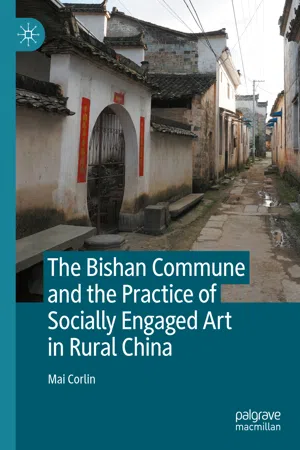
This book is concerned with socially engaged art projects in the Chinese countryside, with the artists and intellectuals who are involved, the villagers they meet and the local authorities with whom they negotiate. In recent years an increasing number of urban artists have turned towards the countryside in an attempt to revive rural areas perceived to be in a crisis. The vantage point of this book is the Bishan Commune. In 2010, Ou Ning drafted a notebook entitled Bishan Commune: How to Start Your Own Utopia. The notebook presents a utopian ideal of life based on anarchist Peter Kropotkin's idea of mutual aid. In 2011 the Commune was established in Bishan Village in Anhui Province. The main questions of this book thus revolve around how an anarchist, utopian community unfolds to the backdrop of the political, social and historical landscape of rural China, or more directly: How do you start your own utopia in the Chinese countryside?
- English
- ePUB (mobile friendly)
- Available on iOS & Android
eBook - ePub
The Bishan Commune and the Practice of Socially Engaged Art in Rural China
About this book
Information
© The Author(s) 2020
M. CorlinThe Bishan Commune and the Practice of Socially Engaged Art in Rural Chinahttps://doi.org/10.1007/978-981-15-5795-8_11. Introduction: Radical Rural Intellectuals
Mai Corlin1
(1)
Chinese University of Hong Kong, Hong Kong, Hong Kong
In 2010, Ou Ning exhibited the notebook Bishan Commune: How to Start Your Own Utopia .1 The notebook presents basic ideas and structures for the Bishan Commune, a utopian ideal of an alternative way of life far away from Chinese society and authorities. The notebook displayed Ou Ning’s research into alternative communities, anarchism and the Chinese historical Rural Reconstruction Movement (RRM ) of the 1930s. In 2011 Ou Ning and his colleague Zuo Jing began the work to establish the Bishan Commune in a village in rural China. The main questions of this book thus revolve around how an anarchist, utopian community unfolds to the backdrop of the political, social and historical landscape of rural China. Or more directly: How do you start your own utopia in the Chinese countryside?
This book presents research into the lifecycle of the Bishan Commune as it was imagined and as it unfolded in Bishan Village; from the beginning of the project, with the creation of the notebook in 2010, to the establishment of the commune in Bishan Village in 2011, on to Ou Ning’s move to Bishan together with his family in 2013, to the closure of the Bishan Commune project by the Chinese authorities in early 2016 and again on to Bishan Village after the departure of Ou Ning, with Zuo Jing maintaining his commercial activities in the village.2 These periods of Bishan Commune reveal five different, but not strictly demarcated, phases of the project and offer ways in which to understand how urban artists engage in opposition to and negotiate and cooperate with the Chinese authorities as well as with the local villagers.
The Bishan Project, the name by which it has primarily been known,3 had its headquarters in Ou Ning’s house, a large Hui-style compound he named Buffalo Institute (牛院). The Institute has served as a hub for arriving visitors, including artists, intellectuals and activists from near and far who came and stayed for varying periods of time. For the first couple of years, the primary activities unfolded around the Bishan Harvestival,4 a yearly large-scale art festival that invited artists and activists from all over the world and attracted large numbers of visitors of all kinds. Later, in 2013, when Ou Ning moved to the village together with his family, another kind of work began—work that focused on dialogue and collaboration with the villagers through activities such as reading groups, smaller exhibitions, researcher-in-residence programs, concerts, publication of magazines, preservation of local handicrafts traditions, a community supported agriculture (CSA ) project and much more. Many of these activities took place at the Bishan Bookstore (碧山书局), opened by Ou Ning’s long-time friend Qian Xiaohua the spring of 2014,5 or later at the School of Tillers (理农馆), a gallery, library and education space opened by Ou Ning the spring of 2015 in the house adjacent to the Buffalo Institute.6
Early texts and interviews with Ou Ning reveal that the Bishan Commune was conceived by the initiator as an extra-governmental, extra-system activity, simply providing an alternative to the existing order (0086 Magazine 2015 [2010], 15), whereas later texts lay out a re-evaluation and restructuring of these views and focus more on the Bishan Project as interconnected with surrounding society and the need for the Bishan Project to respond to the necessity of economic development for the local residents and authorities (Ou 2012a, 104–105). It is, of course, not surprising that the project changes when utopian ideals meet the ever-so demanding reality, so what I am interested in is not that it changes, but how and why it changes, thus exploring the Bishan Commune as a practical example of what happens when urban artists and activists engage in practice in the face of power and people in rural China. This study provides an analysis of the six years that the Bishan Project existed (2010–2016) and its endeavors to transform Chinese society starting from a rural village; an unstable trajectory of cooperation, negotiation, misunderstandings, opposition, control, co-existence and (im)possibilities. Furthermore, this book examines how artists and intellectuals alike bring utopian imaginaries of the future developed in urban centers to the countryside. It traces the transformation of urban-based artists and intellectuals into socially engaged artists in rural China and unfolds what occurs when processes of art and social engagement are introduced into a specific village and how this affects local officials, villagers and artists in dissimilar ways.
Closing Down
In February 2016, as I was preparing to leave for Bishan for a research trip, I received an e-mail from Ou Ning, telling me that the Bishan Project had been shut down, that he and his wife and children had had to leave the village with a few days’ notice, furthermore urging me not to visit Bishan in the near future until things had settled down a bit. The closure came as unexpectedly to me as to other observers,7 though Ou Ning mentioned in the e-mail that the relationship with the local authorities had been particularly strained the last couple of months. The project has in its relationship to the local authorities gone through phases of a better or worse relationship, but Ou Ning had managed to pull through despite this. While it is perhaps not surprising that the local authorities were not in favor of housing an anarchist community of artists, this book shows the willingness on behalf of Ou Ning and others engaged in the project to compromise their goals in order for the project to proceed altogether. Whether compromise is a viable route to take in the larger picture is of course another discussion. Despite the compromises, the authorities were not satisfied.
The closure in itself inevitably casts a different light on the entire project as well as the findings of this book. What I thought was the story of compromise, dialogue and negotiations, instead became yet another addition to the long story of the oppressive censorship regime of an authoritarian government, whether or not the decision to close the project was spurred by ideological or economic concerns, or decided by the local or the central government. The closure added a layer of that indeterminable fabric called censorship and once again made the all-encompassing power of the CCP very visible. The Bishan Commune is history (for) now and remains as yet another contribution to the bulking literature on anarcho-communist rural utopias that flourished, died out and wandered into the imaginary of other worlds and ways to be.8
Despite the closure of the Bishan Project, its trajectory can reveal important insights into the workings of a socially engaged art project trying to manifest itself in rural China. This book spans a variety of methods and approaches in the venture to answer the questions to which this research has given rise. The basic questions have been: what is the Bishan Commune and how did it (manage to) unfold in the Chinese countryside? Of course, these questions spur a string of other questions such as: what constitutes the thinking of Ou Ning and his position in the project? What are the larger Chinese and international contexts of Ou Ning’s thinking? What does community mean within the boundaries of the utopian Bishan Commune, or how does its utopian propositions unfold in the reality of a Chinese village with the political landscape that entails? And once we enter the village, how do the villagers and local authorities perceive the project? How does this triangular (and dialectical) relationship affect the project? In short, how has the project evolved, changed and accommodated to claims and wishes from a variety of agents? And then, how can this be understood in the broader light of socially engaged art practices in rural China? Are socially engaged art projects, understood in the United States and Europe as political and critical projects aimed at social change, possible in in a place like rural China, which is constrained by party control? And if so, on what terms are they possible? In other words: how do artists practice in the face of power in rural China? And do they themselves become powerful? The description of the structure of the book towards the end of the introduction will add nuance and depth to these questions as each chapter deals with specific phases and aspects of the Bishan Project. For now, I will provide a bit more information to guide the reader along into the world of Bishan.
Extradisciplinary Investigations
I will explain the concept of socially engaged art in detail in Chap. 2, but for the reader unfamiliar with the terminology of v...
Table of contents
- Cover
- Front Matter
- 1. Introduction: Radical Rural Intellectuals
- 2. Fields of Socially Engaged Art
- 3. Imagining the Commune
- 4. The Great Leap into Utopia
- 5. Trojan Horses or the Artist as Realtor
- 6. Whose Village?
- 7. Conclusion: The End of Utopia?
- 8. Epilogue: Guanxi Aesthetics or the State as Artistic Director
- Back Matter
Trusted by 375,005 students
Access to over 1.5 million titles for a fair monthly price.
Study more efficiently using our study tools.
Frequently asked questions
Yes, you can cancel anytime from the Subscription tab in your account settings on the Perlego website. Your subscription will stay active until the end of your current billing period. Learn how to cancel your subscription
No, books cannot be downloaded as external files, such as PDFs, for use outside of Perlego. However, you can download books within the Perlego app for offline reading on mobile or tablet. Learn how to download books offline
Perlego offers two plans: Essential and Complete
- Essential is ideal for learners and professionals who enjoy exploring a wide range of subjects. Access the Essential Library with 800,000+ trusted titles and best-sellers across business, personal growth, and the humanities. Includes unlimited reading time and Standard Read Aloud voice.
- Complete: Perfect for advanced learners and researchers needing full, unrestricted access. Unlock 1.5M+ books across hundreds of subjects, including academic and specialized titles. The Complete Plan also includes advanced features like Premium Read Aloud and Research Assistant.
We are an online textbook subscription service, where you can get access to an entire online library for less than the price of a single book per month. With over 1.5 million books across 990+ topics, we’ve got you covered! Learn about our mission
Look out for the read-aloud symbol on your next book to see if you can listen to it. The read-aloud tool reads text aloud for you, highlighting the text as it is being read. You can pause it, speed it up and slow it down. Learn more about Read Aloud
Yes! You can use the Perlego app on both iOS and Android devices to read anytime, anywhere — even offline. Perfect for commutes or when you’re on the go.
Please note we cannot support devices running on iOS 13 and Android 7 or earlier. Learn more about using the app
Please note we cannot support devices running on iOS 13 and Android 7 or earlier. Learn more about using the app
Yes, you can access The Bishan Commune and the Practice of Socially Engaged Art in Rural China by Mai Corlin in PDF and/or ePUB format, as well as other popular books in Politics & International Relations & Art General. We have over 1.5 million books available in our catalogue for you to explore.