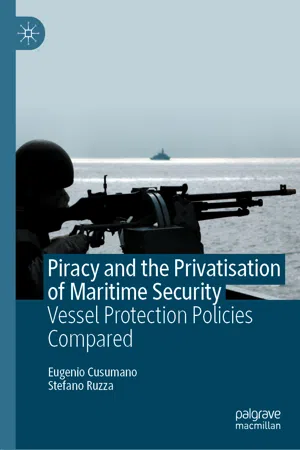
In response to pirate attacks in the Western Indian Ocean, countries worldwide have increasingly authorized the deployment of armed guards from private military and security companies (PMSCs) on merchant ships. This widespread trend contradicts states' commitment to retain a monopoly on violence and discourage the presence of arms on civilian vessels. This book conceptualizes the extensive use of PMSCs as a form of institutional isomorphism, combining the functionalist, ideational, political and organizational arguments used to account for the privatization of security on land into a synthetic explanation of the commercialization of vessel protection.
eBook - ePub
Piracy and the Privatisation of Maritime Security
Vessel Protection Policies Compared
- English
- ePUB (mobile friendly)
- Available on iOS & Android
eBook - ePub
Piracy and the Privatisation of Maritime Security
Vessel Protection Policies Compared
About this book
Information
© The Author(s) 2020
E. Cusumano, S. RuzzaPiracy and the Privatisation of Maritime Securityhttps://doi.org/10.1007/978-3-030-50156-3_11. Introduction: Protecting Merchant Vessels from Pirates
Eugenio Cusumano1 and Stefano Ruzza2
(1)
History Department, Leiden University, Leiden, The Netherlands
(2)
Department of Cultures, Politics and Society, University of Turin, Turin, Italy
On 25 March 2011, the Marshallese-flagged cargo vessel Avocet, owned by the New York-based firm Eagle Bulk Shipping, was approached by two skiffs carrying suspect Somali pirates after crossing the Gulf of Aden into the Indian Ocean. The pirates had reportedly been following the Avocet for two days, but their attempt to board the ship clashed against massive firepower. As soon as the skiffs approached the Avocet, armed personnel operating onboard the ship started shooting dozens of rounds against their occupants. The defenders of the Avocet believed that their shots killed or injured several pirates, but they could not exactly report how many because they were ‘not in the business of counting bodies’. This statement did not come from a military officer, but was made by Thomas Rothrauff, the CEO of the Trident Group, a private military and security company (PMSC) employing teams of former United States (US) Navy Seals to protect merchant vessels from pirates (Wiese Bockmann and Katz 2012).
While most private security teams showed greater restraint than Trident’s, the Avocet case was hardly unique. Between 2008 and March 2012, Somali pirates hijacked over 170 vessels in the maritime area embracing the Gulf of Aden, the Horn of Africa and the Western Indian Ocean. As the international military missions deployed in the region proved unable to immediately stop attacks, the shipping industry has increasingly resorted to onboard armed personnel. Although precise figures are missing, at least 50% of the merchant ships crossing the Gulf of Aden in 2012–2013 employed armed protection, using around 2700 guards (Brown 2012: 6). Not all these personnel were PMSC contractors. Some countries did not initially authorise the presence of private armed guards, providing merchant ships flying under their flag with vessel protection detachments (VPDs) consisting of military personnel. By 2020, however, all flag states with a sizeable registry had accepted the presence of private guards on ships.
This widespread convergence towards the resort to PMSCs as providers of vessel protection stands in stark contrast to the established practice of discouraging the presence of weapons onboard merchant vessels and states’ commitment to uphold a monopoly of violence. For centuries, the most powerful states in the international system sought to limit private violence on land and at sea alike, marginalising the use of actors like mercenaries and privateers as dangerous aberrations. Why have countries worldwide departed from such norms and increasingly authorised the resort to commercial security providers aboard vessels? This book seeks to answer this question.
1.1 Why This Book
Over 90% of the commodities traded worldwide travel by sea. Container ships and tankers are crucial suppliers of vital commodities including 2.9 billion tons of oil per year, roughly 62% of all the petroleum produced worldwide. Consequently, the shipping industry plays a crucial role in enabling today’s economic globalisation. The Gulf of Aden—close to the strategic Suez chokepoint and crossed by around 30,000 ships per year at the peak of the piracy emergency—plays an especially prominent role among international shipping routes (Reuters 2011). For this reason, the rise of Somali piracy threatened an incalculable economic damage to the world economy. In 2011 alone, ship owners and operators paid a grand total of USD 146 million in ransoms for hijacked ships and crews (Brown 2012: 4). Ransoms were only one among the many externalities of Somali piracy. Higher insurance premiums, the extra fuel and time spent on re-routing and the need to maintain higher speed caused additional costs that could endanger the economic viability of shipping, disrupting international trade at large. The risk that hijackers would cause natural disasters by deliberately or inadvertently damaging tankers, combined with the concern that the money obtained from ransoms could be used to fund terrorist organisations like Al Shabaab, further magnified the threat posed by Somali pirates (Singh and Bedi 2016).
Armed protection onboard vessels has played an important role in reducing the likelihood and success rate of pirate attacks. To date, no vessel protected by armed guards has been hijacked by Somali pirates. Suspect cases of disproportionate response and abuse in the use of force by PMSCs, however, have been hardly limited to the Avocet case. In fact, YouTube is replete with videos of armed contractors directing massive firepower against suspect pirates. The initial lack of any clear applicable regulatory frameworks and the very high likelihood that incidents would go under-reported led commentators to describe the situation off the Horn of Africa in 2011–2012 as a ‘Wild West’ (Wiese Bockmann and Katz 2012). Since then, monitoring and regulatory mechanisms have been significantly tightened thanks to multistakeholder initiatives like the establishment of an International Code of Conduct signed by a large number of PMSCs, the development of maritime security standards by the International Organization for Standardization (ISO), and the 100 Series Rules for the Use of Force (Ralby 2018; Marin et al. 2017; Petrig 2013). Notwithstanding these initiatives, the deployment of armed guards onboard merchant vessels and the difficulties attached to monitoring their behaviour inevitably continue to raise issues of accountability and due diligence, questioning the appropriateness of commercialising tasks like vessel protection. To be sure, the presence of military personnel onboard merchant vessels has proven problematic as well. On 15 February 2012, two Italian Navy Marines were charged with accidentally killing two Indian fishermen and subsequently arrested by Indian authorities. Their detention caused a diplomatic controversy that still continues to date (Virzo 2017). As the use of both PMSCs and VPDs to protect merchant ships against pirates raises thorny legal and ethical issues, understanding the considerations underlying the choice of either public or private providers of vessel protection has important policy implications.
Flag states worldwide have been compelled to reconcile factors as diverse as ship owners and operators’ preferences, defence ministries’ manpower and budgetary strain, the political constraints attached to deploying military personnel abroad and the commitment to preserve a monopoly of violence. Examining how decision-makers juggle these different considerations and why they have eventually opted for commercialising vessel protection provides new theoretical insights into security studies and International Relations (IR) at large. Most notably, our book offers a novel contribution to two topical research areas: private and maritime security studies.
1.2 Vessel Protection and Security Studies: The State of the Art
The increasing use of PMSCs has attracted considerable scholarly attention. Already in the 1990s, scholars have noted the important role played by violent private actors in European state formation and colonial expansion (Thomson 1994; Black 1994; Tilly 1992). Scholars with an interest in African security also examined the role played by mercenaries in decolonisation wars as well as the development of the first military companies and their involvement in the civil wars in Angola and Sierra Leone (Arnold 1999; Shearer 1998; Howe 1998). More recently, the invasions of Iraq and Afghanistan popularised the crucial role played by private con...
Table of contents
- Cover
- Front Matter
- 1. Introduction: Protecting Merchant Vessels from Pirates
- 2. Piracy and Counter-Piracy in the Twenty-First Century
- 3. From Divergence to Isomorphism in Vessel Protection Policy: A Theoretical Framework
- 4. Privateers Versus Pirates? The United Kingdom Case
- 5. Vessel Protection in the Netherlands: A Belated Commercialisation?
- 6. From Hybrid to Commercial Vessel Protection: The Italian Case
- 7. Vessel Protection in Other European Countries
- 8. Open Registries and Vessel Protection: Panama, Liberia and the Marshall Islands
- 9. Isomorphic Convergence in Vessel Protection
- 10. Conclusion: Vessel Protection Between Private and Maritime Security Studies
- Back Matter
Trusted by 375,005 students
Access to over 1.5 million titles for a fair monthly price.
Study more efficiently using our study tools.
Frequently asked questions
Yes, you can cancel anytime from the Subscription tab in your account settings on the Perlego website. Your subscription will stay active until the end of your current billing period. Learn how to cancel your subscription
No, books cannot be downloaded as external files, such as PDFs, for use outside of Perlego. However, you can download books within the Perlego app for offline reading on mobile or tablet. Learn how to download books offline
Perlego offers two plans: Essential and Complete
- Essential is ideal for learners and professionals who enjoy exploring a wide range of subjects. Access the Essential Library with 800,000+ trusted titles and best-sellers across business, personal growth, and the humanities. Includes unlimited reading time and Standard Read Aloud voice.
- Complete: Perfect for advanced learners and researchers needing full, unrestricted access. Unlock 1.5M+ books across hundreds of subjects, including academic and specialized titles. The Complete Plan also includes advanced features like Premium Read Aloud and Research Assistant.
We are an online textbook subscription service, where you can get access to an entire online library for less than the price of a single book per month. With over 1.5 million books across 990+ topics, we’ve got you covered! Learn about our mission
Look out for the read-aloud symbol on your next book to see if you can listen to it. The read-aloud tool reads text aloud for you, highlighting the text as it is being read. You can pause it, speed it up and slow it down. Learn more about Read Aloud
Yes! You can use the Perlego app on both iOS and Android devices to read anytime, anywhere — even offline. Perfect for commutes or when you’re on the go.
Please note we cannot support devices running on iOS 13 and Android 7 or earlier. Learn more about using the app
Please note we cannot support devices running on iOS 13 and Android 7 or earlier. Learn more about using the app
Yes, you can access Piracy and the Privatisation of Maritime Security by Eugenio Cusumano,Stefano Ruzza in PDF and/or ePUB format, as well as other popular books in Politics & International Relations & European Politics. We have over 1.5 million books available in our catalogue for you to explore.