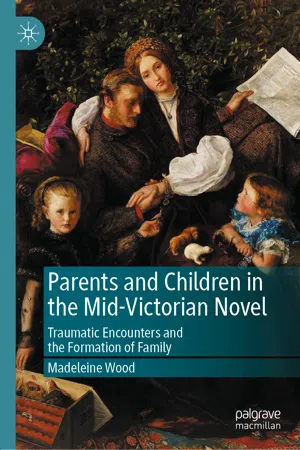
This book produces an original argument about the emergence of 'trauma' in the nineteenth-century through new readings of Dickens, Emily and Charlotte Bronte, Collins, Gaskell and Elliot. Madeleine Wood argues that the mid-Victorian novels present their protagonists in a state of damage, provoked and defined by the conditions of the mid-century family: the cross-generational relationship is presented as formative and traumatising. By presenting family relationships as decisive for our psychological state as well as our social identity, the Victorian authors pushed beyond the contemporary scientific models available to them. Madeleine Wood analyses the literary and historical conditions of the mid-century period that led to this new literary emphasis, and which paved the way for the emergence of psychoanalysis in Vienna at the fin de siècle. Analysing a series of theoretical texts, Madeleine Wood shows that psychoanalysis shares the mid-Victorian concern with the unequalrelationship between adult and child, focusing her reading through Freud's early writings and Jean Laplanche's 'general theory of seduction'.
eBook - ePub
Parents and Children in the Mid-Victorian Novel
Traumatic Encounters and the Formation of Family
- English
- ePUB (mobile friendly)
- Available on iOS & Android
eBook - ePub
Parents and Children in the Mid-Victorian Novel
Traumatic Encounters and the Formation of Family
About this book
Information
© The Author(s) 2020
M. WoodParents and Children in the Mid-Victorian Novelhttps://doi.org/10.1007/978-3-030-45469-2_11. Introduction
Madeleine Wood1
(1)
Children’s Services, NSPCC, London, UK
The category of trauma relies on origins but—as psychoanalysis and trauma studies repeatedly show—origins tend to recede from view. In order to understand the literary representation of parents and children in the mid-Victorian novel, we must place the enquiry within a dynamic historical context: the consolidation of bourgeois ideology from 1832 onwards and the anxieties concerning home emerging in the 1840s. However, in so doing, I do not imply that 1832 constitutes a decisive wound. The pathologisation of the parent-child relationship occurred through a complex network of historical and literary conditions propelled by bourgeois ideologies of home, nationhood and gender. Mid-Victorian novelists (contemporary with Karl Marx, without following him) actively formulate the relationship between ideology and (un)consciousness, and they do so within a cross-generational schema. The elder generation does not just psychologically damage the younger; they perform, consciously or unconsciously, an ideological inscription.
The way in which bourgeois ideologies are maintained through fantasy is a recurring concern for this study. Drawing on Marx and Fredrich Engels, Slavoj Žižek (1989) writes, ‘What they do not know is that their social reality itself, their activity, is guided by an illusion, by a fetishistic inversion. What they overlook, what they misrecognize, is not the reality but the illusion which is structuring their reality, their real social activity’. He clarifies this: ‘And this overlooked, unconscious illusion is what may be called the ideological fantasy’ (32–33). Žižek provides two helpful examples of such illusions: first, that money is the literal ‘embodiment of wealth’; and second, that the Law is universal (31–32). Žižek claims that even if we know these are fantasies, we act as if they are true, thus reinforcing the ideological structure of bourgeois capitalism.1 I argue that the mid-Victorian novel perpetuates the ideological fantasy of home as sanctified and private (and separate from the marketplace), while simultaneously revealing this to be a damaging fetish. There is nothing stable about this process, however, as the textual analyses show.
Traumatic Encounters does not focus on childhood in isolation, but on the dynamic relationships between parents and children. However, this development is predicated upon the earlier ‘discovery’ of childhood. The mid-Victorian novel shows us that we are always children to our own parents—childhood is not simply a lost realm, being someone’s ‘child’ is a structural position in the family. Jacqueline Rose’s The Case of Peter Pan (1992 [1984]) identifies the ‘impossible relations between adult and child’ (1). In elaborating this thesis, Rose reads children’s literature in the context of eighteenth- and nineteenth-century thinkers, John Locke, Jean-Jacques Rousseau and Sigmund Freud. Rose analyses Peter Pan in detail, considering the commercialisation of the child. Rose wrote the preface to the second edition of The Case of Peter Pan in 1992 in the context of heightened media attention and awareness of childhood sexual abuse. Sexual abuse is not the explicit focus for this study (most notably because it is not the specific focus for the mid-Victorian novels I analyse); however, it cannot be excluded from the wider conversation concerning cross-generational trauma.2 I look at this from the psychoanalytic perspective in this chapter. Now, in the context of internet pornography and its regulation, and the shocking revelations of the Jimmy Savile case in Britain (from 2012 onwards), the definition and protection of childhood become ever more pertinent.3 The Serious Crime Act 2015 criminalised coercive and controlling behaviour in intimate relationships and the family, showing the ways in which the anxieties expressed in the mid-Victorian novel continue to resonate in twenty-first century Britain. Since the Children Act 1989 (CA 1989), the state’s involvement in family life has been grounded by Section 1 CA 1989, the ‘Paramountcy Principle’, which insists that the ‘child’s welfare shall be the court’s paramount consideration’. This principle, without the supporting legislation, is found throughout the mid-Victorian novel.4
Creation of Childhood
The mid-Victorians inherited a complex set of eighteenth-century intellectual legacies concerning childhood. Eighteenth-century empiricist thought brought about a paradigmatic shift: the insistence that each child is born as a tabula rasa necessitated a detailed consideration of the processes by which minds are formed. For Locke, childhood therefore emerged as a conceptual necessity; education became a philosophical question, though his educational treatise, Some Thoughts Concerning Education, treats the topic in a matter-of-fact fashion: unlike Rousseau, he does not create a philosophical Bildungsroman. Instead, Locke reflects pragmatically upon parenting and pedagogy, with some startlingly progressive formulations. He insists that ‘childish actions’ and play should be permitted to be ‘free and unrestrained’ (2007, 43); he argues that children should learn actively, through ‘practice’, rather than ‘rules’ (45): he writes, ‘Praise should be given in public, blame in private’ (43).5 Most significantly, he seeks to construct a nuclear family, despite the lived reality of middle- and upper-middle-class life: ‘Next, to make them in love with the company of their parents, they should receive all their good things there, and from their hands. The servants should be hindered from making court to them’ (49). Embedded within this Enlightenment philosophy, then, we have a class-based codification of family. Moreover, Locke is concerned with the parent-child relationship as the focus for emotion, moral influence and pedagogy. He does, however, see it as the parent’s duty to rule the child with ‘fear and awe’ in their early years, and to soften with time (33). He argues in favour of home schooling for girls and boys since children are ‘susceptible of vicious impressions’ (50). Throughout, it is moral authority that is privileged, rather than systems of punishment or reward (37): ‘the great work of a governor is to fashion the carriage, and form the mind; to settle in his pupil good habits, and the principles of virtue and wisdom; to give him, by little and little, a view of mankind’ (75).
Rousseau’s Emile: On Education presents itself as a grave and urgent departure from previous works, including Locke’s. In the Preface, he writes, ‘Childhood is unknown. Starting from the false idea one has of it, the farther one goes, the more one loses one’s way’ (1979, Book I, 32). Criticising contemporary thinkers, he adds: ‘They are always seeking for the man in the child without thinking of what he is before being a man’. Rousseau designates childhood as inherently different from adulthood. The child is ‘natural man’, governed by instinct and sensation rather than reason, which is developed later through experience, defined as the coalescing of sensations into ideas, and ideas into reason (Book II, 203). Rousseau’s emphasis on experience and practice is not simply opposed to Locke’s educational treatise, or to empiricism more widely. Like Locke, he is concerned with the family. He appeals to maternal love in the Preface, but quickly moves on to consider the degeneracy of mothers in mid-eighteenth-century France: ‘No mother, no child. Between them the duties are reciprocal, and if they are ill-fulfilled on one side, they will be neglected on the other’ (46). His representation of the mutual influence of parents and children has much in common with the debates concerning familial responsibility found throughout the mid-Victorian novel.
The text poses an imaginative encounter between adult and child that sets the foundation for Romantic and Victorian literature. Like Locke, Rousseau is concerned with the child’s entrance into a social realm; however, where Locke saw the governor’s duty as ‘to settle in his pupil good habits’, Rousseau argued the child should be kept away from the corrupting force of civilisation until youth, fostering the child’s identity as ‘natural man’. Rose writes, ‘For Rousseau, education has the same function of giving back to culture the nature it had destroyed […] Nature is not something which can be retrieved, it has to be added’ (1992, 44). The child’s governor is not an authority figure in the conventional sense, but someone who manipulates the environment around the child to develop their autonomy. Throughout Emile, Rousseau makes a powerful argument concerning free will: it exists where necessity operates as the only check on our behaviour. In Emile which, we must remember, is a philosophical treatise and not a parenting manual, childhood is driven by an elaborate theatrics: the governor defines each situation without the child’s knowledge, giving the illusory impression that Emile is confronting natural law rather than adult authority. This theatricality resonates with how childhood is mobilised in Victorian literature, specifically in the Bildungsroman.
Rousseau argues that the parent should not make moral demands upon the child: morality is associated with the social contract, which is a contract between adults. In a witty parody of a conversation between the governor and child, Rousseau highlights the circularity of attempting to enforce a moral norm upon a child:
Master. You must not do that.
Child. And why must I not do it?
Master. Because it is bad to do.
Child. Bad to do? What is bad to do?
Master. What you are forbidden to do.
Child. What is bad about doing what I am forbidden to do?
Master. You will be punished for having disobeyed.
Child. I shall fix it so that nothing is known about it.
Master. You will be spied upon.
Child. I shall hide.
Master. You will be questioned.
Child. I shall lie.
Master. You must not lie.
Child. Why must I not lie?
Master. Because it is bad to do, etc. (Book II, 90)
He goes on: ‘Childhood has its ways of seeing, thinking and feeling which are proper to it. Nothing is less sensible than to substitute ours for theirs, and I would like as little to insist that a ten-year-old boy be five feet tall as that he possess judgement. Actually, what would reason do for him at that age? It is the bridle of strength, and the child does not need this bridle’ (ibid.). We find a comparable insistence on the child’s ‘way of seeing’ throughout the mid-Victorian period. In Hard Times (1854), arguing against the growing dominance of utilitarian thought, Dickens represents the importance of maintaining the child’s ‘fancy’ in an industrialised and alienating modern world, an argument that can be coherently traced back to Rousseau who, despite writing before industrialisation, formulates modern existence in terms of alienation and disenfranchisement. Post-Rousseau, childhood appears progressively different from adulthood, something to b...
Table of contents
- Cover
- Front Matter
- 1. Introduction
- 2. A Crisis in Relations: Psychic Wounds, Fantasy, and the Construction of Family
- 3. Emily and Charlotte Brontë—Childhood Passions and Pathologies: Wuthering Heights and Shirley
- 4. Charles Dickens—Lost Children and ‘Primal Scenes’: The ‘Autobiographical Fragment’, Dombey and Son and Great Expectations
- 5. Wilkie Collins—Vampiric Inheritances: No Name and Armadale
- 6. Elizabeth Gaskell and George Eliot—Mourning and Elegy: North and South and The Mill on the Floss
- 7. Conclusion
- Back Matter
Trusted by 375,005 students
Access to over 1.5 million titles for a fair monthly price.
Study more efficiently using our study tools.
Frequently asked questions
Yes, you can cancel anytime from the Subscription tab in your account settings on the Perlego website. Your subscription will stay active until the end of your current billing period. Learn how to cancel your subscription
No, books cannot be downloaded as external files, such as PDFs, for use outside of Perlego. However, you can download books within the Perlego app for offline reading on mobile or tablet. Learn how to download books offline
Perlego offers two plans: Essential and Complete
- Essential is ideal for learners and professionals who enjoy exploring a wide range of subjects. Access the Essential Library with 800,000+ trusted titles and best-sellers across business, personal growth, and the humanities. Includes unlimited reading time and Standard Read Aloud voice.
- Complete: Perfect for advanced learners and researchers needing full, unrestricted access. Unlock 1.5M+ books across hundreds of subjects, including academic and specialized titles. The Complete Plan also includes advanced features like Premium Read Aloud and Research Assistant.
We are an online textbook subscription service, where you can get access to an entire online library for less than the price of a single book per month. With over 1.5 million books across 990+ topics, we’ve got you covered! Learn about our mission
Look out for the read-aloud symbol on your next book to see if you can listen to it. The read-aloud tool reads text aloud for you, highlighting the text as it is being read. You can pause it, speed it up and slow it down. Learn more about Read Aloud
Yes! You can use the Perlego app on both iOS and Android devices to read anytime, anywhere — even offline. Perfect for commutes or when you’re on the go.
Please note we cannot support devices running on iOS 13 and Android 7 or earlier. Learn more about using the app
Please note we cannot support devices running on iOS 13 and Android 7 or earlier. Learn more about using the app
Yes, you can access Parents and Children in the Mid-Victorian Novel by Madeleine Wood in PDF and/or ePUB format, as well as other popular books in Literature & European Literary Criticism. We have over 1.5 million books available in our catalogue for you to explore.