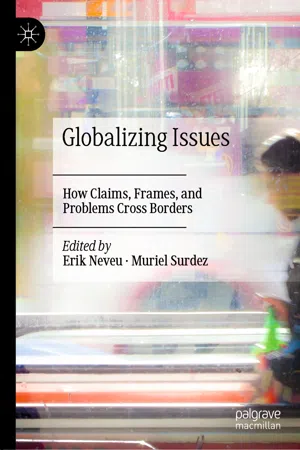
This book is an invitation to question conventional and often misleading visions of globalization. No problem is global by nature: issues are transformed by the action of claims-makers to become 'problems' debated in supra-national forums, triggering policy choices and policy transformations. Contributions highlight how health issues, environmental issues and/or political issues are framed as global by a set of stakeholders (scientific experts, bureaucrats, political parties or actors, social movements, social networks, firms). As the volume maps the social logic behind the globalization of problems, it also presents an opportunity for the very cross-disciplinary collaboration it calls for: researchers mobilizing the "agenda-setting" paradigm of issue globalization and those working within the "social constructionist" model are both represented here, providing a unique opportunity to examine the dynamics of globalization from the perspectives of (political, media, economic) sociology, international relations, social movement studies, and beyond.
eBook - ePub
Globalizing Issues
How Claims, Frames, and Problems Cross Borders
- English
- ePUB (mobile friendly)
- Available on iOS & Android
eBook - ePub
Globalizing Issues
How Claims, Frames, and Problems Cross Borders
About this book
Information
© The Author(s) 2020
E. Neveu, M. Surdez (eds.)Globalizing Issueshttps://doi.org/10.1007/978-3-030-52044-1_11. Introduction: An Invitation to Explore the Processes, Puzzles and Ecosystems of Issues’ and Problems’ Globalization
Erik Neveu1 and Muriel Surdez2
(1)
Sciences Po, Rennes, France
(2)
University of Fribourg, Fribourg, Switzerland
Keywords
Issues’ globalizationScale gamesSocial constructionismAgenda settingInterdisciplinarityThe starting point for this book was a workshop entitled “Transnationalization of problems and agendas: Theoretical and empirical challenges” that took place in Nottingham during the 2017 Joint Sessions of the European Consortium for Political Research.1 If the aim of the workshop was a better understanding of transnationalization processes, its driver was dissatisfaction with two specific aspects of research in this area. The ambition for this book is to transform dissatisfaction into fruitful theoretical and empirical statements.
The first source of dissatisfaction was academia’s indiscriminate use of the words “global” and “globalization” in relation to issues or problems, and the major risk of oversimplification this entails. The globalization category becomes largely meaningless when it is taken for granted. The word “globaloney” has even been coined to suggest the emptiness of many of its uses, as if combining the adjective “global” with any kind of social fact magically produces a deeper understanding and testifies to the theoretical modernity of its user. In the field of social problems studies, the adjunction of the term “global” to certain issues since the 1990s indicates a growing attention to issues considered to have considerable impacts on billions of people, beyond borders (Chirico, 2018; Glynn, Hohm, & Stewart, 1996; Mazur, 2007; Seitz & Hite, 1991/2012; Snarr & Snarr, 1998/2012). Concurrently, it demonstrates the increasing interdependency of countries in contemporary societies. From this perspective, a successful undergraduate textbook defines two types of global issues:
First, there are those issues that are transnational ones—that is, they cross political boundaries (country borders). These issues affect individuals in more than one country. A clear example is air pollution produced by a factory in the United States and blown into Canada. Second, there are problems and issues that do not necessarily cross borders but affect a large number of individuals throughout the world. Ethnic rivalries and human right violations, for example, may occur within a single country but have a far wider impact. (Snarr & Snarr, 1998/2012, p. 2)
While this type of definition points to a crucial reappraisal in social sciences, namely the fact that problems long studied within national social systems deserve a broader approach,2 it only tells part of the story. Authors giving useful depictions of “the most important environmental, economic, social, and political concerns of modern life” (Seitz & Hite, 1991/2012, cover) or “examining major problems around the world” (Mazur, 2007, cover) compile long lists of “global issues,” from weapons proliferation to the regulation of the atmospheric commons.3 In doing so, they attempt to establish an objective hierarchy of problems, overlooking the struggles around the recognition of some issues and leaving other issues out altogether, regardless of how critical they may be for some social actors. Textbooks are regularly re-edited to include additional chapters about “new” (though not necessarily more important or more global) problems and the choice of issues usually appears reasonable and coherent. Why? It is worth noting that the issues labeled as global—islamophobia, the instability and fluidity of conjugality, or animal abuse and well-being, for example—are selected because they have been socially defined as important, debated in TV studios or at political rallies, and supported and challenged by spokespersons. In short, they have already been transformed from “issues” into “social problems.” Meanwhile, other issues may have an enormous impact on particular groups or multiple countries and yet remain under the radar, due to a lack of voices expressing them. To go back to the first example in the definition quoted above, the effects of industrial smoke crossing borders will only be discussed if they are visible enough to be detected, if their negative impacts on public health are known, if some interpretive categories such as “pollution” or “industrial hazard” are available, and if claims-makers challenge the situation. The existence of an “issue” is never enough in itself. Issues do not speak. Claims-makers do.
Thus, our claim is that a political sociology of the “globalization” of problems must explore the processes by which, among the enormous variety of issues that are not unique to one country, some, and only some, trigger attention, discussion, and policy action.4 Global issues are not global in essence, waiting to be identified by clever academics. They are the products of networks of interdependencies, of communication systems. They gain the status of “problems” in the media and public opinion through the cross-border actions of claims-makers. This critical stance is not specific to global issues. It was already at the heart of the constructivist approach to social problems as it distanced itself from a reified perspective of problems. However, it would seem that this insight got lost somewhere along the way to globalization.
The second source of dissatisfaction behind our collective work was the strange absence of synergy between “the social construction of public problems” paradigm institutionalized by Gusfield (1963) and Spector and Kitsuse (1977) on the one hand, and the powerful agenda setting tradition deriving from the seminal research by Cobb and Elder (1972) and McComb and Shaw (1972) on the other. Each approach has contributed rich case studies and theoretical developments that illuminate different aspects of the globalization of problems. The agenda setting approach has developed impressive international comparisons (Princen, 2009) and, more recently, has examined the influence of national agendas on each other, questions that are underdeveloped in the social construction approach. It has produced solid materials for understanding the interdependencies between media agendas, opinions, and policies. Conversely, social constructionists have paid much more attention to the actions, peculiarities, and trajectories of claims-makers, as well as to the process of news production, while the proponents of agenda setting focus on the journalistic output. If it is too much to describe these two research communities as being in conflict or in a state of mutual ignorance, their relationship does bring to mind a famous French song from the 1960s: “Je t’aime…moi non plus” (I love you…neither do I). We want to explore the possible convergences and bridges between the social construction and agenda setting approaches,5 as well as with other scholarly traditions within political and social sciences that deal with globalization issues, such as international relations, policy transfer studies, global health studies, media studies, sociology of science, and expertise. This book can therefore also be considered an attempt to supply a provisional synthesis of poorly connected research fields studying the multifaceted processes that go into globalizing problems, agendas, and policies.
The Making of Global Problems
This book considers that issues are not global simply by virtue of existing in several countries, in a tightly interconnected world, but as a result of processes. It engages with three related research questions.
Firstly, it tries to clarify the category of “global problems” to enable an academically sound exploration of the international dimension of public problems. What can be defined sociologically as a “global problem”? If we start from the position that issues are not global per se, that they cannot cross borders or impact people in more than one country in and of themselves, the answer to this question is not straightforward. In line with the constructivist approach, we would argue that “global” is a putative rather than an objective condition, even though some problems in certain circumstances are more likely to become global than others. Based on the agenda setting approach, we also assume that global issues have been framed as such and put on the agenda of global or international organizations. If problems appear to be more global nowadays, historians and sociologists can remind us that attempts to handle social problems and to build social policies at an international scale characterize some periods (the second half of the nineteenth century, from 1945 onward) and institutions (such as the ILO or the WHO). The effort to define “global problems” thus consists less in explaining how they appeared out of the blue fifty years ago than in making sense of how some kinds of issues came to be considered to require management across national borders, giving birth to a new cognitive category of “global problems.” Inspired by a social history of ideas, we argue that this inte...
Table of contents
- Cover
- Front Matter
- 1. Introduction: An Invitation to Explore the Processes, Puzzles and Ecosystems of Issues’ and Problems’ Globalization
- Part I. Globalization of Issues and Problems: Frameworks Revisited
- Part II. Mapping the Actors and the Social Logics of Issues’ Globalization
- Part III. Arenas and Venues: Bringing Scales, Frames and Temporalities Back In
- Back Matter
Trusted by 375,005 students
Access to over 1.5 million titles for a fair monthly price.
Study more efficiently using our study tools.
Frequently asked questions
Yes, you can cancel anytime from the Subscription tab in your account settings on the Perlego website. Your subscription will stay active until the end of your current billing period. Learn how to cancel your subscription
No, books cannot be downloaded as external files, such as PDFs, for use outside of Perlego. However, you can download books within the Perlego app for offline reading on mobile or tablet. Learn how to download books offline
Perlego offers two plans: Essential and Complete
- Essential is ideal for learners and professionals who enjoy exploring a wide range of subjects. Access the Essential Library with 800,000+ trusted titles and best-sellers across business, personal growth, and the humanities. Includes unlimited reading time and Standard Read Aloud voice.
- Complete: Perfect for advanced learners and researchers needing full, unrestricted access. Unlock 1.5M+ books across hundreds of subjects, including academic and specialized titles. The Complete Plan also includes advanced features like Premium Read Aloud and Research Assistant.
We are an online textbook subscription service, where you can get access to an entire online library for less than the price of a single book per month. With over 1.5 million books across 990+ topics, we’ve got you covered! Learn about our mission
Look out for the read-aloud symbol on your next book to see if you can listen to it. The read-aloud tool reads text aloud for you, highlighting the text as it is being read. You can pause it, speed it up and slow it down. Learn more about Read Aloud
Yes! You can use the Perlego app on both iOS and Android devices to read anytime, anywhere — even offline. Perfect for commutes or when you’re on the go.
Please note we cannot support devices running on iOS 13 and Android 7 or earlier. Learn more about using the app
Please note we cannot support devices running on iOS 13 and Android 7 or earlier. Learn more about using the app
Yes, you can access Globalizing Issues by Erik Neveu, Muriel Surdez, Erik Neveu,Muriel Surdez in PDF and/or ePUB format, as well as other popular books in Social Sciences & Globalisation. We have over 1.5 million books available in our catalogue for you to explore.