This book explores the effective management of HR functions in an African context. While previous research has thoroughly explored central issues such as staffing, benefits, employee relations, and HR compliance, other topics such as appraisals, promotion, succession planning, and exits have rarely been considered. The author draws on empirical research and incorporates contextual issues such as technology, politics, culture, and economics to enrich readers' understanding of HR in Africa's emerging economies. By highlighting theoretical underpinnings while also placing emphasis on the practical relevance of HR issues, this book offers an insightful guide for students and scholars interested in HR and management in developing economies.
eBook - ePub
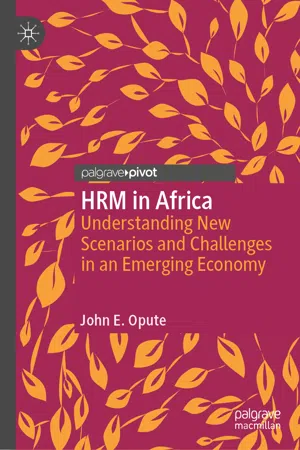
HRM in Africa
Understanding New Scenarios and Challenges in an Emerging Economy
- English
- ePUB (mobile friendly)
- Available on iOS & Android
eBook - ePub
About this book
Information
© The Author(s) 2020
J. E. OputeHRM in Africahttps://doi.org/10.1007/978-3-030-47128-6_11. Introduction
John E. Opute1
(1)
London South Bank Business School, London South Bank University, London, UK
Abstract
Labour relations took the central place in all the struggles for democracy and so the initial outcome of the democratic process was extended to the labour relations in many developing economies albeit this faced different contours (Nkomo in Organization 18: 365–386, 2011; Ayittey in Africa Betrayed. St. Martin’s Press, New York, 1992). Some of these are related to imperialism that took a prominent place in several African countries and robbed the continent of some key cultural underpinnings (Hack-Polay “Compassionate Investment?—Diaspora Contribution to Poverty Alleviation in Francophone West Africa” in African Diaspora Direct Investment: Establishing the Economic and Socio-cultural Rationale. Palgrave, London, 2018; Fanon in The Wretched of the Earth. New York, Grove Weidenfeld, 1963). This book is an exploratory effort on examining some of the perceived contextual issues that impact the management of some topical HR functions in most developing economies (with focus on Africa). The structure of the book is novel and captures the background, contemporary HR approaches, country perspectives, conclusions and implications as well as topical and discussion questions to capture the essence of each chapter. For many international students and multinational corporations with presence in Africa that are desirous to investigate appropriate approaches to managing the HR function, this book will serve as an outstanding ‘companion’ in the management of HRM.
Keywords
Labour relationsDemocracyDeveloping economiesAfricaHR functionsBackground
The scramble for Africa was the occupation, division and colonisation of African territory by European powers during the period between 1881 and 1914 and this lasted until the late 1950s and early 1960s when independence was gradually being achieved by the respective states. Colonialism, imperialism and neocolonialism have given rise to modern organisations in Africa which mirrors the organisation of work in the former colonial powers, mainly Britain, France, Portugal and Spain. Contemporary organisations in Africa are therefore a legacy of domination. These were likely to cause disruptions to the societal and organisational arrangements, including labour relations and the sourcing and management of people. Although contemporary HR issues at the local/country levels are discussed on a contemporary basis, there are no in-depth discussions on specific HR roles and functions neither do such texts delve into African nations and the emerging challenges (Kamoche 2011). Therefore, at the company level it is obvious that the HR function should seek to understand the impact of a company’s international operations on HRM (Wintersberger 2017). Unfortunately, this is somewhat descriptive insofar as it describes what is going on in different countries.
With several countries in Africa now independent, it should be recognised that these states were previously under colonial rules and it is worth investigating if the effect of the colonial rule remains prevalent and whether these can be examined from a comparative narration and to investigate the similarities, differences and the extent to which these past experiences influence labour relations in Africa and in particular, the management of the applicable HR functions. Labour relations is a significant area in which these recent developments have had a dramatic impact, and redefining relationships between institutional structures, decision-making processes and the key actors in the industrial relations system is essential in this new global environment. Concomitant with this understanding is the recognition that an effective human resource and labour relations system is an important determinant of economic performance. The book draws the attention to the need for management and labour processes which are congruent with African values but at the same time can respond to the constraints of globalisation as a way of enhancing the sustainability of contemporary African organisations.
Africa is taking a central stage in world affairs, and the effective management of the HR function will contribute to business efficacy in a globalised world. The uniqueness of the project is in understanding the HR function from the perspective of crucial contextual issues, such as technology, politics, culture and economy. It highlights the important roles these contextual issues play in the understanding and management of the HR function in many African countries. In particular, the project will focus on those key HR initiatives that have attracted several scenarios and challenges for which the understanding of current developments will be revealing. Nevertheless, it highlights the theoretical underpinnings but focuses much more on the relevance and practicality of these HR issues from the perspective of the identified contextual issues. For many international students including those willing to explore Management or/and HR positions in developing economies or desire to work for international/multinational organisations, this book will serve as an outstanding ‘companion’ in the management of HRM.
The project is much more definitive on the selection of pertinent HR issues and how technology, socio-economic, cultural and political developments impact on the selected topics from a practical perspective. Several texts discuss HR from a broad perspective concentrating on the traditional HR functions/issues and at best delving into a comparative perspective. The text also takes an abridged approach to identifying the similarities and differences across Saharan and Sub-Saharan Africa with respect to these contextual issues rather than a comparative approach based on traditional HR topics.
There is an abundance of text dealing with the subject of HR from an intentional perspective in relation to the traditional HR function such as recruitment, selection and talent management and much more of how culture and the institutional factors impact on these approaches. Additionally, employee relations are discussed generally to cover other human resource functions and the role of multinational enterprises in diffusing HR best practice from the home country to the host countries within which they operate, hence leading to distinct HRM outcomes in different countries. Another observation is that various texts in international HRM tend to drift to application as it relates with management of expatriates to improve expatriation but somewhat limited focus on how the multinational enterprise can benefit from understanding the challenging contextual issues from a host country perspective. Furthermore, Harzing and Pinnington (2015) make the case for the three main strands of research in the field of international HRM to cover cross-cultural management, comparative management and international management and HQ subsidiary relationships but admit that the legislation, political, economic, institutional and cultural differences between nations can all influence local practice. Malik (2018) supports this preposition that HRM is at least partly a function of the societal effect.
Many other texts (Harzing and Pinnington 2015; Tarique et al. 2016) take a similar narration. On the strategic international HRM front, the human resource function examines the application of HR concepts and practices such as Best practice, Best fit, Resource base and the accompanying strategic choices but focusing more on application, that is, how managers implement HRM and employment relations in a given institutional environment (Malik 2018).
Furthermore, these texts approach the subject of HRM from a broad perspective, examining the traditional topics of HRM with focus on implications for multinational companies and taking a comparative approach to the practice of HR from a country perspective. It does not address specific HR issues and topics that are traditionally influenced by specific contextual issues (such as culture, politics, socio-economic and technology) which commonly cut across nearly every country in Africa but in varying proportions or applications. There is therefore a significant focus on discussions relating to convergence versus divergence, exportative, adaptative and integrative strategies as well as hard and soft goals as it relates to expatriate orientation and management. To the credit of these texts, there is useful exposition on culture and cross-cultural management and the transfer and suitability of employment practices across borders in multinational enterprises albeit what matters in the context seems missing, particularly with respect to the African nations (Opute et al. 2020; Mwaniki and Gathenya 2015; Kamoche 2011).
The project addresses specific ‘down-to-earth’ HR issues (particularly from an empirical perspective, reflecting specific country applications in some countries in Africa—covering the western, eastern, northern and southern Africa) that are normally central to developing economies, which have been neglected or relegated to the background in most publications or mainly from a theoretical perspective. Additionally, the examples capture new developments on HR issues. The unique points are reiterated as follows:
- i.The book addresses key HR topics that have been relegated to the background or have received limited discussions.
- ii.The book relates politics, culture, socio-economic and technological developments and their relevance to these issues. This is a rare approach.
- iii.The book goes beyond a theoretical discussion of concepts and employs empirical discussions.
These texts also do not sufficiently address HR topics which challenge participation and engagement in the workplace. In contrast, the project delves into those contextual issues that can impact on the management of HR as well as the understanding of how these contextual issues can be accommodated in the management of the HR function. In this respect, the project identifies key HR issues that most texts neglect or fail to pay adequate attention from an empirical approach. The contributors to this text may not be authors of specific HR functions (as may be the case in several international texts) but they share experiences based on engagement with the HR function at company and country levels in their roles as HR practitioners. Nevertheless, this text will complement various international HRM texts to the extent that it improves awareness of the complexity and challenges of managing HRM in Africa in the twenty-first century.
Country Profile
The interviews and discussions with colleagues from some African countries have enriched the empirical data of the book. The author has compiled some background information to provide a broad perspective of the countries to cover political, economic/socio-economic, infrastructural and cultural issues over the years.
Ghana
In 1957 Ghana became the first African country to achieve independence from a European colonial power, and today it is one of the continent’s most vibrant democracies. The 2016 elections saw Nana Akufo-Addo, then president, speak to voter dissatisfaction with the economy, which at the time was suffering from the protracted downturn in global prices of its chief commodity exports. The election was thus fought on an issue affecting all Ghanaians, rather than on sectarian grounds, whilst the exemplary behaviour of both presidential candidates and their supporters in the transfer of power also indicated the growing st...
Table of contents
- Cover
- Front Matter
- 1. Introduction
- 2. Recruitment and Selection
- 3. Training and Development
- 4. Appraisal, Rewards and Promotion
- 5. Succession Planning
- 6. Management of Disputes, Exits and Retirement
- 7. Conclusion
- Back Matter
Trusted by 375,005 students
Access to over 1.5 million titles for a fair monthly price.
Study more efficiently using our study tools.
Frequently asked questions
Yes, you can cancel anytime from the Subscription tab in your account settings on the Perlego website. Your subscription will stay active until the end of your current billing period. Learn how to cancel your subscription
No, books cannot be downloaded as external files, such as PDFs, for use outside of Perlego. However, you can download books within the Perlego app for offline reading on mobile or tablet. Learn how to download books offline
Perlego offers two plans: Essential and Complete
- Essential is ideal for learners and professionals who enjoy exploring a wide range of subjects. Access the Essential Library with 800,000+ trusted titles and best-sellers across business, personal growth, and the humanities. Includes unlimited reading time and Standard Read Aloud voice.
- Complete: Perfect for advanced learners and researchers needing full, unrestricted access. Unlock 1.5M+ books across hundreds of subjects, including academic and specialized titles. The Complete Plan also includes advanced features like Premium Read Aloud and Research Assistant.
We are an online textbook subscription service, where you can get access to an entire online library for less than the price of a single book per month. With over 1.5 million books across 990+ topics, we’ve got you covered! Learn about our mission
Look out for the read-aloud symbol on your next book to see if you can listen to it. The read-aloud tool reads text aloud for you, highlighting the text as it is being read. You can pause it, speed it up and slow it down. Learn more about Read Aloud
Yes! You can use the Perlego app on both iOS and Android devices to read anytime, anywhere — even offline. Perfect for commutes or when you’re on the go.
Please note we cannot support devices running on iOS 13 and Android 7 or earlier. Learn more about using the app
Please note we cannot support devices running on iOS 13 and Android 7 or earlier. Learn more about using the app
Yes, you can access HRM in Africa by John E. Opute in PDF and/or ePUB format, as well as other popular books in Business & Business General. We have over 1.5 million books available in our catalogue for you to explore.