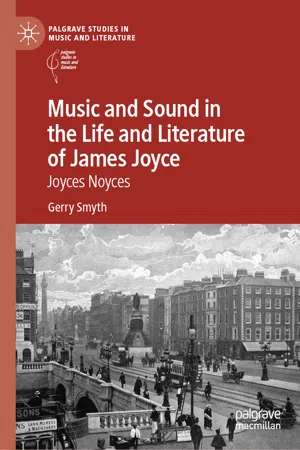
Music and Sound in the Life and Literature of James Joyce: Joyces Noyces offers a fresh perspective on the Irish writer James Joyce's much-noted obsession with music. This book provides an overview of a century-old critical tradition focused on Joyce and music, as well as six in-depth case studies which revisit material from the writer's career in the light of new and emerging theories. Considering both Irish cultural history and the European art music tradition, the book combines approaches from cultural musicology, critical theory, sound studies and Irish studies. Chapters explore Joyce's use of repetition, his response to literary Wagnerism, the role and status of music in the aesthetic and political debates of the fin de siècle, music and cultural nationalism, ubiquitous urban sound and 'shanty aesthetics'. Gerry Smyth revitalizes Joyce's work in relation to the 'noisy' world in which the author wrote (and his audience read) his work.
- English
- ePUB (mobile friendly)
- Available on iOS & Android
eBook - ePub
About this book
Information
Topic
LiteraturaSubtopic
Crítica literaria europeaPart IReading and Writing
© The Author(s), under exclusive license to Springer Nature Switzerland AG 2020
G. SmythMusic and Sound in the Life and Literature of James JoycePalgrave Studies in Music and Literaturehttps://doi.org/10.1007/978-3-030-61206-1_11. Joyce and Music a Critical Fantasia
Gerry Smyth1
(1)
Liverpool John Moores University, Liverpool, UK
Abstract
This chapter is comprised of ten sections, each considering a different musical issue bearing upon Joyce’s musical imagination. They are: (1) Three Lives (Éamonn Ceannt, Ina Boyle and John McCormack); (2) Music and/as Language (issues relating to music and human evolution); (3) Listening to the Novel (the impact of music on fiction after the late nineteenth century); (4) Real People (some of the historical persons incorporated into Joyce’s work); (5) Aesthetics (debates concerning aestheticism, decadence, realism and modernism in the 1890s and 1900s); (6) Joyce as Composer? (the state of music in the Ireland of Joyce’s youth); (7) Joyce’s Missing Music (the absence of Turlough O’Carolan and Irish traditional music from Joyce’s musical reservoir); (8) Popular Music (Joyce’s love of music hall); (9) Playback Technology (the rise of the record player and its impact on modern musical practices) and (10) Space and Place (the locations where Joyce’s music is made and heard).
FANTASIA. The word is Italian for ‘fancy’, and its musical application is to any kind of composition in which form takes second place in deference to the demands of imagination or even of mere wilfulness—or, indeed, to any kinds of composition for which no other name happens to occur to the composer.Percy A. Scholes, The Oxford Companion to Music (1938), p. 309[For Joyce] music was a language and perhaps even something more. It was an atmosphere, a condition of thought, an aura beyond all words, which nevertheless was to be found in the words, grouping them, guiding them, giving them breath of life. For Joyce, a sentence was not severable from its melodic qualities, for they alone gave existence to it. Attention has been drawn many times to this fact and the remark has become trite: Joyce’s art is primarily musical. It was for Joyce that the divine rule of Verlaine’s Art Poétique appears to have been dictated: De la musique avant toute chose …Louis Gillet, Claybook for James Joyce, (1941), p. 110 (original emphases)
1 Three Lives
Three lives, three modes of Irish identity, three music-makers.
Edward Kent was born on 21 September 1881 in the village of Ballymoe in Co. Galway. The family of nine moved to Ardee in Co. Louth when father James, a policeman in the Royal Irish Constabulary, was transferred. On his retirement in 1892 they moved again, this time to Dublin.
Kent’s strong Catholic upbringing and interest in history primed him for politicisation. He took a clerical job with Dublin Corporation, but his primary energies were devoted to the cause of Irish independence. In 1899 he joined the Gaelic League, which had been founded a few years earlier (1893) with Douglas Hyde as its first president. Kent became fluent in Irish, Gaelicised his name to Éamonn Ceannt and became a dynamic force in the League’s cultural programme.
In February 1900 Ceannt, along with the cultural activist Edward Martyn founded the Dublin branch of Cumann na bPíobairí (The Pipers Club). The uilleann pipes (originally known as the Union bagpipe, or sometimes just the Irish pipes) is ‘one of the world’s most distinctive multi-reed instrument’ (Ó hAllmhuráin 1998: 74). It evolved from a simpler design in the early eighteenth century, and its strong national credentials made it a popular choice for nativist musicians, among the diaspora as well as in the major cities across the island. The Dublin Club was in fact a cradle of nationalist sentiment, with Ceannt among its most active and ardent agents.
Ceannt was treasurer of the Dublin Pipers Club until he retired following his marriage to the club’s secretary Áine Brennan in June 1905. In the same year he was elected a member of the League’s governing body, although he was already beginning to question what he considered to be its abbreviated remit. The following year he won a gold medal for his playing at An Oireachtas; two years later, as a member of the Catholic Young Men’s Society, he performed in Rome for Pope Pius X.
By 1906, the Pipers Club was in financial difficulties.
The following year Ceannt joined Sinn Féin.
In 1911 the club was in a ‘moribund’ condition.
In 1912 Ceannt was sworn in as a member of the Irish Republican Brotherhood.
The last entry in the minute book (dated 14 October 1913) is a request relayed by Éamonn Ceannt for pipers to play at Pádraig Pearse’s Irish-language school St Enda’s.
Earlier the same year Ceannt had joined the Irish Volunteers and was one of the principal architects of its successful gun-running operation.
On the morning of 8 May 1916 Éamonn Ceannt was executed by firing squad at Kilmainham Gaol for his role in the Easter Rising.
During the twentieth century the uilleann pipes emerged as one of the most popular and most recognisable of traditional Irish musical instruments. Na Píobairí Uilleann Teoranta, based in Henrietta Street in Dublin, continues to thrive in the present day.1
***
Ina Boyle was born in Enniskerry in Co. Wicklow on 10 March 1889 to a well-to-do Protestant family. Her clergyman father William engaged a governess to provide Ina and her sister with lessons on violin and cello. Her obvious talent warranted further investment, so she continued her studies with Samuel Myerscough, and also took correspondence classes in composition with the Irish composer Charles Wood, whose other pupils included Ralph Vaughan Williams and Herbert Howells. Other acclaimed teachers were Percy Buck (later knighted), non-residential professor of music at Trinity College between 1910 and 1920, and Charles Kitson, organist and choirmaster at Christ Church Cathedral as well as professor of music at University College.
By now Boyle had decided that she wished to embrace the life of the composer—a decision which seemed to be justified when she won first and second prize for original composition at the Sligo Feis Ceoil of 1913. The Great War, as well as a decade of civil unrest in Ireland, curtailed her progress, although her orchestral rhapsody The Magic Harp (1919) was selected for performance by the London Symphony Orchestra at the Royal College of Music. It’s a brooding piece of late Romantic Victoriana which makes absolutely no concessions at all to continental modernism; nor, despite the harp reference, does it contain much in the way of a recognisably ‘Irish’ tonality.
Between 1923 and 1937 Boyle travelled regularly to England to take lessons’ with Vaughan Williams—actually more like friendly inquiries about her current compositions and encouragement to keep faith with her calling. Boyle seems to have been unlucky with her family’s health—she was obliged to care for both her parents and her younger sister for much of their lives—and this also stymied her career development. She continued to compose, however, although the majority of this work—chorales, song-cycles, string quartets, tone poems, operas as well as three ballets—remained unperformed. Her papers languished in the Manuscripts and Archives Research Library of Trinity College until, under the impetus of restorative feminism, a Lyric FM documentary of 2010 and a Trinity exhibition of 2013 went some way towards reviving her reputation. Ita Beausang’s 2018 biography finally enabled us to hear another of the lost voices of modern Irish history.
***
John McCormack was born in Athlone, Co. Westmeath on 14 June 1884, the fifth of eleven children to immigrant Scottish parents. Throughout his youth and teenage years he sang in church choirs and in concerts. In 1902 McCormack auditioned for the newly formed Palestrina Choir in Dublin’s Pro-Cathedral where its director Vincent O’Brien, recognising an extraordinary talent, accepted the young man.
McCormack’s first taste of the fame that he was to so enjoy came in May 1903 when he won the gold medal in the tenor section of the Feis Ceoil. (The same prize had been won two years earlier by a well-regarded Dublin tenor named Augustine ‘Gus’ Boylan—Costello 1992: 192.) It was during these early days in the city that he made the acquaintance of a slightly older Dubliner whom he encouraged to consider a singing career. The bronze medal that JJ won in the following year’s Feis had a resounding afterlife in his imagination, in his work, and in his attitude towards McCormack himself.
With money generated through recording and sponsorship, McCormack moved to Milan to study with one of Italy’s premier singing teachers, Vincenzo Sabatini. His professional operatic début came on 13 January 1906 when he sang the title role of Pietro Mascagni’s L’Amico Fritz (1891). McCormack promptly married his Irish sweetheart—Lily Foley, also a singer, whose career mysteriously stalled at this point.
Thereafter McCormack’s star commenced a spectacular career across the musical heavens of the twentieth century. With Europe conquered he headed for the home of the new technologically driven mass media. Overnight celebrity was achieved with his performance in La traviata (at rival New York opera houses, and alongside different divas) in November 1909. He had already commenced what was to be an incredibly successful recording career, aided in no small measure by his ability to perform repertoire from opera, art song, popular song and folk ballad. Besides making him a household name around the world McCormack’s subsequent career as a concer...
Table of contents
- Cover
- Front Matter
- Part I. Reading and Writing
- Part II. Listening
- Back Matter
Trusted by 375,005 students
Access to over 1.5 million titles for a fair monthly price.
Study more efficiently using our study tools.
Frequently asked questions
Yes, you can cancel anytime from the Subscription tab in your account settings on the Perlego website. Your subscription will stay active until the end of your current billing period. Learn how to cancel your subscription
No, books cannot be downloaded as external files, such as PDFs, for use outside of Perlego. However, you can download books within the Perlego app for offline reading on mobile or tablet. Learn how to download books offline
Perlego offers two plans: Essential and Complete
- Essential is ideal for learners and professionals who enjoy exploring a wide range of subjects. Access the Essential Library with 800,000+ trusted titles and best-sellers across business, personal growth, and the humanities. Includes unlimited reading time and Standard Read Aloud voice.
- Complete: Perfect for advanced learners and researchers needing full, unrestricted access. Unlock 1.5M+ books across hundreds of subjects, including academic and specialized titles. The Complete Plan also includes advanced features like Premium Read Aloud and Research Assistant.
We are an online textbook subscription service, where you can get access to an entire online library for less than the price of a single book per month. With over 1.5 million books across 990+ topics, we’ve got you covered! Learn about our mission
Look out for the read-aloud symbol on your next book to see if you can listen to it. The read-aloud tool reads text aloud for you, highlighting the text as it is being read. You can pause it, speed it up and slow it down. Learn more about Read Aloud
Yes! You can use the Perlego app on both iOS and Android devices to read anytime, anywhere — even offline. Perfect for commutes or when you’re on the go.
Please note we cannot support devices running on iOS 13 and Android 7 or earlier. Learn more about using the app
Please note we cannot support devices running on iOS 13 and Android 7 or earlier. Learn more about using the app
Yes, you can access Music and Sound in the Life and Literature of James Joyce by Gerry Smyth in PDF and/or ePUB format, as well as other popular books in Literatura & Crítica literaria europea. We have over 1.5 million books available in our catalogue for you to explore.