This edited book brings together a collection of perspectives and studies on the role and potential uses of vocabulary assessment in second and foreign language learners' needs analysis. Assessing what vocabulary a student already knows - and what therefore might be a realistic goal for language learning - is an essential aspect of developing and delivering effective foreign language classes. The chapters in this book address what has so far been an under-researched aspect of classroom needs analysis, exploring the influence of vocabulary tests, the lexical profiles of teaching materials, and learner as well as teacher beliefs and practices. This book will be of interest to students and scholars of applied linguistics and TESOL, language teachers and teacher trainers, and educators engaged in assessment and evaluation.
eBook - ePub
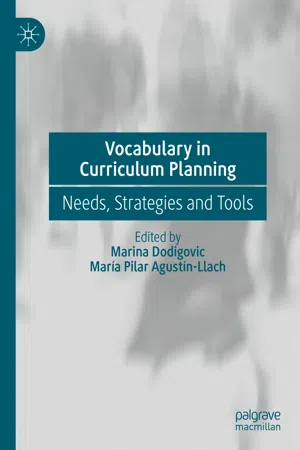
Vocabulary in Curriculum Planning
Needs, Strategies and Tools
- English
- ePUB (mobile friendly)
- Available on iOS & Android
eBook - ePub
Vocabulary in Curriculum Planning
Needs, Strategies and Tools
About this book
Information
© The Author(s) 2020
M. Dodigovic, M. P. Agustín-Llach (eds.)Vocabulary in Curriculum Planninghttps://doi.org/10.1007/978-3-030-48663-1_11. Introduction to Vocabulary-Based Needs Analysis
Marina Dodigovic1 and María Pilar Agustín-Llach2
(1)
University of La Rioja, Logrono, Spain
(2)
Department of Modern Philologies, University of La Rioja, Logrono, Spain
Keywords
VocabularyNeeds analysisAssessmentProfilingLearning strategiesErrorsUnderstanding the needs of second or foreign language (L2) learners is essential in the process of both planning and delivering L2 lessons. This volume is dedicated to a particular variable which can be successfully used to gauge learner needs, namely vocabulary. This variable might turn out to be the single most important variable in language learning, as Wilkins points out that “without vocabulary, nothing can be conveyed” (cited in Thornbury, 2002).
Vocabulary is one of the often underestimated factors in L2 classrooms. It seems to be particularly underrepresented in needs analysis. According to Basturkmen (2005), needs analysis is the kind of investigation “curriculum developers use to identify the gap between what learners already know and what they need to know in order to study or work in their specific target environments” (p. 15). Failing to determine which vocabulary the students already know and what might be the realistic vocabulary targets for their classes is likely to result in failure to make progress in the target language, an outcome unfortunately too often observed in foreign language settings. Similarly, failing to examine the extent to which textbook vocabulary addresses the needs of students, more often than not, results in the absence of learning. Finally, vocabulary learning strategies are frequently taken for granted, leaving the students ill-equipped for the task. Hence it is the intention of this volume to support language teachers, administrators and a broad range of stakeholders in the language teaching process with ideas and examples of vocabulary-related needs analysis.
Needs analysis is often done particularly in language centres specialised in teaching L2. This is usually done by means of administering the kind of test that is called placement test in language assessment literature (Hughes, 2003). This type of test is a kind of “sorting hat”, designed to facilitate adequate placement of students across classes and levels. Another type of test which is used to determine the individual strengths and weaknesses of a learner’s L2 is called diagnostic test (Hughes, 2003). This is usually far more detailed than a placement test. Other means of conducting aspects of needs analysis are surveys and interviews with a variety of stakeholders, including learners themselves, their employers, families and the community at large. This is especially the case in the arena of English for Specific Purposes (ESP) (Basturkmen, 2010), where the leaners are meant to use L2 within the confines of a particular academic discipline or profession. This kind of needs analysis often entails identifying the vocabulary, discourse and genres (Basturkmen, 2010) the leaners would be expected to use. It then ideally attempts to gauge to what extent the students are or are not familiar with the identified items, in order to facilitate setting achievable goals.
Apart from specialised vocabulary, the choice of vocabulary has generally received quite moderate attention in terms of needs analysis. Research (e.g. Dodigovic, 2005; Wei, this volume) has identified a perplexing nonchalance toward the choice of general vocabulary, be it for the development of teaching materials or language classes. This is surprising, since it is clear from the available and convincing body of research that learning approximately two thousand of the most frequent words is a prerequisite for learning other, less frequent words (Nation, 2006; Schmitt, 2000). Yet, in a sweeping attempt to catch up with the agenda of communicative language teaching, students are often pushed to read or listen to texts in which they do not understand enough vocabulary in order to make sense of the text itself (Dodigovic, 2005). Other times, they are made to memorise a large number of rare and complex words before they can confidently remember the small number of frequent and most useful words (Dodigovic, 2009). Rather than stretching the student’s minds or boosting their critical thinking skills, this approach is tantamount to an exercise in futility, since, as Nation (2006) points out, such infrequent words will not be followed up by contextualised encounters, and will hence inevitably fall prey to attrition. Sadly, the time invested in trying to achieve the unattainable will be lost where it would have been needed most, i.e. in learning such words that would enable reading and listening comprehension.
Any lexically driven needs analysis should therefore seek to establish how many words the students know, especially of the most frequent variety, and how well they already know these words (Schmitt, 2000). The next step would be to analyse the texts intended for teaching for the evidence of containing the words the students need and finally matching texts with students. Also, clear goals for vocabulary acquisition must be set, enabling the students to benefit most from learning within the time at their disposal.
Understanding how leaners approach learning vocabulary is another step that can and should be taken to improve the outcome of L2 learning (Schmitt, 2000). A number of vocabulary learning strategies have been identified in research. In fact, part two of this volume is devoted to choosing or devising an appropriate taxonomy of such strategies and identifying the ones that the students are using. It is also believed that teachers can and should coach students in the use of vocabulary learning strategies that could prove more fruitful than the ones used by them (Thornbury, 2002).
Finally, familiarity with learner lexical errors paired with an understanding of the reasons for these errors is another prerequisite for designing the lexical component of the language curriculum. Thus, there is much room for vocabulary-based needs analysis in any language class or learning situation. This volume has attempted to provide a blueprint for this and to model some of the steps that can be taken to improve not just vocabulary learning but overall L2 performance. The following briefly describes the contents of the volume, in which we have selected four salient foci of interest.
First, the theoretical underpinnings of vocabulary needs analysis are presented. Thus, Milton and Alexiou (Chap. 2) draw attention to the importance of vocabulary size assessment and how it can be related to the goals set by the CEFR levels. Identifying what and how many words correspond to the different proficiency levels is crucial for the EFL classroom, and in this line, Chap. 2 introduces a variety of assessment methods conducive to the said identification. The notions of productive and receptive vocabulary are the main concern of Chap. 3 by Amin. Examining both vocabulary sets and their sizes, as well as establishing the difference between both, becomes central to determine the lexical items that learners need to know. Furthermore, Amin relates the size of Afghan tertiary students’ productive and receptive vocabulary sets with the context of language acquisition and the impact of it on vocabulary development. Wei’s chapter (Chap. 4) closes this first section by addressing the relationship between lexical knowledge and reading comprehension. The reading comprehension performance of Chinese learners is evaluated against the framework of their vocabulary size and breadth. The pedagogical implications of the relationship are also explored.
The second main focus of interest of the present volume spins around the importance of learners’ strategic behaviour when learning vocabulary in the foreign language. Accordingly, in Chap. 5, Dodigovic et al. raise the question of the connection between vocabulary learning strategies and effective vocabulary acquisition. By determining which strategies are used by and useful for advanced language learners in the Armenian context, but also for learners at lower stages of acquisition, teachers can develop pedagogical plans that adapt the effective vocabulary strategies to the specific learning needs of the students at the different stages. In the very same line, Manoukyan, Chap. 6, expands the discussion of which vocabulary learning strategies are most frequently used by Armenian students, with special emphasis on the students’ perceptions of the usefulness and effectiveness of the strategies they use. Cognitive and metacognitive self-regulated strategies in an English for Specific Purposes (ESP) course are the main issue of Bošnjak Terzić and Pavičić Takač in Chap. 7. The use of diary records to explore the effectiveness of these strategies in vocabulary acquisition presents an interesting and far-reaching methodological novelty in the analysis of learners’ strategic behaviour.
The examination of learners’ lexical errors and inconsistencies and what they tell research about the processes of vocabulary acquisition are the topic of the third section of the present volume. In Chap. 8, Harutyunyan and Dodigovic devote special attention to the lexical errors of advanced English learners in Armenia and provide insightful didactic implications derived from their findings. Following the same argumentative line, Agustín-Llach, Chap. 9 addresses how the native language and culture of the learners affects their semantic and conceptual renderings in the FL. By using a lexical availability task, she identifies examples of L1 conceptual influence in learners’ lexical production and traces that transfer back to the conceptual representations in learners’ minds, and the impact of their native culture. Learners seem to successfully suppress L1 formal influence, but mostly carry conceptual information in L1-shape.
Finally, the urge to develop needs analysis based procedures and tools to support vocabulary learning makes up the last focus of i...
Table of contents
- Cover
- Front Matter
- 1. Introduction to Vocabulary-Based Needs Analysis
- Part I. Some Lexical Principles for Needs Analysis
- Part II. Understanding Vocabulary Learning Strategies in Another Language
- Part III. Examining Lexical Errors
- Part IV. Developing Needs Based Procedures and Tools to Support Vocabulary Learning
- Back Matter
Trusted by 375,005 students
Access to over 1.5 million titles for a fair monthly price.
Study more efficiently using our study tools.
Frequently asked questions
Yes, you can cancel anytime from the Subscription tab in your account settings on the Perlego website. Your subscription will stay active until the end of your current billing period. Learn how to cancel your subscription
No, books cannot be downloaded as external files, such as PDFs, for use outside of Perlego. However, you can download books within the Perlego app for offline reading on mobile or tablet. Learn how to download books offline
Perlego offers two plans: Essential and Complete
- Essential is ideal for learners and professionals who enjoy exploring a wide range of subjects. Access the Essential Library with 800,000+ trusted titles and best-sellers across business, personal growth, and the humanities. Includes unlimited reading time and Standard Read Aloud voice.
- Complete: Perfect for advanced learners and researchers needing full, unrestricted access. Unlock 1.5M+ books across hundreds of subjects, including academic and specialized titles. The Complete Plan also includes advanced features like Premium Read Aloud and Research Assistant.
We are an online textbook subscription service, where you can get access to an entire online library for less than the price of a single book per month. With over 1.5 million books across 990+ topics, we’ve got you covered! Learn about our mission
Look out for the read-aloud symbol on your next book to see if you can listen to it. The read-aloud tool reads text aloud for you, highlighting the text as it is being read. You can pause it, speed it up and slow it down. Learn more about Read Aloud
Yes! You can use the Perlego app on both iOS and Android devices to read anytime, anywhere — even offline. Perfect for commutes or when you’re on the go.
Please note we cannot support devices running on iOS 13 and Android 7 or earlier. Learn more about using the app
Please note we cannot support devices running on iOS 13 and Android 7 or earlier. Learn more about using the app
Yes, you can access Vocabulary in Curriculum Planning by Marina Dodigovic, María Pilar Agustín-Llach, Marina Dodigovic,María Pilar Agustín-Llach in PDF and/or ePUB format, as well as other popular books in Languages & Linguistics & Education General. We have over 1.5 million books available in our catalogue for you to explore.