This book studies how the pursuit of becoming an established 'insider' in an international community shapes a state's foreign policy. It looks at Poland's response to three international crises that called for joint action of the EU and its members: the Iraq war of 2003, the Russo-Georgian war of 2008, and the Ukraine crisis beginning in 2013. The book develops the concept of strategic culture as a collection of historically informed narratives that guide a state's pursuit of ontological security, a basic sense of certainty about the state's role and place in the international environment. Building on this concept the author argues that Poland's behavior reflects the awareness of its stigma as a 'late arrival' in the EU, and more generally in the'West' as an identity community. The study thus provides insight into how stigmatization and struggle for recognition shape international dynamics.
eBook - ePub
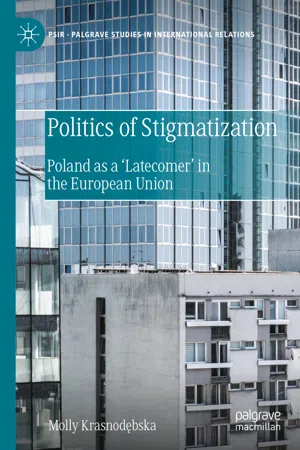
Politics of Stigmatization
Poland as a ‘Latecomer’ in the European Union
- English
- ePUB (mobile friendly)
- Available on iOS & Android
eBook - ePub
About this book
Information
© The Author(s) 2021
M. KrasnodębskaPolitics of StigmatizationPalgrave Studies in International Relationshttps://doi.org/10.1007/978-3-030-51521-8_11. Introduction
Molly Krasnodębska1
(1)
Warsaw, Poland
The end of the Cold War has been widely understood as a sign of not only the material but also ideological triumph of the Western model of modernity (Sarotte 2009). Often, the events of 1989 have been narrated as the victory of ‘Western’ liberalism and democracy over ‘Eastern’ communism. This was despite the fact that communist ideas and movements were strong in different parts of the globe, including Western Europe and the United States, whereas the strive for freedom of democracy had been internally driven in Central Eastern European countries, which regarded communism as something externally imposed. With the absence of the competing Soviet model, the Western world and its value system became the only version of modernity and progress. It became a ‘norm’ and a model for others to follow. The process of enlargement of Western international institutions, particularly the European Union (EU) and the North Atlantic Treaty Organization (NATO) into Central Eastern Europe further affirmed the idea of the West (represented by these institutions and their members) as a disseminator of liberal and democratic norms and values.
In the early 2000s, as the biggest wave of the enlargement process of NATO and the EU was taking place, many studies in international relations emerged, analyzing the transformation process in Central and Eastern Europe as a result of socialization (e.g. Checkel 2005; Gheciu 2005; Schimmelfennig and Sedelmeier 2005). Those scholars argue that the institutions as ‘teachers’ promote norms, such as democracy, the rule of law, and liberalism, and guide the new members as ‘students’ in their process of transformation from former communist to ‘Western’ states. The socialization framework, however, is not merely an academic fashion of the 2000s; it corresponds to a widespread understanding of the relationship between the new members and Western institutions in public and political discourse. In recent years, many scholars have argued that the post-communist transformation of Central Eastern Europe has failed and the countries are undergoing a process of “democratic backsliding” (Herman 2016; e.g. Börzel and Schimmelfennig 2017; Sedelmeier 2017). Both narratives have in common that they portray these states not as entities in their own right, but objects in the process of transition. The progress of their transition is measured against the European or Western model.
These countries also perceived themselves in such a way after 1989. Realizing that communism had inhibited their development, political leaders in Central Eastern Europe engaged in the process of redesigning their state institutions and economies in accordance with the Western model, drawing upon the advice of Western experts. The post-communist transformation was intended as a catching-up revolution or nachholende Revolution (Habermas 1990), a process of modernization through imitation. The progress of this transformation was measured based on the degree of approximation to the West, not only in economic terms but also in terms of the transformation of political structures (e.g. the development of multi-party systems) and culture (e.g. secularization and individualization). This view was shared both internally, in Central and Eastern Europe, and externally—by the members of the former Western bloc.
However, over time this view became increasingly challenged in countries of Central and Eastern Europe. First, it became clear that some cultural features of Central European countries remained despite the successful transition toward democracy and market economy. From the perspective of these countries, these features were not national or regional peculiarity but local variants of the ‘Western’ culture. However, deviation from the abstractly-formulated ‘Western’ ideals of secularism, individualism, and liberalism was often framed as normatively inferior. This deviation includes, for example, the attachment to family values, the role of the church in public life, and different political cultures. Second, despite significant processes in the building of democratic institutions and entering Western international institutions, including NATO and the EU, it became noticeable that the countries continued to be regarded as ‘students’ remaining in an incomplete process of transformation. They continued to be negatively perceived even for traits of culture and identity that they wanted to preserve. The states were stigmatized for decisions of their governments that from their own perspective were rational and in accordance with their interest.
This was also noted in academic literature. Some scholars (often from countries of the region) argued that despite having become members of Western institutions, Central and Eastern European countries (CEECs) continue to be perceived as geographically and culturally on the ‘verge of Europe’, ‘not quite European’ or ‘in transition’. As Merje Kuus (2004) points out, in this normative judgment, “Eastern Europe” is not so much a geographical place but a “quality”, which the new members are in danger of slipping back into. “Easterness”, while having different shades and degrees (see Todorova 2009), is associated with various negative attributes, such as backwardness, immaturity, tendencies to corruption and authoritarianism—to name a few. These stereotypes draw on ideas ingrained in European intellectual thought at least since the era of the Enlightenment which were reinforced during the Cold War (see Wolff 1994).
The discursive framework about socialization and backsliding, which depicts the CEECs as being in the process of transition to or away from the West, is more than just a way of describing certain processes taking place. The discourses described above are shaping political processes, such as those between members of the European Union. The awareness of having a stigma that is associated with their delayed process of modernization and arrival in Western institutions, but which has deeper historical roots, affects these states’ self-perception and is reflected in their behavior in the international arena. With this premise in mind, this book studies specifically how the pursuit of overcoming such a stigma and gaining full acceptance and recognition in a community of states, such as the EU, shapes a state’s foreign policy.
1.1 Conceptual Framework
Drawing on the theoretical works of Ayşe Zarakol (2011), Rebecca Adler-Nissen (2014a), and others, I argue that the relationship between the new members and Western institutions, including their older members, can be best understood in terms of stigmatization. The ‘Eastern European past’ of the Central and Eastern European member states, and their status as ‘latecomers’ in Western institutions, can be seen as a stigma, an undesirable characteristic that sets them apart from an imagined community of ‘normals’. The ‘normals’ are in this case the more ‘established’ members of these international institutions. Socialization understood as a process of becoming like the ‘normals’ turns out to be a process that is never completed as actors that bear a stigma often remain tainted by their past.
The concept of stigma is derived from Erving Goffman’s (1963) work in sociology and had been applied by a number of scholars to international relations theory (Zarakol 2011; Adler-Nissen 2014a). Stigma as a sociological concept describes a quality that is judged by a society as a deeply discrediting deviant from the ‘norm’. In the case of the CEECs their stigma is the status as late joiners in the EU and other Western institutions to which other characteristics are attributed, such as their alleged inability to live up to the EU’s expectations in foreign policy. The process of stigmatization draws a distinction between a community of ‘normals’ and the actor bearing the stigma. While stigmatization can happen through a number of mechanisms (see Adler-Nissen 2014b), in the case discussed in this book, it happens primarily through language. This includes labeling, verbal scolding, and the use of “representational force”, which is a type of force entailed in discourse and “operates through the structure of a speaker’s narrative representation of ‘reality’” (Bially Mattern 2005: 586).
When a stigmatized actor in one form or another takes part in the society of ‘normals’, and shares some common values, the actor internalizes the society’s judgment of its own inferiority. The awareness of stigma leads to a constant strive for recognition in the eyes of the ‘normals’ and triggers a sense of fundamental uncertainty about the own position, also referred to as ontological insecurity. Ontological security was developed by Anthony Giddens (1990, 1991) in sociology and can be understood as “security as being”. States, like persons, pursue ontological security which can be as vital as physical security (see Mitzen 2006; Steele 2008; Mälksoo 2019). Zarakol (2011) argues that ontological in...
Table of contents
- Cover
- Front Matter
- 1. Introduction
- 2. From Socialization to Stigmatization: New Members in Western Institutions
- 3. Strategic Culture and the Quest for Ontological Security
- 4. Poland’s Strategic Culture: East and West
- 5. Becoming ‘New Europe’: The Iraq Crisis and the Construction of Poland’s ‘Latecomer’ Stigma
- 6. A Little War the World Forgot: Poland’s Initiative During the Russo-Georgian War
- 7. Managing the Ukraine Crisis: A Triumph of Poland’s EU Politics?
- 8. Conclusion
- Back Matter
Trusted by 375,005 students
Access to over 1.5 million titles for a fair monthly price.
Study more efficiently using our study tools.
Frequently asked questions
Yes, you can cancel anytime from the Subscription tab in your account settings on the Perlego website. Your subscription will stay active until the end of your current billing period. Learn how to cancel your subscription
No, books cannot be downloaded as external files, such as PDFs, for use outside of Perlego. However, you can download books within the Perlego app for offline reading on mobile or tablet. Learn how to download books offline
Perlego offers two plans: Essential and Complete
- Essential is ideal for learners and professionals who enjoy exploring a wide range of subjects. Access the Essential Library with 800,000+ trusted titles and best-sellers across business, personal growth, and the humanities. Includes unlimited reading time and Standard Read Aloud voice.
- Complete: Perfect for advanced learners and researchers needing full, unrestricted access. Unlock 1.5M+ books across hundreds of subjects, including academic and specialized titles. The Complete Plan also includes advanced features like Premium Read Aloud and Research Assistant.
We are an online textbook subscription service, where you can get access to an entire online library for less than the price of a single book per month. With over 1.5 million books across 990+ topics, we’ve got you covered! Learn about our mission
Look out for the read-aloud symbol on your next book to see if you can listen to it. The read-aloud tool reads text aloud for you, highlighting the text as it is being read. You can pause it, speed it up and slow it down. Learn more about Read Aloud
Yes! You can use the Perlego app on both iOS and Android devices to read anytime, anywhere — even offline. Perfect for commutes or when you’re on the go.
Please note we cannot support devices running on iOS 13 and Android 7 or earlier. Learn more about using the app
Please note we cannot support devices running on iOS 13 and Android 7 or earlier. Learn more about using the app
Yes, you can access Politics of Stigmatization by Molly Krasnodębska in PDF and/or ePUB format, as well as other popular books in Politics & International Relations & European Politics. We have over 1.5 million books available in our catalogue for you to explore.