This book examines macroeconomic theory from an analytical framework provided by theories of complex systems, in contrast to conventional theories founded on aggregation. The resulting difference in analytical perspectives is huge: the macro level of society is notpursued through aggregation over micro entities. To the contrary, the micro-macro relation is treated as one of parts-to-whole, and this relation is approached from within an ecological scheme of thought. A society is a complex ecology of plans. That ecology, however, is not reducible to a single plan.
Conventional macro theory presents a national economy as a collection of such aggregate variables as output, employment, investment, and a price level, and seeks to develop theoretical relationships among those variables. In contrast, the social-theoretic approach to macro or social theory in this book treats the standard macro variables as having been shaped through social institutions, conventions, and processes that in turn are generated through interaction among economizing persons. The object denoted as macro is thus of a higher order of complexity than the object denoted as micro.
Macroeconomics entails theorizing about the entirety of an economic system, in contrast to microeconomics which entails theorizing about various parts of that system. This distinction suggests the image of someone standing in a hot-air balloon as it ascends from a town square. As the ascension continues, a wider field of vision appears; however, the clarity of individual objects on the ground weakens. An economic system in its entirety is obviously an object of great interest because its qualities and properties affect the lives of everyone who inhabits that social system. While it is easy to understand why economists would seek to theorize about economic systems in their entirety, a significant challenge accompanies that theoretical effort because no one can see that system in its entirety (Veetiland Wagner2015). Theorists cannot see the object about which they theorize, and yet they theorize about it all the same. This situation is not unusual. It is common. No physicist has seen gravity, and yet physicists theorize about it and its properties. Those theoretical efforts are guided by a desire to explain such observable phenomena as the rising and falling of tides in relation to the moon’s proximity. Economists face a similar situation. They, too, observe such phenomena as variability in wealth across time and place, and seek to theorize about the underlying processes that might generate those observations.
To be sure, economics, or social theory more generally, pertains to different types of objects than does physics, or the natural sciences generally. Humans are part of the natural world, so human actions are subject to natural processes. For instance, humans will die without receiving water or food at regular intervals. They will also die if exposed to extreme temperatures for prolonged periods. And even if experienced temperatures are not that extreme, humans become distinctly uncomfortable when exposed to temperatures above 80 degrees Fahrenheit or below 60 degrees, and so seek to change their environment through heating or cooling. Humans are biological creatures, so are subject to biological as well as physical laws. Indeed, it is possible to develop an economic theory around the imaginary actions of a Robinson Crusoe alone on his island. Such theories could be described as laws of a natural economy in recognition of Crusoe’s struggle for survival within the natural world.
But we find Crusoe alone only in our imaginations. That aloneness, moreover, creates severe analytical problems because Crusoe cannot duplicate himself. If you start with Crusoe, you can never get to society. Yet all of our observations of humans, both historical and archeological, pertain to humans living in the groups that we designate variously as tribes or societies. This situation of humans existing in groups creates analytical challenges and opportunities that extend beyond any effort to reduce humans to adherence to physical and biological laws. Sure, as part of the natural world humans are subject to the laws of natural science. Their living together in societies, however, creates a further menu of analytical questions, and with that menu speaking to what Norbert Elias (1939 [1982]) describes as The Civilizing Process, which pertains to the varied settings within which infants mature into adults. This menu of questions takes us to the brink of the chasm that separates theorizing about micro or individual phenomena from theorizing about macro or social phenomena. Macroeconomics construed as systems theory pertains to some concept of society as a whole, in contrast to theorizing about the individual entities that constitute that society. Indeed, macroeconomics construed as systems theory has much in common with what Joseph Schumpeter (1954: 12–22) described as economic sociology as one of the five branches of economics, the others being theory, history, statistics, and political economy.
Any scheme of thought will start with intuitive hunches that are organized through the analytical tools and techniques that an author possesses. As the Preface notes, so far as I am aware Erik Lindahl advanced the first explicit distinction between microeconomics and macroeconomics. He did this in 1919 in a paper in Swedish that wasn’t published in English until Lindahl (1919 [1939]). For Lindahl, what he described as microeconomics pertained to individual action, while macroeconomics was the domain of interaction among individuals within society. Micro thus pertains to the parts of an economic system while macro pertains to the entirety of that system. Lindahl wrote at the time when the development of national income accounting was just getting underway, and with Dianne Coyle (2015) providing a lucid account of that development. Moreover, the analytical schema of systems theory awaited development when Lindahl articulated his micro–macro distinction. In the absence of analytical tools for thinking about systems of interacting agents, it is easy to understand how macro variables came to be treated as aggregations over the activities of the economizing entities within a society.
But aggregation over individual entities is not the only way a macro theory can be articulated. An alternative approach is through systems theory, where the micro–macro relationship is exemplified beautifully by Thomas Schelling (1978) who set forth an analytical template for exploring how system-level properties can emerge out of micro-level interaction, including situations where rational individual action can generate systemic outcomes that can be disagreeable to a good number of the participants. Starting with Ludwig Bertalanffy (1968), the idea of systems theory as pertaining to the systematic study of parts-to-whole relationships took a sizeable step forward, and with Ervin Laszlo (1996) and Donella Meadows (2008) providing succinct statements of the challenges of thinking in terms of systems of interacting agents. Any system can be described as containing elements along with connections among those elements. The performance of the system depends on both the properties of the elements and the pattern of connection among the elements. There are two distinct formats through which someone can theorize about systems of interacting elements. One format arises when those elements are mechanical or robotic. The other format pertains to systems where the elements are creative or volitional. This difference between types of system makes all the difference in the world for theorizing about economies in their entirety.
Contemporary economic theory typically treats economies as mechanical, as illustrated by repeated references to “economic mechanisms” and similar notions. In contrast, this book is grounded on the presumption that economic systems contain agents who are creative and can exercise volition. When macro theory is approached within the framework of systems theory, it becomes an adventure in theorizing about invisible hands (Clower1994; Aydinonat2008) and spontaneously generated social order (Howittand Clower2000).
The Network Architecture of Economic Systems
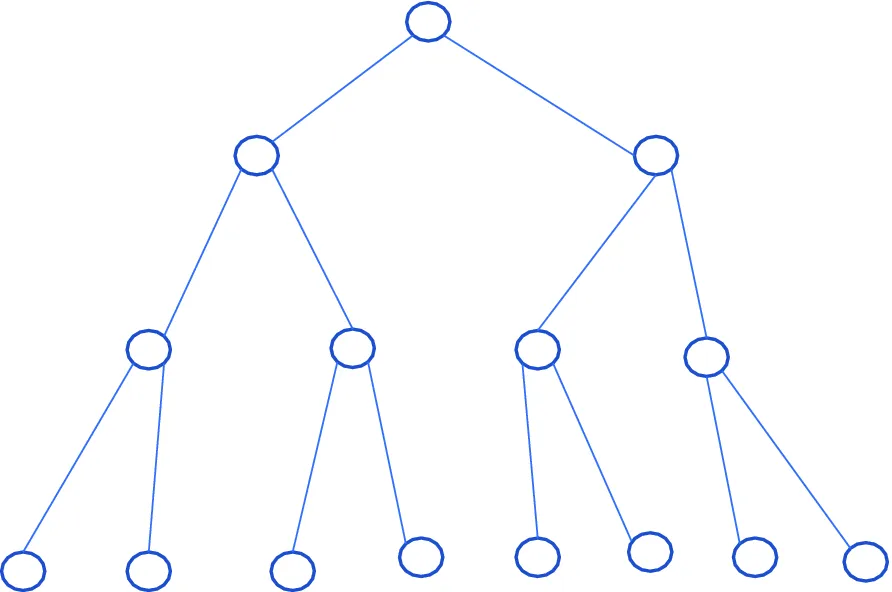
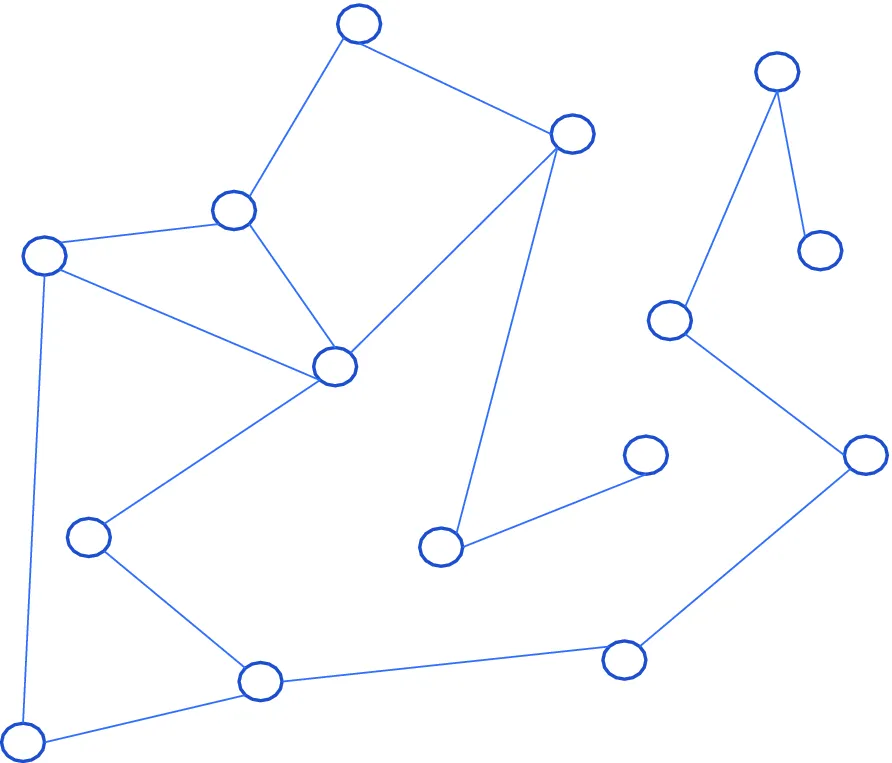
All systems, whether populated by mechanical or creative entities, have an architecture based on some pattern of connection among the entities that constitute the system. Graph theory provides a convenient analytical framework for working with systems of interacting agents, with Richard Trudeau (1993) making a lucid presentation of graph theory and with Jason Potts (2000) developing system-theoretic ideas lucidly in a microeconomic context. Within a graph-theoretic framework, the entities are commonly denoted as nodes and the connections denoted as edges. Figures 1.1 and 1.2 contrast two forms of network architecture that will be used often in this book. Both networks contain 15 nodes. Those networks differ in their patterns of connection among the participants, and with a central presumption of network theory being that patterns of connection have significant analytical work to do. Where Fig. 1.1 denotes a monocentric or homophonic network, Fig. 1.2 denotes a polycentric or polyphonic network.
Fig. 1.1
A monocentric or homophonic network
Fig. 1.2
A polycentric or polyphonic network
Both terms pertain to the same formal distinction but have been developed within different contexts. The pair monocentric–polycentric has been invoked in social settings, originally by Michael Polanyi’s (1951) treatment of liberty within society and then elaborated often by Vincent Ostrom, especially as found in Ostrom (1999). The pair homophonic–polyphonic pertains to literature and music, which Mikhail Bakhtin (1981, 1984) expresses lucidly in distinguishing between settings where all figures in a story speak through the author and settings where the figures speak among themselves. Existing macroeconomic theory operates almost wholly within a monocentric or homophonic voice. In contrast, this book explores how macroeconomics might be reoriented in a polycentric or polyphonic direction.
Figure 1.1 illustrates a monocentric or homophonic network. Figure 1.1 resembles the tables of organization that sometimes appear in textbooks on management and organization. Monocentric networks are governed by relationships of superior-to-subordinate; someone who occupies a higher node in that network holds superior rank to those who occupy lower nodes. Any such sketch is an abstraction from a reality that is more complex than the sketch depicts. Figure 1.1 invites the image of higher nodes issuing orders to lower nodes, and with those lower nodes responding to those orders and subsequently being evaluated by those higher nodes. The relationship superior-subordinate flows in two directions, as all relationships do, with orders flowing downward and actions flowing upward. As usual with such abstractions, both truth and fiction inhabit Fig. 1.1. This book is not about organization theory, so no effort will be made to develop more complex depictions of the actual operation of organizations that have nominally monocentric character.
Figure 1.2 sets forth a polycentric or polyphonic network. One thing that is immediately apparent from Fig. 1.2 is the absence of any obvious concept of higher and lower or superior and inferior. All nodes are created equal, as it were, or at least as they seem superficially to be. In both panels, all nodes are constructed to be the same size to avoid cluttering the graphics as well as to avoid dealing with possible analytical implications of differing size and significance of nodes. With respect to the pattern of connection among the nodes in Fig. 1.2, two points are worth mentioning. First, the graph is completely connected, which means that starting from any node you can travel to every other node without leaving the graph. There are no orphans as it were, or no Robinson Crusoes to recur to a common idiom of economic theory. Second, the density of connection varies among the nodes. Two of the 15 nodes are connected to only one node. Most of the nodes are connected to two other nodes. One node is connected to three other nodes, and with one node being connected to five other nodes.
A significant economic-theoretic question regarding the application of concepts from graph theory concerns the scalability of graphs. If the network depicted by Fig. 1.1 were to expand from 15 to 30 nodes, would a similar pattern of connectivity remain or would there be a tendency for some nodes to become increasingly popular relative to the other nodes? In the former case, a network is described as being scalable. With scalable networks, an expansion in the size of the network does not change network architecture to any significant extent. Sure, there will be differences among nodes in the number of their connections, but the distribution of connections among nodes will not change significantly with expansions in the size of the network. Connections, in other words, are formed randomly as new nodes enter the graph.
The alternative to a scalable network is a scale-free network. The distribution of connections is not generated randomly as new nodes enter the graph. To the contrary, new nodes might reflect preference for attaching to densely connected nodes. To the extent this is so, an expansion in the size of the graph will confer some advantage on densely connected nod...
Table of contents
Cover
Front Matter
1. Macroeconomics as Systems Theory: Setting the Stage
2. Models of Social Order: Mechanical vs. Creative
3. Structures of Production and Properties of Social Order
4. Diachronic Action Within an Ecology of Plans
5. Kaleidic Economies and Internally Generated Change
6. Entangled Political Economy Within Human Population Systems
7. Public Policy as the Political Calculation of Economic Value
8. Money, Credit, and Commanding the Societal Heights
9. Reason, Sentiment, and Democratic Action
10. Liberalism, Collectivism, and Democracy
Back Matter
Trusted by 375,005 students
Access to over 1.5 million titles for a fair monthly price.
Study more efficiently using our study tools.
Frequently asked questions
Yes, you can cancel anytime from the Subscription tab in your account settings on the Perlego website. Your subscription will stay active until the end of your current billing period. Learn how to cancel your subscription
No, books cannot be downloaded as external files, such as PDFs, for use outside of Perlego. However, you can download books within the Perlego app for offline reading on mobile or tablet. Learn how to download books offline
Perlego offers two plans: Essential and Complete
Essential is ideal for learners and professionals who enjoy exploring a wide range of subjects. Access the Essential Library with 800,000+ trusted titles and best-sellers across business, personal growth, and the humanities. Includes unlimited reading time and Standard Read Aloud voice.
Complete: Perfect for advanced learners and researchers needing full, unrestricted access. Unlock 1.5M+ books across hundreds of subjects, including academic and specialized titles. The Complete Plan also includes advanced features like Premium Read Aloud and Research Assistant.
Both plans are available with monthly, semester, or annual billing cycles.
We are an online textbook subscription service, where you can get access to an entire online library for less than the price of a single book per month. With over 1.5 million books across 990+ topics, we’ve got you covered! Learn about our mission
Look out for the read-aloud symbol on your next book to see if you can listen to it. The read-aloud tool reads text aloud for you, highlighting the text as it is being read. You can pause it, speed it up and slow it down. Learn more about Read Aloud
Yes! You can use the Perlego app on both iOS and Android devices to read anytime, anywhere — even offline. Perfect for commutes or when you’re on the go. Please note we cannot support devices running on iOS 13 and Android 7 or earlier. Learn more about using the app
Yes, you can access Macroeconomics as Systems Theory by Richard E. Wagner in PDF and/or ePUB format, as well as other popular books in Economics & Economic History. We have over 1.5 million books available in our catalogue for you to explore.