The correspondence between the years of 1846 and 1894 covers three definable periods: the years before Ulrichs began writing (1846-1864); the years between which all his principle works, his lobbying and all his activism took place (1865-1879); and his final years in exile (1880-1895). The analysis will contend that the correspondence reveals that Ulrichs' project was not just a lonely campaign against legal prohibition of the 'hydra of public contempt', but instead was part of a far wider campaign of community-led self-definition that was actively promoted at home and abroad.
eBook - ePub
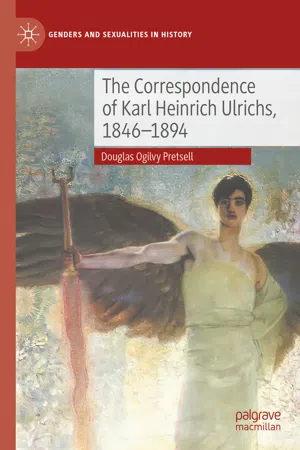
The Correspondence of Karl Heinrich Ulrichs, 1846-1894
- English
- ePUB (mobile friendly)
- Available on iOS & Android
eBook - ePub
The Correspondence of Karl Heinrich Ulrichs, 1846-1894
About this book
This book will be the first critical edition of all the surviving correspondence to, from and about Karl Heinrich Ulrichs between 1846 and 1894. Ulrichs, a former Hanoverian lawyer, was the first to articulate a personal identity of sexuality that defined individuals by their sexual object. This articulation of sexual modernist identities is Ulrichs' abiding legacy to the world. He wrote twelve short books between 1864 and 1879, arguing for the removal of laws and prejudice against 'urnings' and articulating a scientific theory that placed them as a third gender. He is a foundational figure in the history of sexuality, yet there has never been an edition of his complete correspondence in either English or the original German.
Information
© The Author(s) 2020
D. O. PretsellThe Correspondence of Karl Heinrich Ulrichs, 1846-1894Genders and Sexualities in Historyhttps://doi.org/10.1007/978-3-030-39763-0_11. Introduction
Douglas Ogilvy Pretsell1
(1)
La Trobe University, Melbourne, VIC, Australia
Douglas Ogilvy Pretsell
Karl Heinrich Ulrichs (1825–1895) was a pivotal if enigmatic figure in the emerging historical discourse of modern sexuality. With no precedent or template to follow, he single-handedly launched a campaign of literary activism advocating for the rights of men who were sexually attracted to other men, publishing 12 books between 1864 and 1880.1 He called these men ‘urnings’ and the men attracted to the opposite sex, ‘dionings.’2 A lawyer by training, he based his arguments on contemporary medical knowledge and was influential on the emerging sexual sciences.
Scholarship has only turned his way within the last 50 years. More than a century elapsed between his main years of activity and the first historical appraisal. Much of what we know of Ulrichs came from his surviving correspondence. In contrast to his published works, the correspondence offers tantalising insights into Ulrichs’ intellectual world and networks of exchange. They also reveal facets of his character that extend our understanding of the man himself. Tragically, for the historian of sexuality, many of Ulrichs’ personal papers and letters were confiscated and then lost by the state and the remainder destroyed in a house fire in 1893. It is likely that many of the letters he wrote to others were also destroyed. Despite this, from the letters that have survived, historians can glean biographical details, insights into motivations and emotional responses and map out how other individuals reacted to Ulrichs and his campaign of literary activism. The following collection includes both the surviving letters from Ulrichs and, where available, the responses and unsolicited letters from others. Just under half of the letters are addressed to Ulrichs from other parties. The diversity of correspondents, including Prussian authorities, men responding to Ulrichs’ writings, friends and employers, allows for a layered impression of where Ulrichs was situated and perceived by those interacting with him in correspondence.
The critical biographical narrative that follows guides the reader chronologically through the letters in this volume. It follows the flow of Ulrichs’ letters, augmented by other sources not included in this volume. The narrative pauses around five points where a ‘Spotlight’ illuminates key developments in Ulrichs’ life and campaigns in greater detail:
- Spotlight One: Employment in state service.
- Spotlight Two: Formulating the theories.
- Spotlight Three: Urning correspondence.
- Spotlight Four: Arrest and imprisonment.
- Spotlight Five: Rivals, comrades and followers.
Critical Biographical Narrative
Karl Heinrich Ulrichs was born at his family’s Westerfeld estate near Aurich in the East Friesland region of the independent Kingdom of Hanover in 1825. His father, Hermann Heinrich Ulrichs, was an architect in the civil service of the Hanoverian government and his mother, Elise (nee Heinrichs), came from a prominent family of Lutheran clerics.3 Ulrichs’ family was part of the Bildungsbürgertum (the educated bourgeoisie), that had emerged in the nineteenth century as the dominant political class.4 Ulrichs had two sisters, Louise and Ulrike, and described his childhood as happy (letter 62). Just before his tenth birthday, Ulrichs’ father died tragically in an accident and the family moved to Burgdorf, where they could be close to his maternal relatives. It was from there that Ulrichs began his schooling, first in a village school near Hildesheim and then at Gymnasiums in Detmold and Celle, passing the ‘Matura’ exam in Easter 1844 with second class distinction. Although it had been assumed that he would follow his father into an architectural career, his academic abilities, in particular his facility with classical languages, meant that he went instead to University. Ulrichs matriculated at the Georg Augusta University, Göttingen, in the Easter term of 1844. Göttingen was at that time the preeminent University in Germany, particularly for the study of law. Ulrichs studied there for two years, during which he won a prestigious award for a Latin essay on cross-litigation (letters 1 and 2). While in Göttingen, he became fully aware of his sexual attraction to men (letter 80). Ulrichs transferred to the equally prestigious Friedrich Wilhelm University in Berlin (now the Humboldt University) for his final year. In Berlin, he developed a particular sexual interest in the Prussian soldiers who were garrisoned in large numbers there at the time. On graduation, Ulrichs returned to Hanover where he passed the Official Auditor exam in early 1848.
SPOTLIGHT ONE: Employment in State Service
(letters 3–39 in this volume)
On August 1, 1848, the Royal Hanoverian Ministry of the Interior appointed Karl Heinrich Ulrichs as an Official Auditor.5 Ulrichs would spend a little over six years working for the Hanoverian civil service, occupying six positions in the Ministry of the Interior and one judiciary role. The documents preserved in the Hanoverian civil service archives reveal Ulrichs’ not entirely successful employment in state service.6 In addition to the letters to and from Ulrichs included in this book, the archives also contain internal reports and letters between his superiors about his performance. Together, these documents form Ulrichs’ civil service personnel file. They do not make for comfortable reading.
The bulk of the correspondence in Ulrichs’ personnel files relates to three of his civil service positions. In his initial period in the most junior position of Auditor he spent the longest period at Achim. Following the exams qualifying him for promotion to Assessor and two short stints in other offices, he was transferred to Bremervörde where doubts about his capabilities came to a head. Finally, after leaving the Ministry of the Interior, Ulrichs transferred to the judiciary at the High Court in Hildesheim. It is these three positions that will be the focus of this spotlight.
Ulrichs started his period of employment at the High Court at Achim in February 1849.7 As an auditor, the most junior position for a lawyer in the Hanoverian civil service, Ulrichs kept the minutes, drafted briefs and executed other junior administrative tasks. His academic results might have indicated he would have little difficulty with these tasks, but Ulrichs struggled. On 23 July 1850, after praising his university studies and his gift for theory in a list of points, Ulrichs’ annual review identified three other areas where Ulrichs’ performance was considered to be inadequate:
These three criticisms were to be repeated at every disciplinary meeting throughout his employment in state service. They appeared to be touching on persistent character traits rather than specific tasks that he could master with practice. Ulrichs’ superior at the time, Bailiff Meyer, was a sympathetic man. Ulrichs later commented that ‘he seeks, as I judge him, to live at peace with everyone.’9 Meyer’s letters to the Ministry reveal that he was withholding criticism so as not to discourage Ulrichs.10 However, unknown to Ulrichs, if it had not been that he was about to sit his second professional exam, the administration would have given him a final admonition while he was still at Achim (letter 9).3. that he has absolutely no practical sense, in such a way that one has to assume that he lacks the gift of understanding and judgment.4. that he pleases himself in peculiarities, reluctantly learns about the traditional forms of business, or follow them, or does not separate the person from the business.5. that in social life he is easily offended by his peculiarities and does not know how to find easier forms in social intercourse due to a certain obstinacy.8
After Ulrichs had completed his civil service exams and had been promoted to Official Assessor, he served a short stint in Syke and then a few months in a similar position at Melle, before transferring to the office at Bremervörde in early 1853. Unlike Bailiff Meyer at Achim, Bailiff von Reiche, the superior at Bremervörde, was not one to forgive indiscretions or withhold criticism. Ulrichs noted that von Reiche ‘becomes annoyed and sensitive about the slightest detail.’11 It was therefore not long before his performance became an issue. On 2 April, Chief Magistrate von Bülow wrote:
Bailiff von Reiche suggested to v...Bailiff von Reiche … made it clear to me that among his great acquaintance of older and younger gifted and weak officials, he was convinced that he had never found one so useless in practice.12
Table of contents
- Cover
- Front Matter
- 1. Introduction
- Part I. The
- Back Matter
Trusted by 375,005 students
Access to over 1.5 million titles for a fair monthly price.
Study more efficiently using our study tools.
Frequently asked questions
Yes, you can cancel anytime from the Subscription tab in your account settings on the Perlego website. Your subscription will stay active until the end of your current billing period. Learn how to cancel your subscription
No, books cannot be downloaded as external files, such as PDFs, for use outside of Perlego. However, you can download books within the Perlego app for offline reading on mobile or tablet. Learn how to download books offline
Perlego offers two plans: Essential and Complete
- Essential is ideal for learners and professionals who enjoy exploring a wide range of subjects. Access the Essential Library with 800,000+ trusted titles and best-sellers across business, personal growth, and the humanities. Includes unlimited reading time and Standard Read Aloud voice.
- Complete: Perfect for advanced learners and researchers needing full, unrestricted access. Unlock 1.5M+ books across hundreds of subjects, including academic and specialized titles. The Complete Plan also includes advanced features like Premium Read Aloud and Research Assistant.
We are an online textbook subscription service, where you can get access to an entire online library for less than the price of a single book per month. With over 1.5 million books across 990+ topics, we’ve got you covered! Learn about our mission
Look out for the read-aloud symbol on your next book to see if you can listen to it. The read-aloud tool reads text aloud for you, highlighting the text as it is being read. You can pause it, speed it up and slow it down. Learn more about Read Aloud
Yes! You can use the Perlego app on both iOS and Android devices to read anytime, anywhere — even offline. Perfect for commutes or when you’re on the go.
Please note we cannot support devices running on iOS 13 and Android 7 or earlier. Learn more about using the app
Please note we cannot support devices running on iOS 13 and Android 7 or earlier. Learn more about using the app
Yes, you can access The Correspondence of Karl Heinrich Ulrichs, 1846-1894 by Douglas Pretsell,Douglas Ogilvy Pretsell in PDF and/or ePUB format, as well as other popular books in History & European History. We have over 1.5 million books available in our catalogue for you to explore.