This book examines the evidence-based interventions that can be used to promote creative thinking skills for children and adolescents in schools. It begins by explaining the theoretical basis of these training programmes, before presenting a coherent framework for the application of creativity theory in education. The authors describe and analyse programmes that have drawn on this framework, before offering an overview of the results of experimental studies which have validated the authors' approach. This book provides practical guidance on how the programmes can be applied in the classroom and discusses potential future directions for research and practice for increasing children's creativity. This book will be a valuable resource for teachers and teacher trainers, as well as to researchers in the psychology of creativity, education, and educational psychology.
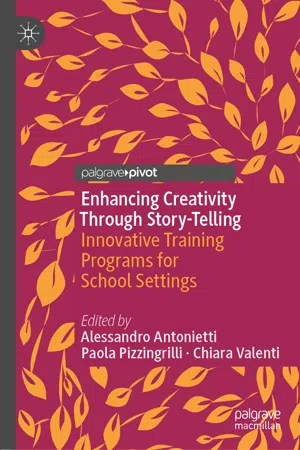
eBook - ePub
Enhancing Creativity Through Story-Telling
Innovative Training Programs for School Settings
- English
- ePUB (mobile friendly)
- Available on iOS & Android
eBook - ePub
Enhancing Creativity Through Story-Telling
Innovative Training Programs for School Settings
About this book
Information
Topic
DidatticaSubtopic
Psicologia dell'educazione© The Author(s), under exclusive license to Springer Nature Switzerland AG 2020
A. Antonietti et al. (eds.)Enhancing Creativity Through Story-TellingPalgrave Studies in Creativity and Culturehttps://doi.org/10.1007/978-3-030-63013-3_11. The Mechanisms of Creative Thinking
Alessandro Antonietti1 , Barbara Colombo2 and Paola Pizzingrilli1
(1)
Department of Psychology, Catholic University of the Sacred Heart, Milan, Italy
(2)
Champlain College, Burlington, VT, USA
Abstract
The theoretical model at the basis of the training programmes which are described in the book is explained. The model tries to synthesise the main theoretical positions about creative thinking in order to define a coherent framework to be applied in education. Three general mental operations seem to rely on the basis of creativity: widening (W), connecting (C) and reorganising (R). W concerns the tendency to keep an open mind and to deal with a great number of elements. C refers to the capacity to establish relationships among different elements and to combine them in unusual ways. R consists of changing the perspective and inverting relationships among elements. The model of creativity resulting from the integration of W, C and R is described by reporting examples coming from everyday life and from cases of innovation in the field of arts, science and technology.
Keywords
CreativityDivergent thinkingProductive thinkingFluencyFlexibilityOriginalityRemote associationsCombinationRestructuringInsight1.1 Three Main Theoretical Perspectives
The perspective according to which creativity concerns primarily the production of abundant and diverse ideas still survives. Starting from Guilford (1950), and according to the Factorialistic perspective, creativity is linked to the ability to produce many ideas from a stimulus. This ability is characterised by the richness of the thinking flow and the ability to follow new directions in order to achieve uncommon and original outcomes. The generation of fluid, flexible and original ideas often comes from changing existing ideas (Perkins, 1988; Simonton, 1999; Weisberg, 1993): By analysing scientific discoveries, technological innovations and artistic masterpieces, it was found that they usually originated from existing ideas that have been modified through gradual adjustments to fit the specific problem or goal the creator had in mind. In fact, information that people gradually obtain while testing solutions that progressively come to their mind by trying to solve a problem leads them to change the direction of their reasoning. Not all changes, however, lead to something useful and valuable. Proposed changes have to be selected. The creative process, hence, becomes similar to the evolution process (Campbell, 1960), which is determined by the generation of variations of the characteristics of existing species. The selection of these variations leads to the maintaining of those that provide greater survival capacity (Johnson-Laird, 1998).
Secondly, associationism is also a resistant conception of creativity. From this perspective, the production of creative ideas would be achieved through the unusual combination of known ideas. Bizarre associations often led scientists and artists to mature brilliant insights. Vygotsky (1932) was one of the first authors who proposed a conception of creativity based on the idea of “association”. According to Vygotsky, creative activity consists of the recombination and processing of information already known or previously acquired, which leads to the production of new realities. Mednick (1962) argued that creativity can be identified by the ability to connect ideas which are distant from each other. According to him, creativity is the ability to combine, in a new and unusual way, disparate elements that apparently have little in common. This perspective has been renewed by Koestler (1964) under the concept of bisociation: The creative act consists of bringing together two structures of reasoning usually considered incompatible or to find similarities between different fields of knowledge. Innovative thinking would be implemented when two independent ways of reasoning come to an intersection, producing something that did not previously exist. The assumption that creativity derives from the association of elements usually considered as unrelated is also present in more recent theories. For example, Rothenberg (1979) identified creativity with Janusian thinking (a name derived from Janus, the ancient Roman goddess having two faces looking at opposite directions). This form of thinking allows one to combine the terms of an antithesis, that is, to simultaneously keep in mind two opposing elements and to attempt their integration. The creative person, therefore, will be able to combine two different elements and to make antagonistic elements coexist in the same line of thought. This aspect of creativity is stressed in the Geneplore model (Smith, Ward, & Finke, 1995), according to which original and innovative outcomes can result by a process in two phases: the generative phase, in which an individual constructs mental representations, and the exploration phase, in which these representations are interpreted in order to lead them to suggest creative discoveries. In the generative phase, the representation results as a consequence of an associative process through which elements are combined together.
Thirdly, some of the suggestions derived from the Gestalt tradition have been used to define an “updated” concept of insight. Gestalt psychologists did not generally use the word “creativity”, even if they dealt with acts of thought that produced discoveries and inventions. What is commonly meant by “creativity” refers to what Gestalt psychologists called productive thinking, which, as Wertheimer (1959) claimed, allows individuals to identify new properties of the given elements, which are then conceived and used in new or different roles or perspectives. This implements a restructuring act, which represents: (a) the transformation of the point of view from which the situation is analysed; (b) the reorganisation of available informational data; (c) the discovery of new relationships and (d) the identification of new functions of the available material.
Gruber and Davis (1988) pointed out that not all innovations and discoveries must necessarily proceed from a sudden reorganisation of the conceptual field. For example, Gruber (1974), by reconstructing the development of Darwin’s evolutionary theory, emphasised the presence of slow and incremental changes in the theoretical system that the British naturalist was gradually formulating. Schank (1988) also maintained that some sort of restructuring is at the basis of creativity. This author suggested that to understand reality we must have specific knowledge structures. A knowledge structure used several times to explain an event constitutes a pattern of explanation. Facing a stimulus, the most economical strategy is to treat it as something familiar, namely, trying to apply a pattern of explanation which refers to other known situations. Creativity emerges with new situations. In this case people can apply an “unexpected” pattern of explanation. The creative process comes from a deliberate misapplication of an explanation pattern: Facing an event, a person does not apply the usual pattern of explanation for it but tries a completely different pattern.
Is it possible to find a way to synthesise those different positions, in order to define a coherent framework to conceptualise creativity and to inspire attempts to educate creativity? Apart from the specific aspects that characterise each theory, we can identify three major mental operations, which appear to be the basis of creativity.
The first group of authors fundamentally claims that creativity comes from the widening of the mental field. If the individual is capable of producing many different and unusual ideas (Guilford), if the individual takes something that exists and tries to change it (Perkins, Simonton, Weisberg), if the individual generates different solutions in order to identify at least one surviving evaluation (Campbell, Johnson-Laird), the individual will discover many mental elements, increasing the probability of finding among them one that could lead to something new and valuable. Hence, expanding the mental horizon through the discovery or invention of new elements contributes to creativity.
The second group of authors recognises, however, that creativity emerges when people establish a relationship between realities which are very different from each other (Vygotsky, Mednick, Koestler) or even opposite (Rothenberg). According to this perspective, connecting mental fields usually considered remote, and possibly antithetical, is the basic process of creativity.
Finally, the third group of authors thinks that a creative act occurs when there is a reorganisation of the mental field. This can happen through restructuring (Wertheimer and Gruber) or through the application of an interpretive scheme that usually applies to other situations but that, when applied to the present one for which it is not the conventional scheme, produces a new vision in which it is possible to grasp not obvious and interesting meanings (Schank).
The WCR model of creativity (Antonietti & Colombo, 2013, 2016; Antonietti, Colombo, & Pizzingrilli, 2011) tries to integrate these operations—Widening (W), Connecting (C) and Reorganising (R)—to help teachers and trainers design interventions which can enhance each different aspect of creativity. Widening concerns the tendency to keep an open mind, to be aware of the great number of elements that can be identified in a given situation, to recognise possible, not obvious, meanings, to discover hidden aspects and to overcome apparent constraints. Connecting refers to the capacity to establish reciprocal relationships among different elements, to draw analogies between remote things, to combine ideas in odd ways and to synthesise the multiplicity of disparate elements into an overall structure. Reorganising consists of changing the perspective, assuming a different point of view, seeing things by inverting relationships between their elements, asking original questions and imagining what should happen if unusual conditions occurred.
1.2 Widening
The first mechanism that we see operating in creative thinking consists of coming out from the limited conceptual framework within which people spontaneously pigeonhole situations and breaking all the “thinking bonds” that often restrain them. To produce something new and original, it is important to move in a wider mental field that will mobilise ideas and lead to new directions of thinking, helping to find new opportunities and new meanings.
A good example is related to marketing. For decades, manufacturers of tennis rackets were bound to a standard shape and size, when actually no regulation prevented the use of different rackets. Breaking this implicit constraint, the owner of a sporting goods company successfully launched onto the market the “big racket”, a tennis racket with a wider than usual tailpiece. A tennis racket with this shape and this size offers several advantages over traditional rackets: First, beginners are more likely to intercept the ball; Second, a larger tailpiece allows tennis players to give more strength to the shot; Finally, the effects of the return stroke on the elbow ligaments are lower. The designer of this “big racket” expanded the field of mind, acknowledging that tools with better and different features could be produced.
This link between creativity and breadth of the mind field within which people move can be found in early childhood. For example, when faced with disconnected data, individuals enact categorisation strategies in order to gather more data within the same class. In such situations it is possible to stress individual differences. On the one hand, there are those (broad categorisers) who tend to form b...
Table of contents
- Cover
- Front Matter
- 1. The Mechanisms of Creative Thinking
- 2. Short Stories for High Goals: The “Creativity in the Classroom” Programmes
- 3. In Search of the Volcano’s Secret: The “Programme to Develop Children’s Creativity”
- 4. A Special School Year: The Programme “Developing Flexible Thinking”
- Back Matter
Trusted by 375,005 students
Access to over 1.5 million titles for a fair monthly price.
Study more efficiently using our study tools.
Frequently asked questions
Yes, you can cancel anytime from the Subscription tab in your account settings on the Perlego website. Your subscription will stay active until the end of your current billing period. Learn how to cancel your subscription
No, books cannot be downloaded as external files, such as PDFs, for use outside of Perlego. However, you can download books within the Perlego app for offline reading on mobile or tablet. Learn how to download books offline
Perlego offers two plans: Essential and Complete
- Essential is ideal for learners and professionals who enjoy exploring a wide range of subjects. Access the Essential Library with 800,000+ trusted titles and best-sellers across business, personal growth, and the humanities. Includes unlimited reading time and Standard Read Aloud voice.
- Complete: Perfect for advanced learners and researchers needing full, unrestricted access. Unlock 1.5M+ books across hundreds of subjects, including academic and specialized titles. The Complete Plan also includes advanced features like Premium Read Aloud and Research Assistant.
We are an online textbook subscription service, where you can get access to an entire online library for less than the price of a single book per month. With over 1.5 million books across 990+ topics, we’ve got you covered! Learn about our mission
Look out for the read-aloud symbol on your next book to see if you can listen to it. The read-aloud tool reads text aloud for you, highlighting the text as it is being read. You can pause it, speed it up and slow it down. Learn more about Read Aloud
Yes! You can use the Perlego app on both iOS and Android devices to read anytime, anywhere — even offline. Perfect for commutes or when you’re on the go.
Please note we cannot support devices running on iOS 13 and Android 7 or earlier. Learn more about using the app
Please note we cannot support devices running on iOS 13 and Android 7 or earlier. Learn more about using the app
Yes, you can access Enhancing Creativity Through Story-Telling by Alessandro Antonietti, Paola Pizzingrilli, Chiara Valenti, Alessandro Antonietti,Paola Pizzingrilli,Chiara Valenti in PDF and/or ePUB format, as well as other popular books in Didattica & Psicologia dell'educazione. We have over 1.5 million books available in our catalogue for you to explore.