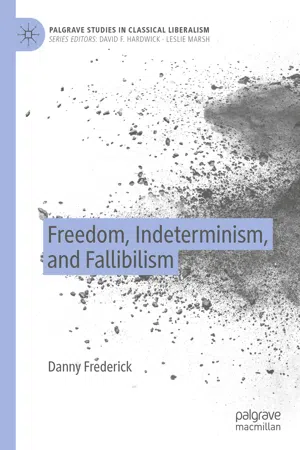
This book uses the concepts of freedom, indeterminism, and fallibilism to solve, in a unified way, problems of free will, knowledge, reasoning, rationality, personhood, ethics and politics. Presenting an overarching theory of human freedom, Frederick argues for an account of free will as the capacity for undetermined acts. Knowledge, rationality, and reasoning, both theoretical and practical, as well as personhood, morality and political authority, are all shown to be dependent at their roots on indeterminism and fallibility, and to be connected to individual freedom. Thought-provoking and original, Frederick's theory of freedom examines a broad spectrum of issues, from the distinction between persons and other animals, to the purpose of the state and political authority. Offering a bold and succinct conspectus of the philosophy of freedom, this book makes surprising connections between perennial issues across the field of philosophy.
- English
- ePUB (mobile friendly)
- Available on iOS & Android
eBook - ePub
Freedom, Indeterminism, and Fallibilism
About this book
Information
Topic
PhilosophySubtopic
Ethics & Moral Philosophy© The Author(s) 2020
D. FrederickFreedom, Indeterminism, and Fallibilism Palgrave Studies in Classical Liberalismhttps://doi.org/10.1007/978-3-030-48637-2_11. Introduction
Danny Frederick1
(1)
Independent Scholar, Yeovil, UK
Danny Frederick
This book is concerned with metaphysics, epistemology, ethics and politics. That is a very large area of study for a relatively short book. The aim is plainly not to provide comprehensive coverage. It is instead to connect those different areas of study by solving related problems in each using the concepts of freedom, indeterminism and fallibilism. To put the point another way, the aim is to obtain an understanding of freedom in the round, in its metaphysical, epistemological, ethical and political aspects. The metaphysics of free will (Chap. 2) depends upon the idea of indeterminism; epistemology and rationality (Chap. 3) depend upon creativity and criticism, which cannot be understood without the ideas of indeterminism and fallibility; the distinction between persons and other animals (Chap. 4) depends upon the ideas of critical rationality and moral agency, and thus on the ideas of freedom, indeterminism and fallibility; morality (Chap. 5) demands both freedom and constraint, so it is also tied to the ideas of indeterminism and fallibility; and the purpose of the state (Chap. 6) is to safeguard freedom, as far as our fallibility permits. Each Chap. of the book gives pointers for the further study of its topic. That further study may, given our fallibility, require some revisions to what is said in this book. The goal here is to provide a unified and coherent account of the different facets of freedom at a high level of generality. The account is novel in its emphasis on indeterminism and fallibilism. It is a curious irony that defences of freedom are often deterministic and dogmatic. That irony is not investigated directly in what follows.
Chapter 2 is concerned with the metaphysical problem of free will. There is a general, though not universal, consensus in contemporary philosophy that indeterministic accounts of free will are incoherent. Some philosophers simply deny that persons have free will, but most seek to show how free will or, rather, some anaemic substitute for it, is compatible with a deterministic account of human behaviour. I show how that consensus is mistaken and how the mistake arises from a simple failure to distinguish acts from other events. I criticise and reject the famous infinite regress arguments of H. A. Prichard and Gilbert Ryle against acts of will; and I expose some confusions or errors about free will to be found in Roderick Chisholm, Donald Davidson, Laura Ekstrom, John Martin Fischer, Harry Frankfurt, Robert Kane, Hugh McCann, Alfred Mele, Robert Nozick, Helen Steward, Richard Taylor and many others.
The topics of Chap. 3 are epistemology and rationality. On the traditional and still current view, rationality is deterministic, either because it compels us, so far as we are rational, to think or act in a particular way, or because it has an authority over us to which we submit, so far as we are rational. As a consequence, on that view, the beliefs and actions of a rational agent are justified. I reject that approach as inconsistent with our fallibility and I criticise the views of Aristotle, Bill Brewer, John Broome, René Descartes, and Christine Korsgaard. Following the lead of Karl Popper, I explain how rationality is critical and I offer an account of deductive reasoning as a process of guessing, testing and freely deciding. I discuss Lewis Carroll’s puzzle about deduction and criticise Ryle’s solution. I summarise Popper’s epistemology to give an account of theoretical reasoning that contrasts with the mainstream. I offer a new account of practical reasoning as guessing and testing and I excoriate contemporary decision theory , particularly its treatment of risk (indeterminism) and uncertainty (fallibilism). I criticise some recent work of Peter Graham, Niko Kolodny and John MacFarlane, and Helen Steward.
In Chap. 4 I discuss the metaphysics and epistemology of personhood. What I say on the metaphysics is broadly in line with traditional philosophers, particularly Immanuel Kant, though updated with insights from Popper and evolutionary biology. Unusually for a discussion of freedom, I give prominence to an organism’s absolute needs. Against Philippa Foot I argue that an organism’s absolute needs depend upon its individual nature, not some hypothesised nature of its species. I show how a person’s possession of critical rationality entails that persons have to discover their individual natures for themselves and that, given their fallibility, they have to proceed by guessing, testing and deciding. To find fulfilment, persons need freedom and thus an open society. I criticise philosophical theories of authenticity, specifically those expounded by Michael Lynch and Charles Taylor.
Chapter 5 deals with ethics. The aims of one person often conflict with the aims of other persons. Moral rules mediate that conflict by permitting individual freedom but setting limits to it. The objective, or factual, set of moral rules is that which sets constraints that allow for persons in general the widest experimentation in quest of personal fulfilment. However, I reject rule consequentialism because fallibility and indeterminism (including free will) mean that consequences cannot be known in advance and that conditions for the widest experimentation in quest of personal fulfilment cannot ensure the best outcome. I consider the different scopes of freedom appropriate to different categories of person and restrictions on persons’ freedom for their own sakes and for the sakes of animals that are not persons, and I discuss deriving ‘ought’ propositions from ‘is’ propositions. I employ Wesley Hohfeld’s scheme to articulate persons’ entitlements to freedom into a set of rights and obligations, thereby showing how freedom requires that resources be, as far as practical, exchangeable private property. I pan James and Stuart Rachels’s denial of moral disagreement.
I venture into political philosophy in Chap. 6, which concerns the obligations owed by the state to persons and vice versa. Collectivist and individualist views of the state are criticised and a third way is proposed. I argue that potential conflicts between persons’ aims and their obligations imply that morality demands a state with the rights and obligations to enforce persons’ obligations to each other, and to impose new obligations on persons for the sake of freedom. I explain briefly how the state evolves rather than being created. An account of persons’ obligations to the state is related to...
Table of contents
- Cover
- Front Matter
- 1. Introduction
- 2. Free Will and Indeterminism
- 3. Rationality and Fallibilism
- 4. Persons and Animals
- 5. Freedom and Constraint
- 6. Individual and State
- 7. Conclusion
- Back Matter
Trusted by 375,005 students
Access to over 1.5 million titles for a fair monthly price.
Study more efficiently using our study tools.
Frequently asked questions
Yes, you can cancel anytime from the Subscription tab in your account settings on the Perlego website. Your subscription will stay active until the end of your current billing period. Learn how to cancel your subscription
No, books cannot be downloaded as external files, such as PDFs, for use outside of Perlego. However, you can download books within the Perlego app for offline reading on mobile or tablet. Learn how to download books offline
Perlego offers two plans: Essential and Complete
- Essential is ideal for learners and professionals who enjoy exploring a wide range of subjects. Access the Essential Library with 800,000+ trusted titles and best-sellers across business, personal growth, and the humanities. Includes unlimited reading time and Standard Read Aloud voice.
- Complete: Perfect for advanced learners and researchers needing full, unrestricted access. Unlock 1.5M+ books across hundreds of subjects, including academic and specialized titles. The Complete Plan also includes advanced features like Premium Read Aloud and Research Assistant.
We are an online textbook subscription service, where you can get access to an entire online library for less than the price of a single book per month. With over 1.5 million books across 990+ topics, we’ve got you covered! Learn about our mission
Look out for the read-aloud symbol on your next book to see if you can listen to it. The read-aloud tool reads text aloud for you, highlighting the text as it is being read. You can pause it, speed it up and slow it down. Learn more about Read Aloud
Yes! You can use the Perlego app on both iOS and Android devices to read anytime, anywhere — even offline. Perfect for commutes or when you’re on the go.
Please note we cannot support devices running on iOS 13 and Android 7 or earlier. Learn more about using the app
Please note we cannot support devices running on iOS 13 and Android 7 or earlier. Learn more about using the app
Yes, you can access Freedom, Indeterminism, and Fallibilism by Danny Frederick in PDF and/or ePUB format, as well as other popular books in Philosophy & Ethics & Moral Philosophy. We have over 1.5 million books available in our catalogue for you to explore.