This book challenges simplified claims of racial, national, and ethnic belonging in music education by presenting diaspora as a new paradigm for teaching music, departing from the standard multicultural guides and offering the idea of unfinished identities for musical creations. While multiculturalism—the term most commonly used in music education—had promised a theoretical framework that puts classical, folk, and popular music around the world on equal footing, it has perpetuated the values of Western aesthetics and their singular historical development. Breaking away from this standard, the book illuminates a diasporic web of music's historical pathways, avoiding the fragmentation of music by categories of presumed origins whether racial, ethnic, or national.
- English
- ePUB (mobile friendly)
- Available on iOS & Android
eBook - ePub
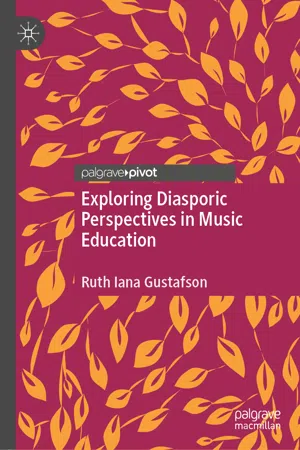
Exploring Diasporic Perspectives in Music Education
About this book
Information
Topic
DidatticaSubtopic
Curricula nella didattica© The Author(s) 2020
R. I. GustafsonExploring Diasporic Perspectives in Music Educationhttps://doi.org/10.1007/978-3-030-52105-9_11. Diaspora: A New Paradigm for Music Education
Ruth Iana Gustafson1
(1)
University of Wisconsin-Madison, Madison, WI, USA
Ruth Iana Gustafson
Abstract
The aim of this chapter is to provide an overview of the concept of diaspora and how it departs from the current framework for the music education curriculum, multiculturalism. The proposed new paradigm avoids the fragmentation of music by categories of origin whether racial, ethnic, or national. The book’s fundamental breakthrough is to illuminate musical contributions submerged in history and to suggest the existence of unknown sources even beyond those that have been granted authenticity by ethnic group, space on the globe, or racial lineage.
Keywords
MulticulturalismDiasporaRaceThe idea for Exploring Diasporic Perspectives in Music Education grew out of my discussions with public school music teachers, university colleagues, and graduate students in music education who are seeking a way to teach without dividing music into categories of national, racial, and ethnic belonging. With over twenty-three years teaching music at all levels of education, I have noted that multiculturalism, cultural diversity, and internationalism have failed to recognize the constant churning of the identities of performers and listeners who have become, in the words of Paul Theroux, “world class practitioners of self-sufficiency” (1997). Or, as Aiwha Ong develops this thought, many participants in a global society find ways to maintain flexible identities created in “specific power contexts” (1999: 5, 19, 68). Music also exhibits flexibility in its identity over time. Change reflects the specific power contexts in which an origin for music becomes a pragmatic way to underline national, ethnic, and racial belonging.
The aim of this book is to upend fixed notions of origin and belonging. From this point of view, so-called origins become unknowns, even while they have been taken for granted as authentically belonging to a particular ethnic group, space on the globe, or racial lineage. By doing so, Exploring Diasporic Perspectives in Music Education departs from the standard multicultural guides. It avoids, as much as possible, the fragmentation of music by categories of presumed origins whether racial, ethnic, or national. The book’s fundamental breakthrough is to illuminate the global web of musical contributions submerged in history and to recognize the high dimensionality of their creation. Central to the diasporic perspective are the questions of how and why particular selections have become multicultural prototypes that purportedly represent African American, Latino, Hispanic, or European music.
Throughout this book I have had to articulate the concept of diaspora in English. This language harbors a system of knowledge or a way of looking at the world through the use of racial, ethnic and national terms. These categories foster racial distinctions and hierarchies, displacing a vast lexicon of words that lead to the historic memories of conquered peoples and the diasporic travels of music. A prominent concern in this book is to reveal how a “strange game of words” created the power of distinction among bodies and music that set them along the paths we now recognize as “reality” (Rancière 2004: 3): e.g., racial, ethnic, and national trajectories. The formation of rhetoric around multiculturalism gives music education considerable, but not total power over the intermixture of flesh and culture that produces music. Music education, like its academic siblings, undergoes continual revision of theories and methods. Change occurs through research and publication, but most notably, through the classroom practices of more than 13,000 school districts in the United States. When it comes to the general music curriculum, the terms “multiculturalism,” “cultural diversity,” “internationality,” and “superdiversity” boil down to distinguishing musical types by racial, ethnic, and national/geographical “origins.” The word game and the system of knowledge it represents prove more enduring than the reforms we attempt to make.
Today, multiculturalism, the term most commonly used in music education, dominates all levels of music teaching, including instruction and research at the post-secondary level. While multiculturalism has promised to be a theoretical framework that puts classical, folk, and popular music on an equal footing with Euro-American music, it perpetuates Western attitudes of aesthetics and historical development. For example, approaches to music teaching represented in the professional literature have, by and large, established the domain of folk music, especially of the Southern Hemisphere. This category sequesters the folk in past times and pre-modern societies. Exploring Diasporic Perspectives argues that recognition of the historical process of fabricating origins, whether racial, ethnic, regional, folkloric, or hybrids of these categories, allows consideration of the idea of unfinished identities for musical creations.
One of the aims of this book is to investigate the emergence of multiculturalism in music education. This requires an analysis of the field from the early 1800s to public music instruction as it now stands. Throughout the following chapters, I argue that multiculturalism derived from the overarching social and governmental principle of the whiteness of the nation and the type of culture understood to be consistent with a civilized society. Caught up with the rhetoric of civilization, musicians and audiences engage with music as a racially inflected entity (Radano 2003). Race has been a major consideration in the design of the music curriculum from its earliest days to the present (Gustafson 2009).
My experience supervising future music educators and classroom observations brought me to investigate music education’s racial foundations. By no means do I understand this foundation to be unique to our field. One of several key incidents that piqued my curiosity took place in a high school general music class. The class had viewed the movie “Showboat.” After the film, the teacher asked a sophomore student to identify an “African American” song he had heard in the performance. He picked out “Ol’ Man River.” The teacher concurred with his choice. Another student, however, raised her hand to comment, “Before the movie you [the teacher] said that the songs were written by famous composers.” “Yes,” the teacher answered, “the words and music were written by Jerome Kern and Oscar Hammerstein who were white. It was sort of their view of black singing at the time.” This was as far as the class went into the fraught history of the creation of “Ol’ Man River.”
The incident left me wondering if a different point of view with a more persistent focus on the social exchanges between so-called African American music and European music within the entertainment industry would better explain the source(s) of “Ol’ Man River.” A more complex view would consider how popular interest in minstrel performances and Negro Spirituals circulated throughout the concert and entertainment world in the first half of the twentieth century. Both genres added to the fanciful link between black music and notions of enslaved peoples’ innate spiritual loftiness. As Ronald Radano writes of black music, it is, among other things, an object with the power to mirror race relations in the United States (2003). The point is that a fuller account of sources for “Ol’ Man River” would include the common, yet imaginary, idea of slavery as an ennobling experience. It would also include the inextricable but little-known musical ties forged over centuries of African and European migrations to North America as well as the racial stereotypes generated from Broadway, concert stage, and film imported into music classrooms. Similar dynamics have compelled Latino, Spirituals, Gospel, Reggae, Mariachi, Gaucho, and European classical music to assume the mythic origin of representing nations, races, and ethnic groups in music teahing. Thus, I have allotted a large portion of this book to understanding the fabrication of music’s origins. Among the subjects covered are Sub-Saharan tribal and popular music and gypsy/flamenco entertainment in modern Spain.
The process of fabricating origins has lent “authenticity” to the already-heated narratives around national, racial, and ethnic conflicts. By focusing on the historical construction of the lineages of the genres mentioned above, Exploring Diasporic Perspectives investigates how racial and national identities emerge from particular political and social conditions and not from inherited dispositions. Thus, I recognize that there is an inherent tension between a multicultural approach that assigns a kind of “ownership” to music and a diasporic perspective which complicates ties between music and particular demographic groups. In this book, I hope to answer the questions of how music education arrived at this point and how a diasporic perspective will help navigate this dilemma.
The first chapters of the book establish how it came to be that music educators are inheritors of the Enlightenment of the Sixteenth, seventeenth, and eighteenth centuries. From this point of view, whether we locate music in the West, the Global North, South, or Euro-America, music is identified as the product of human types. The Enlightenment spawned a comparative logic in which the rubrics of race, nation, and ethnicity were persuasive ways of understanding differences in music, knowledge, religion, and culture in general. This book urges music educators to explore diaspora as a paradigm that rejects comparative scales based on race, nation, and ethnicity on the grounds that these categories are philosophically and historically inaccurate and that they perpetuate inequality. One caveat: diaspora does not fully solve the problem. As a proposal for change it is subject to the uncertainty of the very reason it projects for the future (Popkewitz 2008: i–xv).
Curriculum guides (local or national), generally products of academic music education, have bolstered notions of fixed and comparable music origins. For example, a foundational principle in college music study recommends knowledge of significant musical links between two or more pieces from distinct musical cultures to indicate competence in music appreciation and history (College Music Society 2017). Exploring Diasporic Perspectives in Music Education argues that the concept of distinct cultures overlooks the formation of music on a global scale. By asking how institutions came to see links between distinct musical cultures as a mark of competence, I hope to shed light on the global economic and political forces that made race, ethnicity, and nation a cornerstone of musical knowledge.
An article from the late twentieth century on urban music education published by the Music Educators Journal typifies thinking in the early decades of multiculturalism when race and cultural background imply innate differences in taste and social context. In “Music for the Black Ghetto Child,” Bennet Reimer, noted author of music textbooks and several books on the philosophy of music education stated, “Within the general goal of making a great diversity of music available for freedom of choice, the actual music used will...
Table of contents
- Cover
- Front Matter
- 1. Diaspora: A New Paradigm for Music Education
- 2. The Racial Legacy of the Enlightenment: Early Vocal Instruction, Music Appreciation, and Multiculturalism
- 3. Folk Music and Dance: Imaginary Images of Modern Nationhood
- 4. Fictions of Origin: Music Appreciation, Multiculturalism, and World Music
- 5. Conundrums of Latin/American Music and National Belonging
- Back Matter
Trusted by 375,005 students
Access to over 1.5 million titles for a fair monthly price.
Study more efficiently using our study tools.
Frequently asked questions
Yes, you can cancel anytime from the Subscription tab in your account settings on the Perlego website. Your subscription will stay active until the end of your current billing period. Learn how to cancel your subscription
No, books cannot be downloaded as external files, such as PDFs, for use outside of Perlego. However, you can download books within the Perlego app for offline reading on mobile or tablet. Learn how to download books offline
Perlego offers two plans: Essential and Complete
- Essential is ideal for learners and professionals who enjoy exploring a wide range of subjects. Access the Essential Library with 800,000+ trusted titles and best-sellers across business, personal growth, and the humanities. Includes unlimited reading time and Standard Read Aloud voice.
- Complete: Perfect for advanced learners and researchers needing full, unrestricted access. Unlock 1.5M+ books across hundreds of subjects, including academic and specialized titles. The Complete Plan also includes advanced features like Premium Read Aloud and Research Assistant.
We are an online textbook subscription service, where you can get access to an entire online library for less than the price of a single book per month. With over 1.5 million books across 990+ topics, we’ve got you covered! Learn about our mission
Look out for the read-aloud symbol on your next book to see if you can listen to it. The read-aloud tool reads text aloud for you, highlighting the text as it is being read. You can pause it, speed it up and slow it down. Learn more about Read Aloud
Yes! You can use the Perlego app on both iOS and Android devices to read anytime, anywhere — even offline. Perfect for commutes or when you’re on the go.
Please note we cannot support devices running on iOS 13 and Android 7 or earlier. Learn more about using the app
Please note we cannot support devices running on iOS 13 and Android 7 or earlier. Learn more about using the app
Yes, you can access Exploring Diasporic Perspectives in Music Education by Ruth Iana Gustafson in PDF and/or ePUB format, as well as other popular books in Didattica & Curricula nella didattica. We have over 1.5 million books available in our catalogue for you to explore.