This book draws on the author's experience as a storyteller, drama practitioner and researcher, to articulate an emerging dialogic approach to storytelling in participatory arts, educational, mental health, youth theatre, and youth work contexts. It argues that oral storytelling offers a rich and much-needed channel for intergenerational dialogue with young people.
The book keeps theory firmly tethered to practice. Section 1, 'Storyknowing', traces the history of oral storytelling practice with adolescents across diverse contexts, and brings into clear focus the particular nature of the storytelling exchange and narrative knowledge. Section 2, 'Telling Stories', introduces readers to some of the key challenges and possibilities of dialogic storytelling by reflecting on stories from the author's own arts-based practice research with adolescents, illustrating these with young people's artistic responses to stories. Finally, section 3, 'Story Gaps', conceptualises dialogic storytelling by exploring three different 'gaps': the gap between storyteller and listener, the gaps in the story, and the gaps which storytellers can open up within institutions.
The book includes chapters taking a special focus on storytelling in schools and in mental health settings, as well as guided reflections for readers to relate the issues raised to their own practice.
C. HeinemeyerStorytelling in Participatory Arts with Young PeoplePalgrave Studies In Play, Performance, Learning, and Developmenthttps://doi.org/10.1007/978-3-030-40581-6_1
John arrived as a new inpatient atMaple House, a residential mental health unit for adolescents, with a certain amount of drama. When I came in a few days later and met him for the first time, I couldn’t work out why the atmosphere was so charged, but got on with my weekly workshop. Not many young people wanted to join in any organised activities at that time, preferring to linger around the day room.
So I sat with a small group, including John. Our city had recently been badly flooded, so I told them some flood myths, and we searched through newspapers for stories of local people’s almost equally epic experiences, noting them down as sketches and words on a roll of paper. John was particularly struck by the story of one elderly man for whom the flooding had been a boon, because the insurance money enabled him to carry out much-needed disability adaptations to his house. ‘There are always silver linings in life,’ he said, and showed me a ‘positive newspaper’ he had been writing in his free time for other inpatients.
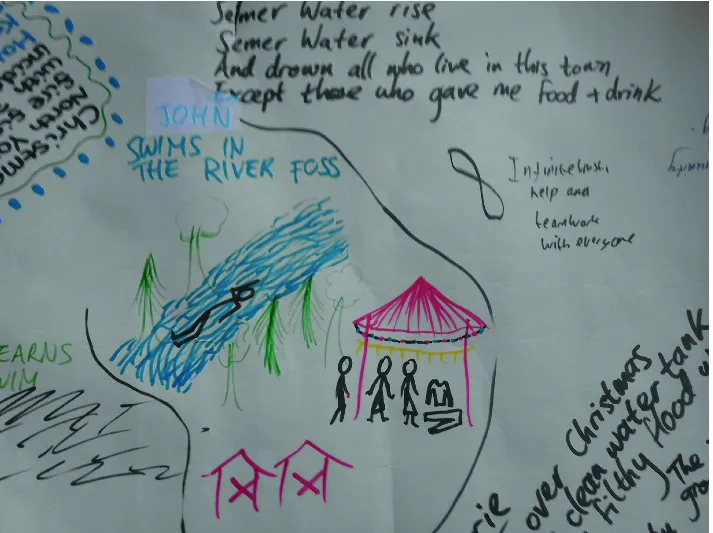
I asked the group if they had any personal watery memories which they wanted to add into the collage, and John erupted into laughter. He told me he had been so distressed on one of his first nights in the unit that he had absconded. He had run through the woods in the rain, swum through the swollen river and ended up, freezing, wounded and bedraggled, in a housing estate, where he had gone knocking from door to door looking for someone to help him. He was eventually invited in by two women who bandaged and cared for him, and returned him to the unit. Two days later the unit was still reeling from the incident. John himself, however, couldn’t believe the two women had been so welcoming to an alarming-looking stranger, and wished he could meet and thank them. Not only had they helped him practically, but the experience had suggested to him the idea of what he called an ‘infinite circle of trust’: ‘The ideal thing would be if everyone trusted each other, a circle of trust, then everything would work brilliantly in life.’ A few other young people and staff then contributed their own stories of the floods (Image 1.1).
Image 1.1
Reflection sheet for John’s legend of swimming
The following week, after gazing at the collage, John and another boy were keen to perform their stories to a group of non-participating young people, and we created a ‘stage set’ for them. John’s retelling was commanding and vivid. I pointed out that it incorporated striking parallels with the ‘Legend of Semerwater’ I had told the group, in which an old woman goes from door to door seeking food and shelter in a valley. No-one but a poor couple high up on the hillside will take her in, and she curses the valley-dwellers with a terrible flood. It was almost as if John were emphasising the parallels, mythologizing his own experience. It had become a legend.
The rest of the group was gripped and, when I asked whether he would like to use the story as the starting point for a song, they encouraged him. It turned out that he was a keen lyricist, and another young man admitted to playing the guitar. John’s enthusiasm was infectious and soon almost all the inpatients were involved, playing instruments and singing the repeating chorus in his song, which featured his message of ‘the circle of trust’. The following week they performed it as a group for all the staff and discussed sending it into the local radio station, which was running a series on mutual aid during the post-flooding period.
Maple House staff could easily have objected to such a celebration of what was essentially miscreant behaviour, related to John’s illness. They also could have discouraged him from discussing his clinical history publicly. Instead, they allowed themselves to be surprised. They saw how John and his legend were bringing other young people back, at least temporarily, into an optimistic engagement with what the unit had to offer.
Storytelling and Adolescents?
Listening to and telling stories has almost certainly always played a vital role in young people’s lives, enabling them to explore their values, learn from the life experiences of others, negotiate their changing social roles and relationships, shape and be shaped by the world around them.
It is even possible to argue that storytelling is the especial property of young people between childhood and adulthood. On a grand scale, narrative psychologist Dan McAdams (1993) suggests that a key challenge of adolescence is to become a mythmaker of one’s own life, to make sense of one’s own role in the world through story. On a more pragmatic, everyday level, Mike Wilson observes that teenagers tell stories informally and skilfully to fulfil a wide variety of personal and cultural agendas:
For teenagers, storytelling is an essential and integral part of the process of social interaction and as such is absorbed into everyday communicative practices […]. (1997: 185)
As Wilson points out, young people’s storytelling is not limited to break time gossip and ghost stories at sleepovers; they are often adept in a wide range of genres, from urban myth to family lore to personal experience, and their repertoire (just like that of adults) is nourished by film, music, literature and television. Subcultures of young people continue to develop their own manifestations of storytelling, such as hip hop and spoken word, drawing on diverse cultural influences. In our increasingly networked society, vlogging, Instagram and other social media allow young people to ‘tell their own stories’ with increasing agility, bypassing adult-dominated mainstream media and making their mark on the publics they wish to influence (Boyd 2014).
We might take from this that nothing needs to be done to develop or nurture storytelling practices among young people, and suspect that they neither need nor want stories told by adults. We may perceive sitting and listening to a story as a role for young children, and adolescents as too challenging, too unwilling to be enchanted, too absorbed in media culture, to enter into it. The traditional oral storytelling exchange seems to belong to smoky cottages or campfires.
We might also ask what stories we have that are of use or interest to young people. The adolescent experience has changed so rapidly that even younger adults’ memories of teenage years seem alarmingly dated, making us anxious that our own life experience may be irrelevant to young people.
We may even worry about the risk of overemphasising narrative at all. Generally speaking, our culture seems well aware of the importance of storytelling these days. Advertisers tell a brand’s story; heritage sites ‘uncover hidden stories’; foreign correspondents focus their reportage on the case study of a single family; and politicians tell stories in place of facts, with alarming consequences for democracy. We are starting to get rightly worried, in fact, that stories told from different perspectives are starting to replace the search for truth. Enough already with all the storytelling!
It is striking, therefore, that there does exist a wide range of storytellers, arts practitioners, teachers, mental health professionals, youth workers and socially engaged researchers, who consciously choose to tell and listen to stories with adolescent young people. Very little of this storytelling takes place around campfires, and much of it crosses boundaries of genre, the written and spoken word, the digital and sensory worlds. Their motivations are as varied as their approaches. In US middle and high schools, Kevin Cordi develops ‘storytelling troupes’ who perform to fellow students to expand pupils’ opportunities for self-expression and creativity (Cordi 2003); on a deprived housing estate in Glasgow, the Village Storytelling Centre (2018) hosts storytelling clubs for secondary school pupils and young carers; volunteer storytellers at Belfast’s Fighting Words project support groups of students to develop their own original stories through both the spoken and written word (Young at Art 2018). The Scottish social enterprise Real Talk facilitates personal storytelling evenings, attended mostly by young people, to enable people to share their experiences of mental ill health (Real Talk 2018); theatre practitioners at the Freedom Theatre in Palestine tell fantastical stories to provide alternative imaginative playgrounds to young people whose everyday lives are fenced in by barbed wire and checkpoints. Participatory filmmakers Inspired Youth (2015) work with young ‘experts by experience’ to make films which explore issues such as the needs of young carers, often curating fictionalised narratives based on the true stories of participant-filmmakers. Theatre troupe Company Three (2020) publish ‘blueprints’, rather than scripts, for plays for young actors to perform, incorporating stories they gather themselves; The Verbatim Formula (undated) facilitates workshops in which looked-after and care-experienced young people swap their own stories and then reshape them to create verbatim theatre.
All of the above might be considered what Walter Benjamin (1973) called ‘sailor storytellers’—visitors to a setting from distant lands, whether the distance is geographical or social. Perhaps even more significant is the endurance of those he called ‘farmer storytellers’, people who work within settings every day and weave their storytelling into the texture of their working practice there. Beneath the notice of any funders or even perhaps of their employers, some secondary teachers stray from their lesson plans and stated learning objectives to respond to a pupil’s slightly left-field question with a story of something they once saw or read. Countless health professionals, probation and housing officers share anecdotes from their own past with their clients, to build trust, or to guide them through situations they are facing.
Whether they name their work as storytelling or not, all these people sense or realise that conversation conducted through the medium of narrative enables a qualitatively different kind of understanding. It is an alternative track to mutual comprehension, providing a parallel path when the usual means of communication with young people are blocked or congested. Arthur Frank (1995) suggests that storytelling is a means of putting one’s experience and one’s self at the service of one’s listener—of ‘being for the Other’, in Zygmunt Bauman’s words (1993). In that sense, these diverse storytellers are making themselves genuinely available to adolescents in their storytelling encounters with them, in a way that everyday professional interactions may not allow.
There is, however, very little articulate exploration of storytelling practice with this age group, or guidance as to its potential as anopen-ended practice. Where storytelling is ‘used’ and documented within, e.g., mental health, education or criminal justice, it is often assessed narrowly on its success in achieving pre-specified behavioural or attitudinal outcomes: perhaps to decrease repeat offending, or to raise awareness of a health issue. This is not only a limited view—it shows a misunderstanding of the very way that story works. Communication through storytelling is always unpredictable, unruly; it is a process of intuitive negotiation between two or more minds. A storyteller may think she has presented an epic which explores the need for tolerance, until she is faced with a barrage of questions as to the fate of the sick dog in the first scene. What listeners take away from a story is, ultimately, u...
Table of contents
Cover
Front Matter
Part I. Storyknowing
Part II. Telling Stories
Part III. Story Gaps
Back Matter
Trusted by 375,005 students
Access to over 1.5 million titles for a fair monthly price.
Study more efficiently using our study tools.
Frequently asked questions
Yes, you can cancel anytime from the Subscription tab in your account settings on the Perlego website. Your subscription will stay active until the end of your current billing period. Learn how to cancel your subscription
No, books cannot be downloaded as external files, such as PDFs, for use outside of Perlego. However, you can download books within the Perlego app for offline reading on mobile or tablet. Learn how to download books offline
Perlego offers two plans: Essential and Complete
Essential is ideal for learners and professionals who enjoy exploring a wide range of subjects. Access the Essential Library with 800,000+ trusted titles and best-sellers across business, personal growth, and the humanities. Includes unlimited reading time and Standard Read Aloud voice.
Complete: Perfect for advanced learners and researchers needing full, unrestricted access. Unlock 1.5M+ books across hundreds of subjects, including academic and specialized titles. The Complete Plan also includes advanced features like Premium Read Aloud and Research Assistant.
Both plans are available with monthly, semester, or annual billing cycles.
We are an online textbook subscription service, where you can get access to an entire online library for less than the price of a single book per month. With over 1.5 million books across 990+ topics, we’ve got you covered! Learn about our mission
Look out for the read-aloud symbol on your next book to see if you can listen to it. The read-aloud tool reads text aloud for you, highlighting the text as it is being read. You can pause it, speed it up and slow it down. Learn more about Read Aloud
Yes! You can use the Perlego app on both iOS and Android devices to read anytime, anywhere — even offline. Perfect for commutes or when you’re on the go. Please note we cannot support devices running on iOS 13 and Android 7 or earlier. Learn more about using the app
Yes, you can access Storytelling in Participatory Arts with Young People by Catherine Heinemeyer in PDF and/or ePUB format, as well as other popular books in Media & Performing Arts & Teaching Arts & Humanities. We have over 1.5 million books available in our catalogue for you to explore.