eBook - ePub
Understanding Urbanism
- English
- ePUB (mobile friendly)
- Available on iOS & Android
eBook - ePub
Understanding Urbanism
About this book
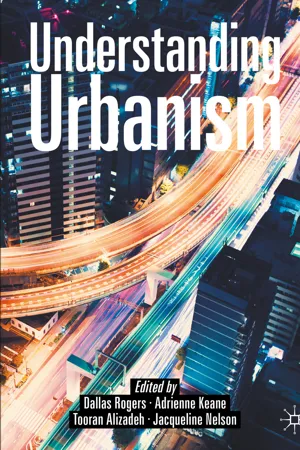
Understanding Urbanism presents built environment students with the latest approaches to studying urbanism. The book is written in an accessible and easy-to-understand format by leading urban academics and practitioners with decades of teaching and practical experience. As students move through the chapters, they will develop a critical understanding of the different ways architects, urban and social planners, urban designers, heritage professionals, engineers and other built environment professionals design our cities. Importantly, the book shows how and why the built environment professional of the future will need to work within the Indigenous context of cities in countries like Australia, New Zealand, the United States and Canada.
Information
Topic
Scienze socialiSubtopic
Geografia umana© The Author(s) 2020
D. Rogers et al. (eds.)Understanding Urbanismhttps://doi.org/10.1007/978-981-15-4386-9_11. Understanding Urbanism
Dallas Rogers1
(1)
School of Architecture, Design and Planning, University of Sydney, Darlington, NSW, Australia
Abstract
By 2050 almost 70 per cent of the world’s people are predicted to live in cities. This chapter begins with a discussion about the difference between urbanisation and urbanism, and suggests that it is at the intersections of the various definitions of these ideas that the most important discussions about cities take place. The Aboriginal context of urban development in Australia is discussed as a case in point. The substantive sections provide six brief contextual primers for the chapters in this book, covering: (1) professions and practices; (2) morphology and change; (3) scales and agglomerations; (4) infrastructures and services; (5) experiences and cultures; and (6) inquiry and analysis. The conclusion suggests to understand the relationships between the physical form and social function of cities, and how urbanisation makes people, changes places, shifts power relations, creates property or changes cultures requires a very broad range of data collection and analysis tools, as well as a broad sweep of urbanism theory.
1.1 Understanding Urbanism
1.1.1 What Is Urbanisation and Urbanism?
This is a question that has been asked for a very long time, a question that is hard to answer. In his meditations on government, democracy and the ancient Athenian city-state the philosopher Aristotle (384–322 B.C.E) said,
The amalgamation of numerous villages creates a unified city-state, large enough to be self-sufficient or nearly so, starting from the need to survive, and continuing its existence for the sake of a comfortable lifestyle.
As hinted at here by Aristotle, at its most foundational, urbanisation ‘is the increase in the proportion of a population that is urban as opposed to rural’ (Gate and Stout 2011: 15 citing Davis 2011: Davis 1965). Historically, urbanisation was underwritten by immigration from the countryside into the city. This rural to urban migration driver of urbanisation is still largely true today. At the turn of the twenty-first century more than 50 per cent of the world’s people lived in cities. In 2020 that figure had reached 55 per cent, and by 2050 almost 70 per cent of the world’s people are predicted to live in cities (United Nations 2018). Countries with populations over 1 billion people, such as China (1.38 billion) and India (1.34 billion), will be key to global urbanisation. Consider this: when the Peoples’ Republic of China was established in 1949 only 10 per cent of the national population lived in cities (Ren 2013). By 1978, a time of major market reforms, that figure had only reached 20 per cent. But 55 per cent of the national population was urban in 2015 and that figure is predicted to reach 60 per cent by 2030. This ‘demographic’ or ‘population mobility’ definition of urbanisation is a useful starting point for our discussion because it suggests that urbanisation and urbanism are not the same thing.
Urbanism is about what happens inside cities, the form and function of cities, and how cities relate to the rural. It often refers to the study of how inhabitants of urban or urbanising areas interact with the social and built environments of cities. What marks the boundary between the rural and the urban or a town from a city is the topic of an extended and ongoing debate in urban studies (Gate and Stout 2011; Lefebvre 1970/2003). In 1938, Louis Wirth (1938) published Urbanism as a way of life and suggested there were three key urban characteristics: a large population, a high population density, and social heterogeneity. Wirth proposed with his universal social theory of the city that the complex phenomena of urbanism could be understood through an analysis of a limited number of basic categories. ‘A sociologically significant definition of the city’, writes Wirth (1938:190), ‘seeks to select those elements of urbanism which mark it as a distinctive mode of human group life’. Wirth’s idea that ‘urban difference’ rather than ‘rural similarity’ shaped the social relations in the city was a powerful heuristic in its day, even if sociologists and geographers later rejected universal theories of the city like his. From Aristotle to Wirth and beyond, cities have be variously defined and analysed by population density, geographic size, integrated economies with a diversity of goods and services, the proliferation of specific building types or changes in urban form such as high-rise buildings, high population recreational spaces such as stadiums and theatres, new forms of government and urban governance, or the increasing detachment of a population from directly providing their own food and energy needs (Brenner and Schmid 2014; Bounds 2004; Engels 1845; Graham and Hewitt 2013; LeGates and Stout 2011; Lefebvre 1970/2003; Mumford 1961). Cities might also be defined by what they produce, such as housing wealth or inequality, or the forms of pollution, noise, water and food shortages, and other issues and inequalities that are somewhat unique to urban environments.
It is at the intersections and edges of the various definitions and analyses that the most interesting discussions about cities take place. But specificity is important. The architect Alexander D’Hooghe (2010:13) provocatively suggests that ‘urbanism’ today ‘describes the world as it is, and also all its alternatives. Taken this way, it now means everything and its opposite. Such a word does not deserve to exist. It is wholly empty’ (p.13). For the term ‘urbanism’ to have practical utility, then, the build environment professions ‘should not compound urbanism’s attempt to be everything to everyone. It needs narrow-mindedness’ (p.13). As such, we are talking about urbanism in a very narrow way in this book, as a set of concerns and issues associated with the built environment professions (see our six urbanism themes below); concerns that are common to people who study urbanism or practice a built environment profession and call themselves urbanists.
An urbanist might be interested in, for example, how the number of people living in poverty in China fell ‘from 250 million at the start of the reform process in 1978 to 80 million people by the end of 1993 and 29.27 million in 2001’, as people moved into cities to find work and other opportunities (Jacques, 2012, p.162). In Australia, urbanist and Yugembir man, Dillon Kombumerri, a principal architect in the Office of the Government Architect NSW, has been involved in the Sydney Ochre Grid, a ‘mapping project that seeks to connect both Aboriginal and non-Aboriginal communities, building knowledge bridges to enable better planning and design decisions that embrace culture and connection to country’ (Russell 2018:np). Wiradjuri man, Joel Sherwood-Spring and Wiradjuri/Gamilaroi woman, Lorna Monro are centring ‘Indigenous voices amongst multicultural Waterloo residents [a suburb of Sydney on Gadigal land] to critique colonisation and gentrification showing there is a Black History to your flat white’ (Sherwood-Spring and Monro 2018:np). Their work shows how the current gentrification of the Gadigal land at Waterloo is connected to the violent invasion of Aboriginal lands in Sydney by the British (Moreton-Robertson 2015; Indigenous Archives Collective 2018). In all three cases, changes in the built environment and how it is governed were central to the social outcomes of the urban inhabitants.
Thus, the concept of urbanism is linked to the professions associated with the physical and social design and management of urban structures and communities. These professions include urban planning, urban design, architecture, engineering and heritage management. But urbanism is also linked to a range of academic disciplines and fields that are, at least partly, focused on the study of urban life and culture (Lefebvre 1970/2003). These academic disciplines and fields include urban sociology, human geography, urban politics, urban anthropology, architecture, engineering and heritage studies, amongst others.
Urbanism is, therefore, a mode of inquiry—a way of analysing and understanding cities—but it is also a component of built environment practice, and it might even be a component of someone’s identity when they say, ‘I’m an urbanist!’. It is probably clear by now that answering the question what is urbanisation and urbanism? from Aristotle’s ancient Athenian city-state to the megacities of today is beyond the scope of this book. There are just too many definitions, theories, and understandings of urbanism to cover, as well as rigorous debates in the built environment professions about what these concepts mean and how to deploy them to inform built environment work. Being an urbanist requires a lifelong commitment to the study of cities, and this book is an entry point into some of the key ideas you will need to begin your built environment studies. As you work your way through the chapters, you will develop a critical understanding of the different ways in which architects, urban planners, urban designers, heritage professionals, engineers, and other built environment professionals understand and design the urban environment.
In other words, this book is an introduction to some of the key ideas you will need to begin your built environment education—this is the beginning of your learning not the end. Rather than focusing on particular case studies, technical practices or policy and regulatory settings you will be presented with 13 key urbanism ideas. These key urbanism ideas are organised under the following 13 chapter headings: Indigenous Cities, Economic Cities, Planned Cities, Heritage and Cities, Designed Cities, Mobile Cities, Multicultural Cities, Public Cities, Green Cities, Healthy Cities, Digital Cities, Data Science and Cities, and Political Cities. As you can see, each chapter covers a specific theme. There are many ways of dividing up the key ideas for thinking about cities, and the 13 urbanism ideas we selected do not cover all the possible entry points into an analysis of the city. As an urbanist, you should ask yourself what are some of the other ways we could have explored the city; what about gender and cities or queer cities? And while the selection of these 13 urban themes should be a source of continuous debate, we made pragmatic decisions to write this book. As such, our 13 themes will provide you with a foundational knowledge of some of the key themes in urbanism upon which to build more discipline-specific learning throughout your under- and post-graduate studies.
You will see that each chapter follows a common heading structure. Each chapter starts with an Introduction to the urbanism theme, followed by the Key Debates in the urbanism theme and finishes up with a Critical appraisal of the urbanism theme. The chapter structure and learning objectives are outlined in Table 1.1. This common heading structure creates a coherent narrative throughout the book that will help you to navigate and compare the ideas in one chapter against the ideas in other chapters. Furthermore, these 13 urbanism themes have been wri...
Table of contents
- Cover
- Front Matter
- 1. Understanding Urbanism
- 2. Indigenous Cities
- 3. Economic Cities
- 4. Planned Cities
- 5. Designing Cities
- 6. Heritage Cities
- 7. Mobile Cities
- 8. Public Cities
- 9. Multicultural Cities
- 10. Digital Cities
- 11. Data, Science and Cities
- 12. Green Cities
- 13. Healthy Cities
- 14. Political Cities
Trusted by 375,005 students
Access to over 1.5 million titles for a fair monthly price.
Study more efficiently using our study tools.
Frequently asked questions
Yes, you can cancel anytime from the Subscription tab in your account settings on the Perlego website. Your subscription will stay active until the end of your current billing period. Learn how to cancel your subscription
No, books cannot be downloaded as external files, such as PDFs, for use outside of Perlego. However, you can download books within the Perlego app for offline reading on mobile or tablet. Learn how to download books offline
Perlego offers two plans: Essential and Complete
- Essential is ideal for learners and professionals who enjoy exploring a wide range of subjects. Access the Essential Library with 800,000+ trusted titles and best-sellers across business, personal growth, and the humanities. Includes unlimited reading time and Standard Read Aloud voice.
- Complete: Perfect for advanced learners and researchers needing full, unrestricted access. Unlock 1.5M+ books across hundreds of subjects, including academic and specialized titles. The Complete Plan also includes advanced features like Premium Read Aloud and Research Assistant.
We are an online textbook subscription service, where you can get access to an entire online library for less than the price of a single book per month. With over 1.5 million books across 990+ topics, we’ve got you covered! Learn about our mission
Look out for the read-aloud symbol on your next book to see if you can listen to it. The read-aloud tool reads text aloud for you, highlighting the text as it is being read. You can pause it, speed it up and slow it down. Learn more about Read Aloud
Yes! You can use the Perlego app on both iOS and Android devices to read anytime, anywhere — even offline. Perfect for commutes or when you’re on the go.
Please note we cannot support devices running on iOS 13 and Android 7 or earlier. Learn more about using the app
Please note we cannot support devices running on iOS 13 and Android 7 or earlier. Learn more about using the app
Yes, you can access Understanding Urbanism by Dallas Rogers, Adrienne Keane, Tooran Alizadeh, Jacqueline Nelson, Dallas Rogers,Adrienne Keane,Tooran Alizadeh,Jacqueline Nelson in PDF and/or ePUB format, as well as other popular books in Scienze sociali & Geografia umana. We have over 1.5 million books available in our catalogue for you to explore.