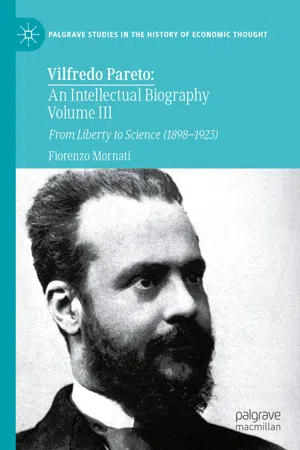
This volume of intellectual biography takes the Italian economist, sociologist, political scientist Vilfredo Pareto (1848-1923) from his disillusionment with liberal and pacifist activism, to the original development of pure economics and the composition of his Treatise on General Sociology and the test of this latter on the war and post-war events.
F. MornatiVilfredo Pareto: An Intellectual Biography Volume IIIPalgrave Studies in the History of Economic Thoughthttps://doi.org/10.1007/978-3-030-57757-5_1
Begin Abstract
1. A New Pure Economics
Fiorenzo Mornati1
(1)
Dipto di Econ e Statistica, University of Turin, Torino, Italy
Manual of Political EconomyTheoretical economicsWalrasTheory of choicePure economics
End Abstract
In the decade following his address at the “Stella” student association in Lausanne and culminating in the publication of the French version of his Manual of Political Economy, Pareto’s conception of theoretical (or “pure”) economics, hitherto constituting an introduction to the field of applied economics which followed broadly in the footsteps of Walras,1 appears to have undergone a definitive and largely self-sustained development which was distinctly original, even if never disconnected from Pareto’s other interests in the social sciences.2 Hence, in this chapter, we will describe his ground-breaking theory of choice (Sects. 1.1 and 1.2) as well as the aspects of the Manual which display innovations in relation to Pareto’s economic thinking of the immediately preceding period (Sect. 1.3). We will then characterise the definitive description of pure economics offered by Pareto (Sect. 1.4) together with a selection of his critical—and self-critical—remarks on the discipline (Sect. 1.5).
1.1 The Beginnings of Paretian Pure Economics: Early References to the Theory of Choice
On the 14th of December 18983 Pareto informed Pantaleoni that for the meeting of the Lausanne student association “Stella” on the following 17th of December, when he was due to be nominated an honorary member,4 he had prepared the paper Comment se pose le problème de l’économie pure (Expounding the pure economics). In this paper he showed “how to circumvent the difficulty arising from the impossibility of measuring ophelimity”. This is recognised as constituting a decisive step forward in the development of Pareto’s theory of utility which was formalised with the abandoning of the always problematical cardinal conception of utility in favour of an ordinal alternative, at least for theoretical purposes. In his paper Pareto affirmed that in order to construct a pure economics, it was necessary, firstly, to conceive the economic characteristic of mankind to be “the pursuit of pleasure and the avoidance of pain”; secondly, to conceive of both pleasure and pain as quantities and, thirdly, to bear in mind that recognising the existence of quantities and actually measuring them are two different things.5
Consequently, Pareto defined pure economics as “a type of rational mechanics” dealing not with points but with homines oeconomici (“economic agents”).6 If one of these agents possesses variable quantities qa and qb of commodities A e B, each possible combination of these quantities “will generate different degrees of utility”.7
Thus, if we are able to measure the separate increases in utility
which the economic agent will obtain in passing from qa to dqa (or similarly from qb to dqb), then ...
Table of contents
Cover
Front Matter
1. A New Pure Economics
2. Arguments in Applied Economics
3. The Definitive Abandonment of Liberal Political Activism
4. The Advance of Socialism and the Obstacles Impeding It
5. A New Sociology
6. The War Seen from Céligny
7. The Post-war Period
8. The Final Phase of Paretology During Pareto’s Lifetime
Back Matter
Trusted by 375,005 students
Access to over 1.5 million titles for a fair monthly price.
Study more efficiently using our study tools.
Frequently asked questions
Yes, you can cancel anytime from the Subscription tab in your account settings on the Perlego website. Your subscription will stay active until the end of your current billing period. Learn how to cancel your subscription
No, books cannot be downloaded as external files, such as PDFs, for use outside of Perlego. However, you can download books within the Perlego app for offline reading on mobile or tablet. Learn how to download books offline
Perlego offers two plans: Essential and Complete
Essential is ideal for learners and professionals who enjoy exploring a wide range of subjects. Access the Essential Library with 800,000+ trusted titles and best-sellers across business, personal growth, and the humanities. Includes unlimited reading time and Standard Read Aloud voice.
Complete: Perfect for advanced learners and researchers needing full, unrestricted access. Unlock 1.5M+ books across hundreds of subjects, including academic and specialized titles. The Complete Plan also includes advanced features like Premium Read Aloud and Research Assistant.
Both plans are available with monthly, semester, or annual billing cycles.
We are an online textbook subscription service, where you can get access to an entire online library for less than the price of a single book per month. With over 1.5 million books across 990+ topics, we’ve got you covered! Learn about our mission
Look out for the read-aloud symbol on your next book to see if you can listen to it. The read-aloud tool reads text aloud for you, highlighting the text as it is being read. You can pause it, speed it up and slow it down. Learn more about Read Aloud
Yes! You can use the Perlego app on both iOS and Android devices to read anytime, anywhere — even offline. Perfect for commutes or when you’re on the go. Please note we cannot support devices running on iOS 13 and Android 7 or earlier. Learn more about using the app
Yes, you can access Vilfredo Pareto: An Intellectual Biography Volume III by Fiorenzo Mornati, John Paul Wilson in PDF and/or ePUB format, as well as other popular books in Economics & Econometrics. We have over 1.5 million books available in our catalogue for you to explore.