This book is the first major work to explore the utility of the border as a theoretical, methodological, and interpretive construct for understanding colonial public health by considering African experiences in the Zimbabwe-Mozambique borderland. It examines the impact of colonial public health measures such as medical examinations/inspections, vaccinations, and border surveillance on African villagers in this borderland. The book asks whether the conjunction of a particular colonized society, a distinctive kind of colonialism, and a particular territorial border generated reluctance to embrace public health because of certain colonial circumstances which impeded the acceptance of therapeutic alternatives that were embraced by colonized people elsewhere. It asks historians to look elsewhere for similar kinds of histories involving racialized application of public health policies in colonial borderlands.
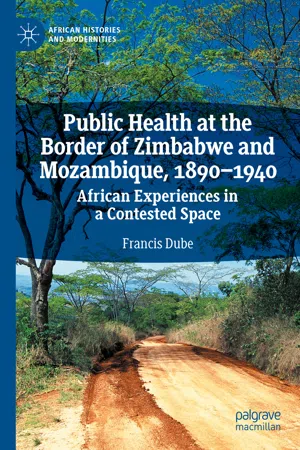
eBook - ePub
Public Health at the Border of Zimbabwe and Mozambique, 1890–1940
African Experiences in a Contested Space
- English
- ePUB (mobile friendly)
- Available on iOS & Android
eBook - ePub
Public Health at the Border of Zimbabwe and Mozambique, 1890–1940
African Experiences in a Contested Space
About this book
Information
Topic
HistoriaSubtopic
Historia africana© The Author(s) 2020
F. DubePublic Health at the Border of Zimbabwe and Mozambique, 1890–1940African Histories and Modernitieshttps://doi.org/10.1007/978-3-030-47535-2_11. Introduction
Francis Dube1
(1)
Department of History, Geography, and Museum Studies, Morgan State University, Baltimore, MD, USA
Keywords
BorderColonial ruleLow compliancePublic healthThe 2014–2015 Ebola epidemic in West Africa highlighted the trans-border nature of epidemics, created in part by the movement of people across borders, and the challenges posed by trans-border coordination of surveillance. Yet this is by no means a new challenge. Portuguese and British colonial governments in Southern Africa, for instance, also dealt with the same public health challenges posed by a common border. The border and the fear of diffusion of diseases it generated contributed to the evolution and implementation of discriminatory public health programs among the Shona people of the Mozambique (Portuguese East Africa)-Zimbabwe (Rhodesia/Southern Rhodesia) border region where mobility was the norm.1 In this region, mobility was the norm because of environmental diversity and kinship connections, which prompted the need for villagers to access resources that lay across the border and to visit kin.2 For the colonial governments, cross-border movements of people, livestock, and wildlife heightened fears of disease diffusion, which affected health and economic productivity. These administrations therefore implemented invasive public health measures, including border controls, compulsory quarantine, medical inspections or examinations, surveillance measures, vaccinations, as well as colonial suppression of indigenous healing practices. Yet, for African villagers and migrants, the border crossing was a crucial part of their livelihood. Africans therefore contested the colonial governments’ public health policies on border restrictions and surveillance. Public health at the border became an area of contestation because of the discriminatory implementation of public health measures and the particularly oppressive nature of settler colonialism, which conspired to make life difficult for Africans. This ultimately contributed to low compliance with invasive aspects of colonial public health and medicine. This contestation of the border and public health by Shona villagers, town dwellers, and migrants served as a powerful force in the constitution of colonial power.3 Hence, by focusing on the contestation of public health at the border, Public Health at the Border explores the utility of the border as a theoretical, methodological, and interpretive construct for understanding colonial public health.
The Zimbabwe-Mozambique border was particularly significant for health, given that cattle disease scares of the turn of the twentieth century, such as East Coast Fever, among others, show how Rhodesians regarded Portuguese East Africa as a reservoir of infection and regarded the Portuguese themselves as incompetent guardians of colonial health.4 Hence, this anti-Latin prejudice on the part of British in Zimbabwe was a factor that made this particular border appear especially dangerous for public health.
Apart from this colonial rivalry, this historical and cultural context also demonstrates how the conjunction of a particular colonized society, a distinctive kind of colonialism and a particular territorial border, generated reluctance to embrace public health. The border led to the disruption of networks of interdependence, not only economic, but those of kinship in particular. This adversely affected African health, given the fact that decisions about therapy alternatives in many precolonial African societies were made collectively by groups of kin.5 Some of these Africans in turn challenged colonial public health decisions on who or what could cross the border and when to cross the border and under what circumstances. Thus, certain colonial circumstances impeded the acceptance of therapeutic alternatives that were in fact embraced by colonized people elsewhere.
Public health implies the duty of government to provide for the health of its citizens, a situation which many believe has never been fully realized in Africa.6 More specifically, public health is the science and art of disease prevention, prolonging life, and fostering physical health and efficiency through organized community efforts.7 Such efforts are generally preventive in nature and they include sanitation, control of contagious infections, hygiene education, early diagnosis and preventive treatment, and maintenance of adequate living standards. Public health interventions require an understanding not only of epidemiology, nutrition, and antiseptic practices but also of social science. However, in colonial Zimbabwe and Mozambique, one essential component of public health, education, was largely absent. Many Shona people of the border region only remember being forced to submit to public health measures without any clear explanation of the purpose of such measures. In view of the fact that they were more coercive than they were persuasive, colonial medical services did little to stimulate changing idioms for comprehending suffering.8 This also reflects the pitfalls of not implementing organic ideas and the overreliance on health care policies developed in Europe and linked to the process of capital accumulation and political domination.9 This oppressive nature of colonial medicine extended all the way to the colonial apparatus involved in the manufacture and application of drugs, for example, Lomidine, a drug that the French forced on Africans in their territories, which was later found to be ineffective in preventing trypanosomiasis.10
Public health interventions limited people’s freedoms of movement, association, and choices of therapies and medical providers and included a host of other dehumanizing effects which were not limited to colonial subjects.11 Nevertheless, what made the colonial situation unique were questions over the legitimacy of colonial authority and the discriminatory nature of public health programs. In the Zimbabwe-Mozambique border region, these also included colonial repression of indigenous healing practices and values which conveyed and reinforced underlying ideas about health and healing. For Africans, therefore, the blatant refutation of these values constituted “cultural disinheritance.”12 As a result, these indigenous healing practices survived because Africans selectively absorbed and adapted elements of Western biomedicine which appeared useful, just in the same way Europeans internalized some elements of indigenous healing practices.13
Questions on the legitimacy of oppressive settler colonial governments, replete with massive land dispossession, forced labor, excessive taxes, and restrictions on movement, among other things, contributed to a lack of trust in colonial institutions and consequently low or noncompliance with public health among the Shona. In the recent past, noncompliance has been used to refer to the measurement of sub-optimal uptake of medical treatment due to a patient’s resistance, ignorance, or cultural beliefs, and characteristics of the disease.14 However, Paul Farmer, looking at the failure of tuberculosis treatments in Haiti, has challenged placing the blame on a patient’s beliefs and attitudes. He argues that what are at play are often times “structural barriers” to treatment, such as lack of access to medical care, medical infrastructure, and income.15 My usage of this term acknowledges the failure of therapy as a result of both material barriers and cultural factors, but goes beyond therapy intake to include all forms of “everyday resistance” or reluctance to accept biomedical practices, akin to what James Scott has called “weapons of the weak.”16
Building upon Paul Farmer’s concept of structural inequality, Elisha Renne has emphasized the fact that effective public health compliance requires trust in government in her vivid comparison of polio eradication efforts in Northern Nigeria and Northeastern Ghana. She notes that Northern Nigerian parents’ lack of faith in national health institutions and international public he...
Table of contents
- Cover
- Front Matter
- 1. Introduction
- Part I. Life and Health Before the Border
- Part II. Life and Health with the Border
- Part III. The Border and Public Health
- Back Matter
Trusted by 375,005 students
Access to over 1.5 million titles for a fair monthly price.
Study more efficiently using our study tools.
Frequently asked questions
Yes, you can cancel anytime from the Subscription tab in your account settings on the Perlego website. Your subscription will stay active until the end of your current billing period. Learn how to cancel your subscription
No, books cannot be downloaded as external files, such as PDFs, for use outside of Perlego. However, you can download books within the Perlego app for offline reading on mobile or tablet. Learn how to download books offline
Perlego offers two plans: Essential and Complete
- Essential is ideal for learners and professionals who enjoy exploring a wide range of subjects. Access the Essential Library with 800,000+ trusted titles and best-sellers across business, personal growth, and the humanities. Includes unlimited reading time and Standard Read Aloud voice.
- Complete: Perfect for advanced learners and researchers needing full, unrestricted access. Unlock 1.5M+ books across hundreds of subjects, including academic and specialized titles. The Complete Plan also includes advanced features like Premium Read Aloud and Research Assistant.
We are an online textbook subscription service, where you can get access to an entire online library for less than the price of a single book per month. With over 1.5 million books across 990+ topics, we’ve got you covered! Learn about our mission
Look out for the read-aloud symbol on your next book to see if you can listen to it. The read-aloud tool reads text aloud for you, highlighting the text as it is being read. You can pause it, speed it up and slow it down. Learn more about Read Aloud
Yes! You can use the Perlego app on both iOS and Android devices to read anytime, anywhere — even offline. Perfect for commutes or when you’re on the go.
Please note we cannot support devices running on iOS 13 and Android 7 or earlier. Learn more about using the app
Please note we cannot support devices running on iOS 13 and Android 7 or earlier. Learn more about using the app
Yes, you can access Public Health at the Border of Zimbabwe and Mozambique, 1890–1940 by Francis Dube in PDF and/or ePUB format, as well as other popular books in Historia & Historia africana. We have over 1.5 million books available in our catalogue for you to explore.