In the Anthropocene age there is a need for unifying the relationships between people, planet and technology, their interactions, experiences and impacts across ecosystems. In response to this need, this book introduces unifying bridging concepts informational waves and transdisciplinary resonance towards producing shared understanding. This book also presents emerging methods for transdisciplinary projects focusing on moments, paradoxes and dialogues for digital social innovation and sustainable development partnership goals for improving quality of life.
Shared understanding is about how people from different fields and perspectives are communicating, curating, embodying, intuiting and reflecting on shared responsibilities within social ecologies. As a guide to co-designing for information experiences that create meaningful moments of shared understanding, the author illuminates essential transferable, lateral mindsets andsoft skills: knowing the gaps through imagination, creativity, listening and noticing, and bridging the gaps through problem emergence, multiple stakeholders, informed learning and personal change.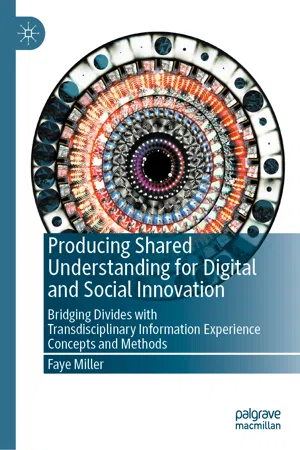
eBook - ePub
Producing Shared Understanding for Digital and Social Innovation
Bridging Divides with Transdisciplinary Information Experience Concepts and Methods
- English
- ePUB (mobile friendly)
- Available on iOS & Android
eBook - ePub
Producing Shared Understanding for Digital and Social Innovation
Bridging Divides with Transdisciplinary Information Experience Concepts and Methods
About this book
Information
Topic
DidatticaSubtopic
Didattica generale© The Author(s) 2020
F. MillerProducing Shared Understanding for Digital and Social Innovationhttps://doi.org/10.1007/978-981-15-7372-9_11. Prologue
Faye Miller1
(1)
Research and Career Development Consultancy, Human Constellation Pty Ltd, Canberra, Australia
Keywords
Shared understandingTransdisciplinary knowledge productionSustainable developmentDigital social innovationRetrofuturistic
The first time I ever saw a live and spinning zoetrope—a pre-cinematic animation device—was on a visit to the Exploratorium Museum of Science, Art and Human Perception on San Francisco’s Pier 15, in March 2017. Derived from the Greek words zoe, meaning “life”, and tropos meaning “turning”, a zoetrope is also known as a “wheel of life”.
This was my first “live” zoetrope experience because as a child I had seen a static zoetrope in a detailed, illustrated entry about how motion pictures were made, in a leather-bound antique encyclopedia volume by Arthur Mee. As Mee’s encyclopedias for children were published in mid-twentieth-century Europe, it is likely that I am in the minority of millennials who have ever heard of Mee’s encyclopedia. I remember being fascinated by countless entries that naturally unified the natural sciences, social sciences, humanities and arts, spanning across several volumes.
Most school teachers said that the information held in those books was quite archaic, and that I should have consulted the latest Britannica CD-ROM or even the pre-Google search engine AltaVista in the mid-1990s wave of the World Wide Web. But browsing these newer resources felt mechanical and limited. They were devoid of the fusing of ethical and humanist wisdom and wonder, alongside scientific proofs.
Over knowing what we know, these classical texts inspired us to place even higher value in being curious about what we do not know. Arthur Mee was honest about his encyclopedia; although it was very thorough, carefully presented and detailed, he made it clear to learning minds that it was not the fountain of all knowledge once devoured. The real magic was found in the unknown gaps in-between. Like the zoetrope, only through the illuminated gaps in the wheel did the whole story come to life.
If I had been more deliberate and orderly in my early research, I might never have randomly come across the zoetrope, as both an innovative concept and a precursor invention which ultimately led to traditional audiovisual motion picture and—as we know and love it today—digital multimedia and animation, social media, GIFs, memes, live streaming on reddit’s Public Access Network, YouTube, cat videos and Pixar.
A zoetrope is also known as a “wheel of life”. An illusion. A simulation. Is digital life an illusion? Is reality a simulation? Is simulation a reality?
You realize the sun doesn’t go down it’s just an illusion caused by the world spinning round—The Flaming Lips “Do You Realize?”
Also inside the Exploratorium that day, there was a sign in the Tinkering Studio.
A quote from Swiss psychologist Jean Piaget in the early 1970s, when transdisciplinary thinking was just taking flight:
To understand is to invent.
Quotes such as this reflect the assumptions prior to the Artificial Age—that the social or environmental impact of any invention was a primary consideration before unleashing it onto the universe. Now it appears to be the opposite. The concept of the Anthropocene is driven by technocratic narratives—both utopian and dystopian—but not all of its solutions will be technological ones. Furthermore, tech solutions to tech problems seem paradoxical. We need to make sure that the problem is not compounded by the “solution”.
Somewhere—in the mix of watching zoetropes live, thinking about Piaget’s thoughts and exploring a very hands-on museum, lighting up our imaginations—came the first sparks of this book.
To share understanding is to reinvent.
Three Big Questions
How Do We Future Proof Our Digital Lives?
In response to a 2018 newspaper headline ROBOKIDS: a hi-tech syllabus for schools to future proof our young, I tweeted: “If you teach a child how to be a robot, it’s likely an actual robot will be able to do their future job. Teach the child how to be a human who can communicate well with people and technologies. Then they should be future proof”. Rather ironically, the tweet went viral and I turned into an Influencer. Not really—but one person did reply with “Well said” and the tweet was kindly picked up and shared globally through The Conversation’s Science and Technology Editor. I hope it made at least some people think and act differently if “hi-tech” is now mainstream in our education system. Technology is a tool made to help humankind. Humans are not tools for tech to control. Technology is increasingly becoming dehumanizing and unsustainable. Don’t get me wrong—I believe in the power and magic of technology to make our lives better in some ways, but there is a growing gap between technology and business development, policy and legality, and fully understanding the intentions, processes and outcomes for humans—those who design and build technologies and those who use them on a daily basis.
In defining the unprecedented and long-term challenges associated with transformative social innovation for sustainability in the Anthropocene, Per Olsson and colleagues highlighted a need for more unifying focus on interactions, experiences and feedbacks for people-planet-technology relationships (Olsson et al. 2017). Transdisciplinary work is production, research or educational design that transcends the boundaries of disciplinary perspectives, involving non-academic and academic participants as equal participants in the process to reach a common goal usually a solution to a problem of society at large. A social-ecological system has two interrelated sides: external interactions between people and things or machines (Informational Waves), and internal experiences within human relationships built on trust and shared understanding (Resonance). Transdisciplinary collaborations and social-ecological systems’ approaches (more on these in Chapters 2 and 3) can help us work towards major global well-being and quality of life outcomes such as the United Nations’ Sustainable Development Goals for 2030, plans for the life-changing contexts of the Anthropocene—the current geological age recognizing humans as a force of nature, their influence and impacts on the environment—and Globalization 4.0, with its emphasis on the collaborative brain, co-creation and talent.
By revealing transdisciplinary invisible work and invisible problems towards social innovation and shared understanding, we can ensure technology makes our lives better by using adaptive approaches and design concepts. One of these adaptive approaches is the focus of this book—a “resource awareness” mindset consisting of: informational waves, transdisciplinary resonance and shared understanding. These concepts representing much of the “invisible work” and “invisible problems” involved in producing for shared understanding are explored in Chapters 2, 3 and 4. In light of developing responsible innovations, these emerging concepts introduced in Part I: Concepts are defined from the literature and perspectives in the humanities, arts, social sciences and the natural sciences.
How Do We Produce Shared Understanding?
As identified in sustainability research, there is a need for more unifying focus on interactions, experiences and feedbacks for people-planet-technology relationships. At the same time, a climate of separatist, polarizing or tribal mentalities is increasing as society becomes more judgmental of differences of opinion and values, or refuses to see differences in harmonious coexistence without it being a betrayal. Shared understanding as a concept and practice—that is both helped and hindered by technological innovations—is something we desperately need now and in the future. Digital and social innovations often do not take a holistic look at their potential impacts and outcomes across an ecosystem (Olsson et al. 2017). We need new ways of bridging divides between different stakeholders around a digital innovation. Decisions and actions based on myopic views prompt a need for broader understanding to prepare for long-term impacts. Transdisciplinary mindsets prompt us to think and act beyond our individual personal agendas and be guided by a mindset that encourages less ego-centrism and more humility to make lasting impacts for community and global goals. There is a need for balance of individual and communal considerations through shared understanding. We can produce or co-produce shared understanding in complex adaptive systems, consisting of informational waves and transdisciplinary resonance, through approaches explored in Part II: Methods, such as navigating paradoxes, capturing moments and mapping dialogues.
How Do We Educate for Responsible Innovation?
With a focus on employment, particularly technical skills and training for the science and technology workforce, mainstream education and training for technology is sidestepping the growing need for safeguarding people and their environments and ecologies from potential harmful effects. Social science and information science research into technology are working towards addressing many pressing ethical issues, which can affect our quality of life, but these often theoretical or applied projects are not collaboratively connecting into computer science and artificial intelligence work as much as they could be, especially in industry contexts. We need more recognition of the growing importance of transdisciplinary work cultures and capacities which, by design, take into consideration the effects and potential impacts of science and technology innovation on the environment and society. For example, the book Human + Machine: Reimagining Work in the Age of AI (Daugherty and Wilson 2018) identifies eight new “fusion skills” that are imperative for success in an AI workplace, drawing on the blending of human and machine talents within a business process to create better outcomes than when each works independently (Accenture 2020; Daugherty and Wilson 2018, pp. 186–205):
8 Fusion Skills for a Workplace of “Collaborative Intelligence”:
- 1.Rehumanizing time. As we no longer rely on the concept of “machine time”, adopted to keep up with assembly lines and, later, to computers in office environments, there’s a new way to think about time and work. People will have more time to dedicate towards more “human activities”, such as increasing interpersonal interactions and conducting creative research.
- 2.Responsible normalizing. It’s time to rethink and responsibly shape, or “normalize”, the purpose and perception of human-machine interaction as it relates to individuals, businesses and society as a whole.
- 3.Judgment integration. In some instances, a machine may be uncertain about or lack the necessary business or ethical context to make decisions. People must be prepared to sense where, how and when to step into provide input.
- 4.Intelligent interrogation. People simply can’t probe massively complex systems or predict interactions between complex layers of data on their own. It’s imperative to have the ability to ask machines the right “smart” questions across multiple levels.
- 5.Bot-based empowerment. A variety of bots are available to help people be more productive and become better at their jobs. Prepare to embrace the power of AI agents to extend your capabilities, reinvent business processes and even boost your professional career.
- 6.Holistic (physical and ...
Table of contents
- Cover
- Front Matter
- 1. Prologue
- Part I. Concepts
- Part II. Methods
- Back Matter
Trusted by 375,005 students
Access to over 1.5 million titles for a fair monthly price.
Study more efficiently using our study tools.
Frequently asked questions
Yes, you can cancel anytime from the Subscription tab in your account settings on the Perlego website. Your subscription will stay active until the end of your current billing period. Learn how to cancel your subscription
No, books cannot be downloaded as external files, such as PDFs, for use outside of Perlego. However, you can download books within the Perlego app for offline reading on mobile or tablet. Learn how to download books offline
Perlego offers two plans: Essential and Complete
- Essential is ideal for learners and professionals who enjoy exploring a wide range of subjects. Access the Essential Library with 800,000+ trusted titles and best-sellers across business, personal growth, and the humanities. Includes unlimited reading time and Standard Read Aloud voice.
- Complete: Perfect for advanced learners and researchers needing full, unrestricted access. Unlock 1.5M+ books across hundreds of subjects, including academic and specialized titles. The Complete Plan also includes advanced features like Premium Read Aloud and Research Assistant.
We are an online textbook subscription service, where you can get access to an entire online library for less than the price of a single book per month. With over 1.5 million books across 990+ topics, we’ve got you covered! Learn about our mission
Look out for the read-aloud symbol on your next book to see if you can listen to it. The read-aloud tool reads text aloud for you, highlighting the text as it is being read. You can pause it, speed it up and slow it down. Learn more about Read Aloud
Yes! You can use the Perlego app on both iOS and Android devices to read anytime, anywhere — even offline. Perfect for commutes or when you’re on the go.
Please note we cannot support devices running on iOS 13 and Android 7 or earlier. Learn more about using the app
Please note we cannot support devices running on iOS 13 and Android 7 or earlier. Learn more about using the app
Yes, you can access Producing Shared Understanding for Digital and Social Innovation by Faye Miller in PDF and/or ePUB format, as well as other popular books in Didattica & Didattica generale. We have over 1.5 million books available in our catalogue for you to explore.