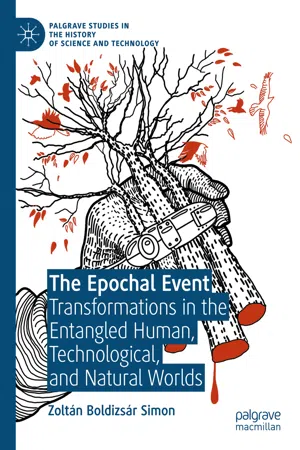
This book is a unique attempt to capture the growing societal experience of living in an age unlike anything the world has ever seen. Fueled by the perception of acquiring unprecedented powers through technologies that entangle the human and the natural worlds, human beings have become agents of a new kind of transformative event. The ongoing sixth mass extinction of species, the prospect of a technological singularity, and the potential crossing of planetary boundaries are expected to trigger transformations on a planetary scale that we deem catastrophic and try to avoid. In making sense of these prospects, Simon's book sketches the rise of a new epochal thinking, introduces the epochal event as an emerging category of a renewed historical thought, and makes the case for the necessity of bringing together the work of the human and the natural sciences in developing knowledge of a more-than-human world.
eBook - ePub
The Epochal Event
Transformations in the Entangled Human, Technological, and Natural Worlds
- English
- ePUB (mobile friendly)
- Available on iOS & Android
eBook - ePub
The Epochal Event
Transformations in the Entangled Human, Technological, and Natural Worlds
About this book
Information
© The Author(s) 2020
Z. B. SimonThe Epochal EventPalgrave Studies in the History of Science and Technologyhttps://doi.org/10.1007/978-3-030-47805-6_11. Prelude to a New Epochality
Zoltán Boldizsár Simon1
(1)
Bielefeld University, Bielefeld, Germany
Abstract
An emerging societal experience of time conceives of changes in epochal terms. Epochal claims increasingly dominate the ways in which we think about transformations both of the world and of knowledge production about the world. To a certain extent, the latter seems self-evident: insofar as we think that epochal changes are around us, it seems reasonable to claim that we need epochal changes in our modes of thinking to be able to come to terms with the vastness of the changes themselves. In briefly introducing the emergence of a new epochality, that is, a new kind of epochal thinking, the chapter touches upon some of the core themes of the book: the perception that human capacities are reaching an unprecedented scale; the entanglement of the human, technological, and natural worlds; the shift toward thinking in planetary terms; and the necessity to develop a knowledge regime attuned to the new conditions. Finally, the chapter ends with an outline of the book.
Keywords
Epochal changeEpochalityExperience of timeHumanTechnologyNaturePlanetaryTransdisciplinarityThe New Epochality
We are living in an age unlike anything the world has ever seen. This is not a claim I wish to advance but a societal experience of time that I think we need to understand. The new experience of time is historical in a specific way: it conceives of changes in epochal terms. Not in the most familiar sense though, not in the sense of historical epochs as we know them. Epochal thought is emerging today in a way that was simply inconceivable before human capacities came to be perceived in terms of a planetary-scale agency that brings about transformations in the condition of the Earth viewed as an integrated system.
Such human agency lurks behind an unprecedented biodiversity loss, the alteration of the climatic conditions of the planet, and the potential to manipulate and create both non-organic and organic life-forms through advanced technologies (artificial intelligence, digital life-forms, genome editing, cloning, and so on). All this, either separately or together, is expected to launch epochal changes on a planetary scale, entangle the human and the natural worlds through advanced technology, and kick off transformations with potentially unpredictable consequences that the human mind is not even equipped to grasp. What we can grasp, however, is the societal experience of the epochal transformations that we are likely to bring about. This book is an effort to come to terms with a potentially new kind of epochal thinking—rooted in the perception of anthropogenic planetary changes—that endows even certain towering events with epochal attributes.
But let’s not get too ahead of ourselves and begin with the most fundamental experiences. There is arguably a growing sense that epochal changes are taking place around us in practically all domains of life. Following the invention of nuclear weaponry and the experiences of the Second World War, we have been said to enter the atomic age. Then came the space age, and subsequently the information age, while we have been undergoing a digital revolution, which is now already old news in light of the fourth industrial revolution that brings together the digital of the third industrial revolution with physical systems. Perhaps some would argue that it is a feature of postmodernity (understood in epochal terms as a societal or socio-cultural condition) that industrial revolutions appear to come lately in sequels, much like Hollywood blockbusters. Yet there is a chance that these claims would fall on deaf ears, as today postmodernity itself as an era is gone, and the intellectual period when postmodernism was a prominent and fashionable mode of thinking (not be confused with postmodernity) is also passé. It seems we have now entered the Anthropocene, with our eyes scanning the horizon for the coming posthumanity.
Anyone can add their favorite epochal claims to the ones listed here. I also add one by writing this book and arguing that coming to terms with our new epochality, that is, with our age of the epochal, so to speak, requires some sort of an intellectual sea change. Besides, this claim will fit quite smoothly with a tendency in present-day scholarship that reproduces the broader societal experience of time on its own scale. Given that scholarly endeavors take place within the broader societal space, it is not much of a surprise that the wider societal sentiment of the epochal boils down to epochal claims concerning knowledge production. In regard to knowledge production, we have gotten used to framing intellectual endeavors as outlines of colossal challenges that demand responses which entail tremendous changes in our modes of thinking.
Again, my intention is not to point fingers. I have been exercising such scholarship before, and this book is no exception. I only want to raise awareness of the fact that this is what we are doing, oftentimes without knowing it. We are of course very well aware of the customary academic turns that typically argue for refocusing attention and aim at rethinking, refiguring, and reinventing that which already exists. Epochal claims, however, aim at a much higher goal; they demand changes on the level of wholesale knowledge formations. And, to a certain extent, this scholarly reproduction of the wider societal experience may even be self-evident. For insofar as we think that epochal changes are around us, it seems reasonable to claim that we need epochal changes in our modes of thinking to understand them.
Here are a few examples. To begin with, consider Donna Haraway’s discussion of “the almost incomprehensible increases in human numbers.” More concretely, Haraway refers to “a 9 billion increase of human beings over 150 years, to a level of 11 billion by 2100 if we are lucky,” which “cannot be explained away by blaming Capitalism or any other word starting with a capital letter.” Instead, the new situation points onward to the need “to think together anew across differences of historical position and of kinds of knowledge and expertise.”1 Haraway’s implied take on the necessity of new knowledge formations is nevertheless less explicit than that of Elizabeth Ermarth (in a context that does not have much to do with planetary-scale changes). In her book History in the Discursive Condition, published less than a decade ago to synthetize her work from the two previous decades, Ermarth puts forward the argument that the “modern condition” has been replaced by a “discursive condition.” She argues that “the departure from modernity signals a tectonic change radical enough to suggest that even the tools of thought must change if we are to keep up with ourselves in any vital or creative way.”2
Less than ten years later, however, there are not many left who still think that we are in anything like a “discursive condition.” Yet, perhaps even more of us think that we are witnessing “a tectonic change radical enough” to rewrite previous knowledges, even though the reasons for thinking so may be other than Ermarth’s. It makes sense then to return to potentially more future proof final examples, ones that reflect the planetary concerns integral to the coming chapters. One of the first things to mention in this context is the human-induced mass extinction of species. In their 1996 book The Sixth Extinction, Richard Leakey and Roger Lewin argue that the recognition of a sixth mass extinction in Earth’s history demands an epochal change in the constitution of knowledge. They claim that “we are in the midst of a seismic shift in thinking about the nature of ourselves and the world we live in. It is no hyperbole to describe the magnitude of the shift as an intellectual revolution.”3 Then, in the context of anthropogenic climate change—and in a more moderate and less alarmist tone—Tracey Skillington even better captures the way in which epochal claims about the world and knowledge production on the world hang together. In her recent book Climate Justice and Human Rights, Skillington writes that “the anticipation of grave environmental catastrophes fundamentally alters ways of being in and thinking about this world.”4
Again, anyone can add their favorite epochal claims concerning the scholarly world of knowledge production. But before all this begins to look too much like a parody (with respect to both scholarship in the age of epochal thinking and the age itself as some sort of a meta-epoch), I must make it perfectly clear that the phenomenon is gen...
Table of contents
- Cover
- Front Matter
- 1. Prelude to a New Epochality
- 2. A Perplexing Appeal to History
- 3. The Entangled Human-Technological-Natural World
- 4. Epochal Thinking and Anthropogenic Catastrophe
- 5. The Historical Event
- 6. The Epochal Event
- 7. Coda: A World of Epochal Transformations
- Back Matter
Trusted by 375,005 students
Access to over 1.5 million titles for a fair monthly price.
Study more efficiently using our study tools.
Frequently asked questions
Yes, you can cancel anytime from the Subscription tab in your account settings on the Perlego website. Your subscription will stay active until the end of your current billing period. Learn how to cancel your subscription
No, books cannot be downloaded as external files, such as PDFs, for use outside of Perlego. However, you can download books within the Perlego app for offline reading on mobile or tablet. Learn how to download books offline
Perlego offers two plans: Essential and Complete
- Essential is ideal for learners and professionals who enjoy exploring a wide range of subjects. Access the Essential Library with 800,000+ trusted titles and best-sellers across business, personal growth, and the humanities. Includes unlimited reading time and Standard Read Aloud voice.
- Complete: Perfect for advanced learners and researchers needing full, unrestricted access. Unlock 1.5M+ books across hundreds of subjects, including academic and specialized titles. The Complete Plan also includes advanced features like Premium Read Aloud and Research Assistant.
We are an online textbook subscription service, where you can get access to an entire online library for less than the price of a single book per month. With over 1.5 million books across 990+ topics, we’ve got you covered! Learn about our mission
Look out for the read-aloud symbol on your next book to see if you can listen to it. The read-aloud tool reads text aloud for you, highlighting the text as it is being read. You can pause it, speed it up and slow it down. Learn more about Read Aloud
Yes! You can use the Perlego app on both iOS and Android devices to read anytime, anywhere — even offline. Perfect for commutes or when you’re on the go.
Please note we cannot support devices running on iOS 13 and Android 7 or earlier. Learn more about using the app
Please note we cannot support devices running on iOS 13 and Android 7 or earlier. Learn more about using the app
Yes, you can access The Epochal Event by Zoltán Boldizsár Simon in PDF and/or ePUB format, as well as other popular books in History & Historiography. We have over 1.5 million books available in our catalogue for you to explore.