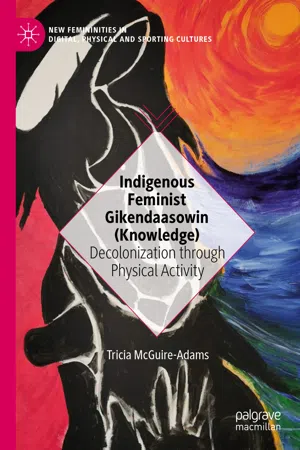
This book presents knowledge from Indigenous women who enact decolonization and wellbeing through physical activity. In sport, physical activity, and health disciplines, there is a significant need for Indigenous women's theoretical and methodological perspectives. While much research is published from a Western perspective on Indigenous peoples' health, sport, and physical activity, less is known from Indigenous feminist and community perspectives. The chapters therefore inform the broader sociology of sport and Indigenous feminist fields on Indigenous cultural perspectives of physical activity.
eBook - ePub
Indigenous Feminist Gikendaasowin (Knowledge)
Decolonization through Physical Activity
- English
- ePUB (mobile friendly)
- Available on iOS & Android
eBook - ePub
Indigenous Feminist Gikendaasowin (Knowledge)
Decolonization through Physical Activity
About this book
Information
© The Author(s) 2020
T. McGuire-AdamsIndigenous Feminist Gikendaasowin (Knowledge) New Femininities in Digital, Physical and Sporting Cultureshttps://doi.org/10.1007/978-3-030-56806-1_11. Introduction
Tricia McGuire-Adams1
(1)
University of Ottawa, Ottawa, ON, Canada
The stories we tell about ourselves and each other matter. They inform how we make sense of our realities, our experiences, and the way we feel and think about each other, and indeed, how we think and feel about ourselves. What stories does settler colonialism tell about Indigenous1 women in Canada? Often, settler colonialism tells a story about Indigenous women in a multitude of negative tones: that Indigenous women are not high achievers; that we have too many babies, with too many fathers; that we are too promiscuous and do drugs and alcohol, which leads us to be murdered and/or missing; that we are not healthy and well; and that we are not physically strong.2 These settler-colonial stories about Indigenous women are rooted in the justification of the taking of Indigenous lands and territories. Indigenous women, from across Turtle Island and from diverse Nations, were (and are) the leaders, thinkers, and cultural catalysts among our respective communities. We had a formidable strength garnered from our immense spirituality, and we fostered knowledge and teachings that continue to guide our journey within mino-biimaadiziwin (the good life). Settler-colonial stories come from a settler-colonial mythology about Indigenous women that maintains the interlocking institutions of heteropatriarchy, white supremacy, and Christianity. Such stories spin a rationalized space in the minds of settler-colonial people in order for their existence on stolen territory to make sense to them. But these stories are not how we, as Indigenous women, think about ourselves and each other.
The dibaajimowinan shared in this book tell different stories. The dibaajimowinan tell of deep ancestral knowledge and strength that show that Anishinaabekweg had immense physicality and strength; they tell of Anishinaabekweg embodying ancestral strengths through physical activity, such as running, and they tell of creating community and support through critical dialogue and physical activity. These dibaajimowinan are a truth telling; they speak to the regeneration occurring among Indigenous women, and they speak back to the settler-colonial stories, stories that are meant to show our presumed disappearance.
This book presents the dibaajimowinan of Anishinaabeg women, Elders, and urban Indigenous women regarding our physicality, health, and well-being. Their stories inform personal decolonization and regeneration within the fields of sociology of sport and Indigenous feminist theory.
Toni Morrison “If there is a book that you want to read, but it hasn’t been written yet, you must be the one to write it” from the Handy English Grammar Answer Book.
Locating Myself
Boozhoo, Dibikgeezhigokwe indigo. Mishkwasdesi dodaim. Bingwi Neyaashi Anishinaabek (Ojibway) nindoonji, Anemki Wekwedong nindoonji. I belong to Bingwi Neyaashi Anishinaabek on Animbiigo Zaagi’igan and grew up in Thunder Bay, Ontario, both of which are in the Robinson Superior Treaty Territory. My paternal family is from Bingwi Neyaashi Anishinaabek. My maternal family is from Animakee Wa Zhing 37 First Nation in Treaty #3 Territory. I also have family ties to Couchiching First Nation in Treaty #3 through marriage. Anishinaabeg, other times spelled Anishinaabek, comprise the Potawatomi, Odawa, and Ojibway (in the United States Ojibway is also known as Chippewa) peoples who span the Traditional Territories now known as Manitoba, Ontario, Québec, in Canada, and the state of Minnesota in the United States. Anishinaabeg reside in rural and urban areas and in their respective First Nation communities, in addition to other global localities. It is important that I introduce to you my Anishinaabeg family and communities to demonstrate and honour my identity, relationships, and the stories shared within this book.
Anishinaabeg knowledge is derived from our stories or dibaajimowinan. We learn from our personal stories, ancestral stories, funny or tragic stories, and truth-telling stories; indeed, “stories are meant to heal” (Wagamese 2008, p. 4). As Anishinaabeg, we have a responsibility to preserve our stories as they are meant to teach us new ways of being. My ancestral stories have guided me while writing this book. I share them now to honour my ancestors who continue to guide me:
These stories speak to the incredible physical strength, health, and wellness that Anishinaabekweg possess. In each story, the women embodied a strong physicality that enabled them to collect fish for their family, deliver babies on their territories, and evade unwelcome circumstances. Together, these ancestral stories provided me with purpose as I thought mindfully and spiritually about my responsibility in conducting research. These stories grounded me and gave me strength, as I knew my ancestors were guiding me. Most incredibly, the stories led me to realize the aim of this book, which was to understand how our ancestral stories of physical strength, and current personal stories of physical activity, may influence our current efforts to challenge ill health. The guiding question for the research presented in this book is, “Can physical activity that encompasses a decolonization approach be a catalyst for regenerative well-being for Anishinaabeg women?” Answering this question required three stages of research, each comprising their own study. In stage one, I held a sharing circle with Anishinaabeg Elders to ask how settler colonialism is manifested upon Anishinaabeg women’s bodies? The results of this stage are positioned in Chap. 3. I choose to place the knowledge that the Elders’ shared in the forefront in the book as their words ground how settler colonialism is both presented and challenged through our stories. In stage two, I interviewed Anishinaabeg women who are exemplars of decolonized physical activity to ask, why did you become physically active? What drives you to commit to physical activity? And, why is physical activity important to you? The results of this stage are presented in Chaps. 4 and 5 of the book and represent how Anishina...I was a young woman, just 19, when my father told me a story about my Anishinaabekweg ancestors living on the territory of Animbiigo Zaagi’igan. A long time ago on Animbiigo Zaagi’igan, three Anishinaabekweg went to check their fishing net beneath the winter ice. One of the women was pregnant and during the trip to collect the fish, she gave birth. She then walked back to our community—carrying the fish with her baby. In this story, my nookomisag showed immense physical strength , both in traversing the frigid, frozen lake to collect the fish meant to feed their families and in delivering a baby on the frozen, icy lake. The birth of this precious baby instilled a far greater strength in my nookomisag than the trip initially demanded of them. My nokomis showed an ethereal physicality to give birth on Animbiigo Zaagi’igan and to then carry her newborn with the fish back to her family . It is extraordinarily meaningful and is an act for which I am very grateful.A second story features the birth of my father. My auntie, Dr. Patricia McGuire, recounted the story of the birth of my father to me on one of our many visits together. My nokomis, who at the time was nine months pregnant, sent her children off to school one day. Upon returning from school, the children began to eat their supper while their mama busied herself with daily chores. The siblings noticed a strange sound coming from a basket. Their first thought was that it was a puppy; however, they were astonished to discover it was their new baby brother. In this story, my nokomis was able to not only give birth to my father completely on her own, but she was also then able to collect the wood to set up the fire in the wood stove, prepare and cook supper for the kids, and continue to occupy herself with other tasks.A third story is about my ancestral relative, Pikaagooseekwe. Shared by my auntie as part of her own dissertation, it is a story highlighting the fortitude and physical strength of our ancestor.Pikaagooseekwe came to Animbigoo Zaagi’igan when her grandmother outfitted her with food and a birch bark canoe. She and her grandmother were living by Lake Superior in what is now Pic Heron First Nation. Her grandmother did not want her to marry a specific man, as Pikaagooseekwe would have become his second or third wife. Pikaagooseekwe was about 14 years old when her grandmother prepared her for this journey … It took her about two weeks to travel by water from Heron Bay, close to Lake Superior and Marathon, Ontario, to the shores of Lake Nipigon. She travelled on her own and was able to avoid fur traders and various other dangers in the process. Pikaagooseekwe arrived safely at the home of her relatives at Nipigon House, a Hudson Bay trading post on Lake Nipigon. She made certain her grandchildren knew of this journey and the reasons why it was undertaken. (McGuire 2013, p. 74)
Table of contents
- Cover
- Front Matter
- 1. Introduction
- 2. Indigenous Feminist Theory and Embodied Settler Colonialism
- 3. Relational Accountability to our Ancestors
- 4. Women’s Stories of Decolonized Physical Activity
- 5. Oshki-Michitweg or New Runners
- 6. Wiisokotaatiwin: Kettlebell Training, Critical Dialogue, and Creating Well-Being Through Physical Activity
- 7. Disciplined Physical Activity as an Ethic of Anishinaabeg Self-Discipline
- 8. Conclusion
- Back Matter
Trusted by 375,005 students
Access to over 1.5 million titles for a fair monthly price.
Study more efficiently using our study tools.
Frequently asked questions
Yes, you can cancel anytime from the Subscription tab in your account settings on the Perlego website. Your subscription will stay active until the end of your current billing period. Learn how to cancel your subscription
No, books cannot be downloaded as external files, such as PDFs, for use outside of Perlego. However, you can download books within the Perlego app for offline reading on mobile or tablet. Learn how to download books offline
Perlego offers two plans: Essential and Complete
- Essential is ideal for learners and professionals who enjoy exploring a wide range of subjects. Access the Essential Library with 800,000+ trusted titles and best-sellers across business, personal growth, and the humanities. Includes unlimited reading time and Standard Read Aloud voice.
- Complete: Perfect for advanced learners and researchers needing full, unrestricted access. Unlock 1.5M+ books across hundreds of subjects, including academic and specialized titles. The Complete Plan also includes advanced features like Premium Read Aloud and Research Assistant.
We are an online textbook subscription service, where you can get access to an entire online library for less than the price of a single book per month. With over 1.5 million books across 990+ topics, we’ve got you covered! Learn about our mission
Look out for the read-aloud symbol on your next book to see if you can listen to it. The read-aloud tool reads text aloud for you, highlighting the text as it is being read. You can pause it, speed it up and slow it down. Learn more about Read Aloud
Yes! You can use the Perlego app on both iOS and Android devices to read anytime, anywhere — even offline. Perfect for commutes or when you’re on the go.
Please note we cannot support devices running on iOS 13 and Android 7 or earlier. Learn more about using the app
Please note we cannot support devices running on iOS 13 and Android 7 or earlier. Learn more about using the app
Yes, you can access Indigenous Feminist Gikendaasowin (Knowledge) by Tricia McGuire-Adams in PDF and/or ePUB format, as well as other popular books in Social Sciences & World History. We have over 1.5 million books available in our catalogue for you to explore.