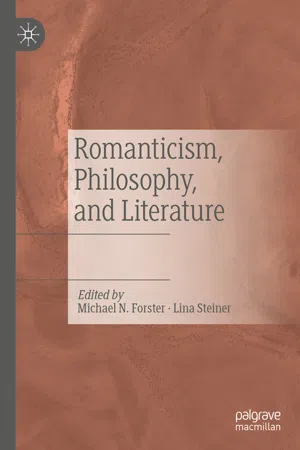
This book offers a broad re-evaluation of the key ideas developed by the German Romantics concerning philosophy and literature. It focuses not only on their own work, but also on that of their fellow travelers (such as Hölderlin) and their contemporary opponents (such as Hegel), as well as on various reactions to and transpositions of their ideas in later authors, including Coleridge, Byron, Kierkegaard, Nietzsche, and Dostoevsky.
eBook - ePub
Romanticism, Philosophy, and Literature
- English
- ePUB (mobile friendly)
- Available on iOS & Android
eBook - ePub
Romanticism, Philosophy, and Literature
About this book
Information
Topic
PhilosophySubtopic
German Language© The Author(s) 2020
M. N. Forster, L. Steiner (eds.)Romanticism, Philosophy, and Literaturehttps://doi.org/10.1007/978-3-030-40874-9_11. Introduction
Michael N. Forster1 and Lina Steiner1
(1)
Bonn University, Bonn, Germany
German Romanticism has not received the attention it deserves from philosophers and literary scholars in the Anglophone world. This volume is concerned with German Romanticism’s ideas about philosophy and literature, especially during its first and most important phase: the early German Romanticism of roughly the period 1796–1801. The volume is also concerned with the influence of those ideas on later thinkers both within Germany and beyond it.
As is well known, German Romanticism was philosophically ambitious not only in a general way, but in particular metaphysically. One of its leading representatives, Schleiermacher, already in the early 1790s embraced a version of Spinoza’s monism, which he attempted to reconcile with the epistemological strictures of Kant’s critical philosophy, and he then continued to propagate such a position in his famous On Religion: Speeches to Its Cultured Despisers from 1799. Friedrich Schlegel, after an initial flush of enthusiasm for the subjective idealism that Fichte developed in Jena during the 1790s, in 1796 turned to criticizing it, and by 1800–01 was instead committed to a project of synthesizing Spinoza’s monism with it (a project that Hegel would continue subsequently). Similarly, Novalis from about 1796 on developed criticisms of Fichte’s subjective idealism, instead preferring a realist monism.
What is equally important, but less well known (at least in the Anglophone world), is that German Romanticism also had a hard-edged “scientific” (in the broad German sense of wissenschaftlich) side, in particular a side that was devoted to issues that are fundamental to the human sciences (as contrasted with the natural sciences). For one thing, Romanticism—especially as it was represented by Friedrich Schlegel and Schleiermacher—was one of the most empirically well-informed and radical champions of what later came to be known as “historicism”: the realization that human mental life—concepts, beliefs, values, perceptual and affective sensations, genres, and so forth—change in profound ways over historical time (as well as varying deeply between cultures and even between individuals at a single time and place).
Romanticism was also the heir to an important “linguistic turn” that had then recently been undertaken by Herder and Hamann, a turn away from conceiving the relation between thoughts or concepts on the one hand and language or words on the other in dualistic terms, as the Enlightenment had usually done, and toward instead conceiving thought as essentially dependent on and bounded by language, and concepts as consisting in word-usages. Moreover, Romanticism effected some important improvements in this new philosophy of language, including substituting for a strong tendency of the Enlightenment that Herder and Hamann had sustained to conceive words and concepts atomistically a new insight into various forms of linguistic holism.
Relatedly, Romanticism essentially founded modern linguistics. It achieved this by recognizing that thoughts’ and concepts’ essential dependence on and bounding by language made the investigation of language an ideal means for discovering the nature of people’s thoughts and concepts, thus providing a sort of empirically accessible and reliable window on them; developing the insight that grammar is fundamental to language; perceiving the deep variability not only of other aspects of language, such as word-meanings, but also of grammars; recognizing that grammar is the best criterion for discerning the genealogical relationships between languages (more reliable than lexicon, for example); generating a taxonomy of different types of grammar; and mapping out the genealogical relationships between the members of what are today known as the Indo-European family of languages (Sanskrit, Greek, Latin, German, the Romance languages, etc.). These achievements were originally due to Friedrich Schlegel in his revolutionary book On the Language and Wisdom of the Indians (1808). They almost immediately stimulated a great wave of closely related work in linguistics by August Wilhelm Schlegel, Franz Bopp, Jacob Grimm, Wilhelm von Humboldt, and others.
On the basis of all of the aforementioned achievements—especially in response to the challenge to interpretation that is posed by historicism, as well as in light of the fundamental role that is played by language in thought and by words in concepts—Romanticism also developed a revolutionary new theory and methodology of interpretation, or “hermeneutics.” This achievement is most famously associated with Schleiermacher in his hermeneutics lectures, which he delivered from 1805 on. But it was also in large part due to Friedrich Schlegel.
Again on the basis of the aforementioned achievements, Romanticism in addition developed a radical new theory and methodology of translation—one that in particular aimed to make it possible to bridge the intellectual, and especially conceptual, gulfs that historicism implied through translation by drawing on the new philosophy of language that has been mentioned. This was above all an accomplishment of Schleiermacher in his groundbreaking essay On the Different Methods of Translation (1813).
In addition, Friedrich Schlegel’s brother August Wilhelm Schlegel developed the science of analyzing the meters of poetry to new heights of sophistication that were previously unknown (so that, for example, Goethe would consult him about questions of meter that were relevant to his own poetry).
These various extraordinary theoretical achievements of the Romantics also formed the indispensable foundation for seminal work that they did on the history of literature. Indeed, they constituted the foundation of virtually all of the most important work that would be done in the human sciences over the course of the nineteenth and twentieth centuries, in fields such as literary studies, classical scholarship, biblical scholarship, historiography of law, historiography of philosophy, general historiography, and (eventually) cultural anthropology.
Another noteworthy and laudable dimension of German Romanticism during its most important, early period was a strikingly progressive political and moral philosophy. During the 1790s and the early 1800s German Romanticism’s leading representatives, Friedrich Schlegel and Schleiermacher, both championed moral cosmopolitanism, republicanism/democracy , liberalism, feminism, and a rejection of racism and antisemitism. They also found important allies in these ideals in Alexander and Wilhelm von Humboldt, who can in many ways be seen as associate members of German Romanticism.
In addition to all of these philosophical achievements, the German Romantics were also profoundly concerned with poetry or literature (and to a significant extent the arts more broadly as well). Several aspects of this preoccupation can be distinguished. First, they aimed to overcome the “old quarrel between philosophy and poetry” of which Plato had already written in the Republic (607b) in a very radical way, namely by effecting a sort of synthesis between philosophy and poetry, or science and art. As Friedrich Schlegel put it in the Athenaeum Fragments (1798), Romanticism aims “to bring poetry and philosophy in contact” (KFSA 2, no. 116, cf. no. 451), “in philosophy the only way to science is through art, as the poet … only becomes an artist via science” (no. 302, cf. no. 255).
This goal can easily be misunderstood. The Schlegels knew enough about the history of literature (for example, about Homer and the ancient tragedians) to avoid the mistake that is often made by philosophers even today of equating literature either with fiction or with mere entertainment. Consequently, their goal of bringing philosophy and poetry together does not, as it might seem to, imply any trivializing of philosophy. Moreover, that goal is at least as much about making poetry more philosophical or theoretical as it is about the converse (see on this especially Athenaeum Fragments, no. 255). In this connection, it is important to avoid another seductive mistake, one that is likely to be especially tempting to Anglophone readers: that of assimilating German Romanticism’s ideal for poetry to the sort of return to nature in rejection of artificiality that at around the same period constituted the ideal of English Romanticism, in particular Coleridge and ...
Table of contents
- Cover
- Front Matter
- 1. Introduction
- Part I. Philosophy
- Part II. Philosophy and Literature
- Back Matter
Trusted by 375,005 students
Access to over 1.5 million titles for a fair monthly price.
Study more efficiently using our study tools.
Frequently asked questions
Yes, you can cancel anytime from the Subscription tab in your account settings on the Perlego website. Your subscription will stay active until the end of your current billing period. Learn how to cancel your subscription
No, books cannot be downloaded as external files, such as PDFs, for use outside of Perlego. However, you can download books within the Perlego app for offline reading on mobile or tablet. Learn how to download books offline
We are an online textbook subscription service, where you can get access to an entire online library for less than the price of a single book per month. With over 1.5 million books across 990+ topics, we’ve got you covered! Learn about our mission
Look out for the read-aloud symbol on your next book to see if you can listen to it. The read-aloud tool reads text aloud for you, highlighting the text as it is being read. You can pause it, speed it up and slow it down. Learn more about Read Aloud
Yes! You can use the Perlego app on both iOS and Android devices to read anytime, anywhere — even offline. Perfect for commutes or when you’re on the go.
Please note we cannot support devices running on iOS 13 and Android 7 or earlier. Learn more about using the app
Please note we cannot support devices running on iOS 13 and Android 7 or earlier. Learn more about using the app
Yes, you can access Romanticism, Philosophy, and Literature by Michael N. Forster, Lina Steiner, Michael N. Forster,Lina Steiner in PDF and/or ePUB format, as well as other popular books in Philosophy & German Language. We have over 1.5 million books available in our catalogue for you to explore.