- English
- ePUB (mobile friendly)
- Available on iOS & Android
eBook - ePub
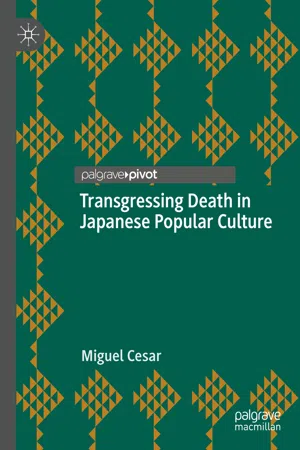
Transgressing Death in Japanese Popular Culture
About this book
This book focuses on the theme of the transgression of life and death boundaries through its representation in Japanese contemporary visual media, more specifically in the manga Fullmetal Alchemist, the animated film Journey to Agartha, and the computer game Shadow of the Colossus. By addressing how the theme was constructed by three different media and what these texts say about it, the book focuses on the narrativization of Japanese ontological anxieties. The book argues that, although these texts deal with matters of afterlife through fantasy worlds, the content of their stories, the archetypes of their characters, and their existential journeys echo contextually-situated conversations. Matters of gender, societal structure and, most of all, the tensions between individuality and sociocentrism not only permeate but structure the interrogation of our relation to the afterlife. This book stands to contribute significantly to media studies, literarystudies, and Japanese studies.
Information
Print ISBN
9783030508791
Subtopic
Media Studies© The Author(s) 2020
M. CesarTransgressing Death in Japanese Popular Culturehttps://doi.org/10.1007/978-3-030-50880-7_11. Introduction
Miguel Cesar1
(1)
University of Edinburgh, Edinburgh, UK
Abstract
This chapter introduces both the theme of this book, the narrative structure that I call EBT (Essential Boundary Transgression), and the Japanese context in which it originates. First, the chapter explains the theory behind the conceptualization of Boundaries and their Transgression. This is followed by an overview of Japanese meditations on death as a phenomenon and a perennial enigma. It follows different historical approaches to death and afterlife, from ancient Japan, pre-Buddhist times, the configuration of death explanations through Buddhism, and the fragmentation of secular Japan. It argues that the fragmentation of contemporary Japan has led to a polyphonic conversation on death, its nature and significance that has been approached through different narrative channels; popular culture being a privileged conductor of such explorations. The chapter emphasizes the relevance of popular culture and justifies its study for they are the new ways in which perennial themes are being discussed. Finally, the chapter concludes with an overview of the structure of the book, the main arguments of each chapter and the overall argument that the EBT is a recurrent narrative human construction which, consequently, incorporates to its structure changes from the authors’ contexts, including their hopes, worries and cosmologies.
Keywords
JapanSecularizationDeathRitesAnthropology of communicationVisualityGhosts, resurrections, afterlife specialists, collective rituals of the death show the deep interest, if not obsession, of the Japanese on the phenomenon of death. Thus, it is not strange that the most popular ritual in Japan, the o-bon, is about the reencounter with the dead, ancestors and the relatives that have passed away. And this recurrence of death, that keen interest, has permeated not only communal or individual rituals but also discursive and narrative manifestations. One of the main reasons has to do with death elusiveness, its fluid nature. Thus, death’s centrality originates from the inaccessible nature of the phenomenon itself, allowing and requiring speculative exploration in narrative forms. Such dynamics have produced a longstanding conversation regarding the possible consequences of death and its connections to life.
This book studies how the long-lasting theme of life and death connections have been explored through Japanese contemporary media such as manga, anime and computer games. Here I study the shape this ancient debate has taken in the context of the Second Lost Decade of Japan (2000–2010) and its representation through new visual media. This study engages the way each medium explores the theme of life and death connections through its medial tools, their content, and their relation to the context from which they originate. The aim is threefold. First, to understand the intertextual connections between context and text. That is, to explore the influence of the Second Lost Decade on the conversation around life and death. Second, to focus on the construction and transmission of these new participations through new media forms not available before. And, third, to explore the authors’ meditations on their media while exploring the metaphysical theme of life and death connections.
The book is then centred on the ancient and recurrent theme of death in Japanese culture. It focuses on how it has been approached in contemporary times through visual narrative media. Most specifically, the book focuses on the debates on afterlife and the significance of death in the recurrent theme of the transgression of the boundaries between life and death, what I call Essential Boundary Transgression (EBT).
But what is this EBT theme and why is it relevant as a theoretical and hermeneutical framework? The EBT, simply put, refers to narratives that deal with journeys to the netherworld. This journey might be physical, an attempt to resurrect a deceased individual, or an abstract manifestation of the non-acceptance of death. This theme slightly resembles the Greek concept of kathabasis. However, kathabasis refers to every descending movement which makes it too imprecise, too broad. The EBT accounts for the meaning and the polysemic connotations I aim to discuss. The use of boundary instead of limit refers to the permeability and the possibilities such a word expresses. The boundaries of life and death are, in these narratives, transgressed, crossed and made fluid.
Boundary comes from the difference between the Kantian idea of limit or boundary and Plato’s. For the latter, the world is a cosmos for which any search for knowledge starts by recognizing its order and harmony. Kant, however, perhaps because of the context in which he lived, looked for knowledge as an attempt to order chaos, fixing human thought (Szakolczai 2015). Another departure point between Greek and Kantian conceptions of boundary is that the latter understood limit as purely negative, mainly concerning the idea of limitation, not availability or restriction, ignoring the possibilities and qualities of limitation and boundary common in Plato’s philosophy.
The second concept, transgression, refers to the act of transgressing, to go beyond the limits or bounds set by commandment, law or convention; in other words, it is “to violate or infringe” (Jenks 2003: 2). However, it also announces the law or convention that it is transgressing, being a deeply reflexive act of both denial and affirmation. It is the transgressor that breaks the rules or exceeds the boundaries culturally and socially established. As a challenge to the system, transgression not only questions categories such as “normal” or “pathological” but also the institutions that have raised and defended those (Foucault and Gordon 1981). However, it is important to note that while transgression is the exceeding of boundaries, human experience is the constant involvement with limits, being constrained, an always recurrent experience in our action (Jenks 2003: 7). Every limit entails the very desire to be transgressed, expressed from ancient mythologies to contemporary narratives and by festivities and attitudes such as periodical carnival experiences (Bakhtin 1968: 11).
Transgression derives from a particular order of thinking in cultural discourse, an argument derived from thinkers whose inspiration comes from the debate between Hegelian and Nietzschean philosophies (Jenks 2013: 20). The former, according to Kojève (1969), envisions an inevitable historical process of the spirit (being) being elided and reason (knowing in the systematic coherent humankind progress). On the other hand, Nietzsche prioritized ontology over epistemology through his theory of the “will to power” as he relativized epistemology (1966). Such a move has greatly influenced post-structuralist and postmodernist theories, elevating the impact of individual cognition as well as questioning all claims of truth in a movement, which Jenks believes opened the gate of transgression.
Transgression is also a social process transcending boundaries and/or exceeding limits. Some authors have argued, however, that transgression is bound to human condition and experience as we have knowledge of our limitations, and of the absolute finitude of death (Suleiman 1991: 75). For Suleiman, transgression is also an “inner experience”, individual or collective. In such acts the bounds of rational, quotidian behaviour are surpassed becoming an experience that keeps the rules it is violating in mind. Suleiman goes even further arguing that, to fully realize any prohibition is necessarily a transgressive act, a thought that ultimately affects the concept of boundary and experience (ibid.). As such, transgressing essential boundaries would bring with us the ontological and existential impulse to question, challenge those primordial categories. Consequently, lacking a term that encapsulates the nuances of the theme of life and death boundaries and their transgressions in narrative form, this book coined the concept of the EBT. Then, it situates these stories about loss, mourning, death non-acceptance and resurrection attempts within a wider intertextuality on the most essential boundaries and how they are explored by transgressing them. It is the aim of this book to understand how that has been done in contemporary Japan, the forms these transgressions have taken and the effect of the media that support and transmit these new engagements.
The EBT conversation and its medial construction is studied here from an anthropological approach, that is, an understanding of the theme as manifestation of public and communitarian negotiations on the meaning of being, of existing as a human and what that is. In this process of discursive conversations, the EBT is situated in a larger ontological and existential interrogation about humanity and our place within the world. This book frames the sample within a larger intertextual tradition of questioning the meaning of being and the ethical and moral consequences of that process. These engagements with the EBT are thus seen as part of an ongoing individual and collective construction. Consequently, the EBT and the texts that engage in this conversation are studied and understood within a greater net of creation and negotiation of meaning and norms. Since the EBT speaks about and to existential interrogations of the human condition, I argue the study of contemporary engagements will benefit from understanding them as part of the cultural and social construction of reality, as texts that create meaning and make sense of the world around them. Moreover, as I discuss, the EBT is, and should be understood, as a dynamic construction, a vehicle for new contextually situated worries and hopes to be shared and discussed. This being the first exploration...
Table of contents
- Cover
- Front Matter
- 1. Introduction
- 2. A Genealogy of the EBT Conversation in Japan
- 3. Transgressing Boundaries: Exile and Loneliness
- 4. Rebellion and Transgression in “Journey to Agartha”
- 5. Tragic Transgressions in Shadow of the Colossus
- 6. Conclusions
- Back Matter
Trusted by 375,005 students
Access to over 1.5 million titles for a fair monthly price.
Study more efficiently using our study tools.
Frequently asked questions
Yes, you can cancel anytime from the Subscription tab in your account settings on the Perlego website. Your subscription will stay active until the end of your current billing period. Learn how to cancel your subscription
No, books cannot be downloaded as external files, such as PDFs, for use outside of Perlego. However, you can download books within the Perlego app for offline reading on mobile or tablet. Learn how to download books offline
Perlego offers two plans: Essential and Complete
- Essential is ideal for learners and professionals who enjoy exploring a wide range of subjects. Access the Essential Library with 800,000+ trusted titles and best-sellers across business, personal growth, and the humanities. Includes unlimited reading time and Standard Read Aloud voice.
- Complete: Perfect for advanced learners and researchers needing full, unrestricted access. Unlock 1.5M+ books across hundreds of subjects, including academic and specialized titles. The Complete Plan also includes advanced features like Premium Read Aloud and Research Assistant.
We are an online textbook subscription service, where you can get access to an entire online library for less than the price of a single book per month. With over 1.5 million books across 990+ topics, we’ve got you covered! Learn about our mission
Look out for the read-aloud symbol on your next book to see if you can listen to it. The read-aloud tool reads text aloud for you, highlighting the text as it is being read. You can pause it, speed it up and slow it down. Learn more about Read Aloud
Yes! You can use the Perlego app on both iOS and Android devices to read anytime, anywhere — even offline. Perfect for commutes or when you’re on the go.
Please note we cannot support devices running on iOS 13 and Android 7 or earlier. Learn more about using the app
Please note we cannot support devices running on iOS 13 and Android 7 or earlier. Learn more about using the app
Yes, you can access Transgressing Death in Japanese Popular Culture by Miguel Cesar in PDF and/or ePUB format. We have over 1.5 million books available in our catalogue for you to explore.