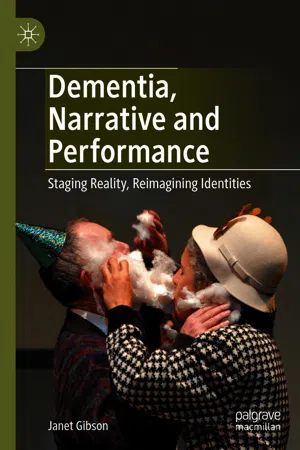
My mother, Barbara Gibson, was diagnosed with ‘probable’ Alzheimer’s disease (AD) in 2008. A diagnosis of AD is usually traumatic, both for the person and for their family; it was so for my mother, my siblings, and myself. My mother entered the dementia wing of an aged care facility a year later. Decisions around institutionalisation are not easy either. We were told by the nursing staff that, at the end of her first day in the facility, Mum put on yellow washing up gloves and, with a hammer in hand (where had she found that?), proceeded to the door of the wing, which could only be unlocked by entering a number code on a key pad, and tried to smash her way out in what appeared to be a (dramatic) bid for freedom. It didn’t succeed. She stayed in the dementia wing for over a year, moving to the palliative care wing for the last three weeks of her life. With a bolus of morphine dripping pain relief into her belly, unable to get out of bed or recognise anyone, and struggling for breath, she finally died on 4 May 2010. She was eighty-one years old.
This experience turned my life around. While not evident at the time, I now see that, as one of my mother’s care partners,1 I entered a new ‘reality’ where affect was the grammar of the communication space, not cognition. Fact merged with fantasy: I found it was not useful to insist on distinctions between them. For instance, when my mother talked as if her Aunt Enid was still alive, which she was not, I learned to accept this fiction. Insisting that Enid was not alive only distressed my mother. She was alive for my mother so that was ‘the truth’. Many ‘liminal’ spaces like these emerged in our time together: some between imagination and memory; some between the present and the past (but not quite past); and some between the woman who I began to see as ‘not my mother’ and also ‘not not my mother’ (after Schechner 1985, 110–113).
The woman who was ‘not my mother’ showed infrequent exhibitionist tendencies and occasional murderous inclinations. When we were out shopping once, she grabbed my breasts, then hers, and asserted that hers were bigger than mine. Another time, Mum was found by the nursing staff trying to strangle Mavis, another woman with dementia, who only had one phrase, repeated ad nauseam, day in and day out: “la di da, la di di”. But the woman who was ‘not not my mother’ still exhibited many familiar behaviours. She loved performing—as she had done for all her children as we were growing up—joyously dancing and singing along to any of the songs on her Nat King Cole CD. She was still generous and compassionate. She spent a week in the facility, on and off, by the bedside of a dying woman, comforting her by stroking her hands and face.
Over time then, I began to comprehend the ‘performativity’ of dementia, finding fledgling connections between my mother’s behaviours and performance theorist Richard Schechner’s notion of performativity. Schechner argues this “occurs in places and situations not traditionally marked as ‘performing arts’ … mak[ing] it increasingly difficult to sustain a distinction between appearance and reality, facts and make-believe, surfaces and depths” (2013, 24). Furthermore, in living through this experience, I noticed that ‘our’ story2 did not match those popularly available, which intrigued me. Gradually, I came to prefer many aspects of my relationship with the ‘new’ mother to whom Alzheimer’s introduced me, which is not to say that I saw AD as a gift. Dementia has always been, and probably always will be, a frightening experience with immense physical and psychological challenges for the person diagnosed and for that person’s friend, partner, spouse, or family member (Basting 2009, 2).3 From a biomedical perspective, dementia is a clinical ‘umbrella’ term for a progressive neurodegenerative syndrome containing a constellation of symptoms that may be caused by a number of underlying diseases such as AD (Bitenc 2020, 8). I examine this perspective, the pre-eminent way we understand the condition today, in more detail in Chap. 2, along with other cultural meanings usually yoked to the biomedical viewpoint—essentially those of tragedy, loss, and deficit. But viewing dementia as an unqualified tragedy, along with notions of ‘losing’ the mother we once knew, which was how my siblings and I greeted the diagnosis when we first heard it, is not the whole story either. In sum, I found myself part of a story for which no template could be found, at that time, in the existing repertoire.
Narrative sociologist Arthur Frank (2010) contends that, although people tell their own stories about their lives, they do not make these stories up by themselves. There is a limited repertoire of stories to be told from which we then tell ‘our’ stories, as is very evident in the case of dementia. I now label this restricted arsenal of narratives the ‘right kind’ of dementia story, in Lyotard’s terms (1984), a ‘grand narrative’, circulating accounts of loss, despair, failure, and tragedy. This story does not tell of the extant or emergent abilities of people affected by dementia, particularly those sixty-five years and older. Instead, it focuses on their pasts or on futures made grim for us all by the probability of a ‘silver tsunami’ coming to destroy lives and push societies towards catastrophe. It may also tell of long-suffering carers coping with the demands of aggressive, forgetful, dependent, loved ones who are draining personal or familial emotional, physical, and financial resources. These dependent humans are framed as ‘burdens’ to the economy, to society, to us all.
In the twenty-first century, in most Western cultures, these types of stories fit into an overarching performance ‘framework’, which performance scholar Jon McKenzie has labelled a “mode of power” (2001, 25). This mode determines the ways in which, and the contexts where, people with dementia ‘perform’ their stories and selves, mainly due to the ascendancy of neoliberal capitalism. Neoliberalism can be defined as:
a theory of political economic practices that proposes that human well-being can best be advanced by liberating individual entrepreneurial freedoms and skills within an institutional framework characterised by strong private property rights, free markets, and free trade … [I]f markets do not exist (in areas such as land, water, education, health care…) then they must be created, by state action if necessary . (Harvey 2007, 2)
Neoliberalism is a pervasive global ideology, referring to the privileged position governments have given to markets in determining global economic, political, and social policies. It has also been “incorporated into the common-sense way many of us interpret, live in, and understand the world” (ibid., 3). Since the 1970s, there has been an emphatic turn to neoliberalism. Under its flag, performance as a “mode of power” (McKenzie 2001, 25) propagates a type of ‘imperative to perform’ in certain ways for people with dementia and their care partners. I contend that this mode currently predominates among others, regulating both the manners in which, and the situations where, people with dementia ‘perform’ their stories and selves. In the domain of human care, performance as a “mode of power” (ibid.) insists on task efficiency over quality time, results over relationships, and measurement over magnanimity, especially in care homes and in interpersonal relationships.
My encounter with dementia and the subsequent institutionalisation of my mother in a care home ...