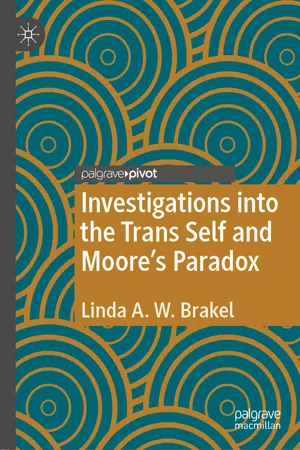
This book explores how the trans phenomenon can challenge the existing concept of the Self and its nature. The catalyst is Moore's Paradox: can a trans person coherently state 'I am a girl but I don't believe that'? More deeply, three fundamental philosophical questions arise, of ontological, epistemological, and conceptual significance: what Self understands that the natal-gender is 'wrong'? How does the trans person know that the natal-gender is 'wrong' and what counts as evidence? And finally, how does this effect the concept of Self itself?
- English
- ePUB (mobile friendly)
- Available on iOS & Android
eBook - ePub
Investigations into the Trans Self and Moore's Paradox
About this book
Information
Topic
PhilosophySubtopic
Mind & Body in PhilosophyPart IIntroduction
© The Author(s) 2020
L. A. W. BrakelInvestigations into the Trans Self and Moore's Paradoxhttps://doi.org/10.1007/978-3-030-44645-1_11. Introduction
Linda A. W. Brakel1
(1)
University of Michigan, Ann Arbor, MI, USA
Abstract
The Trans phenomenon occasions vexing questions about the concept, Self. The book’s catalyst is a Moore’s Paradox question: Can a natally-assigned girl state without incoherence: “I am a girl, but I don’t believe that”? Deeper questions arise: Ontological (what Self believes the natal-gender is “wrong?”), Epistemological (What does that Self know?), and Conceptual. This chapter provides the roadmap to avenues traversed toward addressing these matters. First, extant philosophical Self accounts are explored. Still seeking answers, the monograph turns to biology: An evolutionary proper-function account of gender/Trans-gender is developed. Then recent brain studies on Trans humans and sex-changing fish are reviewed. Finally, empirical Experimental Philosophy studies adapted from Classic Thought Experiments on Self are offered. Also introduced are “Contrast-Cases,” where the Self questions are less problematic.
Keywords
Trans phenomenonMoore’s Paradox“Wrong gender”Mainstream gender binaryThree fundamental questions—ontological, epistemological, conceptualContrast Cases1 Prelude to the Project
This monograph will take up aspects of the Trans experience in an unusual way, investigating the philosophical concept of Self—specifically exploring how the phenomenon of Trans-ness challenges existing concepts of the Self. There is an important assumption embedded here: Namely, that it is change in the concept of Self itself, rather than discovering any irregularities in Trans persons’ selves, that could advance a better fit between theory and reality. That said, let me introduce the project’s several launch sites, indicative of the book’s thoroughly interdisciplinary approach.
First, directly following Chapter 1, the current introductory chapter, Chapters 2–4 examine major categories of existing philosophical Self theories, demonstrating that they do not fare well in accommodating fundamental Self questions the Trans experience highlights. Chapter 2 explores four classical philosophical views of the Self—that of Descartes, Hume, Kant, and Freud. Chapter 3 takes up two classes of modern views—(1) the Self in self-constitution; (2) the Self or “me” I’m concerned with when self-survival is at stake. And Chapter 4 discusses selected gender-theorists on the Self.
Then in Chapter 5, the work takes a major turn, as an evolutionary “proper-function” account of gender and Trans-gender is developed and proposed, including a new ontological phenotype. This proper-function account links together some of the otherwise rather disparate views of the thinkers discussed in the prior chapters—and does so in a biologically relevant fashion.
Chapter 6, continues with biology, examining approximately twenty neuroscience brain research studies conducted over the last twenty-five years related to Trans- vs. Cis-gendered persons, and relevant to the proper-function analysis. I review the research, offer evaluative commentary thereupon, and conclude Chapter 6 with “proof-of-concept” analogies from sex-changing fish.
Chapter 7 consists of several empirical Experimental Philosophy (X-Phi ) Thought Experiments, each adapted from four well known classical Thought Experiments on the Self introduced in Chapter 3. These Experimental Philosophy studies were designed for two purposes: (1) to provide some diagnostic data about individual Trans persons, potentially useful toward future interventions; and (2) to gather evidence for (or against) the notion of a new ontological phenotype posited in earlier chapters of the project. Chapter 8, Summary and Conclusions, offers not only a summary review, but also an outlook for the future.
***
In reading this Prelude, one will perhaps already have become aware that something most often present in works about the Trans experience, is absent here. Indeed, this project does not include the always interesting, often compelling, personal and clinical accounts of and by Trans persons. This is a purposeful omission as the current project is one that is more a nomothetic than an idiographic exploration. Many, perhaps most other authors do take up the Trans phenomena in a personal subjective and/or individual clinical fashion. Moreover, I am confident that many will continue to do so, offering the insights they gain in myriad diverse forms: clinical reports, biographies, autobiographical books, and essays. I admire these works, and moreover appreciate their aims, but realize that my potential contributions, if successful, must arrive from the different tacks outlined above, and elaborated on in the pages to follow.
Now before I introduce the motivation for the project, which revolves around several unanswered, but central philosophical questions forming the core of this monograph, there are two more contextual preliminaries to present. They follow immediately below under the heading of “General Considerations about Trans Phenomena”.
1.1 General Considerations About Trans Phenomena
Other Cultures
Other cultures have frequently recognized more than two genders, i.e., persons who are considered outside of the ordinary mainstream binary of male or female, and instead represent some variation of a third gender. According to the Wikipedia entry for “third gender ,” there are a number of modern societies in addition to several historical ones with persons thought to have genders outside the typical binary genders, all acknowledged as people of one sort of so called “third gender” or another.1 Also, even in our current western mainstream culture,2 there are persons who are identified as fluid-gendered, mixed-gendered, unspecified gender, and non- or a-gendered. As important, interesting, and perhaps even predominant as these gender variants are, the focus of the present project will be centered on (1) denizens of the contemporary western mainstream, and in particular (2) those Trans persons who participate in the world of binary genders—male or female—but know and feel that their natal assigned gender is “wrong.” Narrowing the scope even more, this project will deal with individuals without any genetic or gonadal anomalies, and without major psychiatric diagnoses. This admittedly restrictive framework is adopted with the understanding that the most extreme, stark, unambiguous cases can best provide the clearest understanding of the conceptual phenomena on the nature of the Self to be explored.
Fish
Many species of fish routinely change sex. According to marine biologist Richard Francis (1992, p. 1) “…sex change is particularly common in several species of coral-reef fishes…[In] marine teleosts generally, [sex changing] may prove the rule rather than the exception.” In addition, several species have distinct morphs—natal males who become female-like in all but their gonads, and thereby are mismatched in terms of sexual gametes and gender as they develop. A model form of this de-coupling, as described by marine neuro-endocrinologist, John Godwin (2010, p. 209), includes so-called “parasitic male phenotypes” which while gonadally male, have the morphological and behavioral characteristics of females, not those of the “…large territorial male morph [with]…exaggerated morphological secondary sexual characters, [and] aggressive defense of a [breeding] territory…, and often conspicuous courtship behaviors.” These parasitic morphs, on the other hand, are described by Godwin (2010, p. 209) as female-look-alikes, in that they are “smaller…and do not display the morphological [bodily] specializations [for courtship and territorial defense] exhibited by the larger males…(examples of which include coloration, fin extensions…).” Found in a number of diverse species—wrasses, parrot fish, sunfish, some salmonids, and plainfin midshipman (pp. 209–211)—Godwin demonstrates the operative power of evolutionary reproductive fitness success gained for alternative morphs via the example of sunfish “satellite males” (2010, p. 209): “Parental males are large…exhibit display coloration, and defend nest sites that females visit to deposit eggs…while satellite males mimic females in order to join spawning pairs and [in this different way] release sperm.”
In species demonstrating complete sex change, as with those with alternative morphs, it is evolutionary reproductive fitness success that drives the system. It is my intention to introduce aspects of full sexual transition and gender/sex morph incongrui...
Table of contents
- Cover
- Front Matter
- Part I. Introduction
- Part II. Extant Philosophical Views of Self
- Part III. Biological Considerations
- Part IV. Future Investigations
- Back Matter
Trusted by 375,005 students
Access to over 1.5 million titles for a fair monthly price.
Study more efficiently using our study tools.
Frequently asked questions
Yes, you can cancel anytime from the Subscription tab in your account settings on the Perlego website. Your subscription will stay active until the end of your current billing period. Learn how to cancel your subscription
No, books cannot be downloaded as external files, such as PDFs, for use outside of Perlego. However, you can download books within the Perlego app for offline reading on mobile or tablet. Learn how to download books offline
Perlego offers two plans: Essential and Complete
- Essential is ideal for learners and professionals who enjoy exploring a wide range of subjects. Access the Essential Library with 800,000+ trusted titles and best-sellers across business, personal growth, and the humanities. Includes unlimited reading time and Standard Read Aloud voice.
- Complete: Perfect for advanced learners and researchers needing full, unrestricted access. Unlock 1.5M+ books across hundreds of subjects, including academic and specialized titles. The Complete Plan also includes advanced features like Premium Read Aloud and Research Assistant.
We are an online textbook subscription service, where you can get access to an entire online library for less than the price of a single book per month. With over 1.5 million books across 990+ topics, we’ve got you covered! Learn about our mission
Look out for the read-aloud symbol on your next book to see if you can listen to it. The read-aloud tool reads text aloud for you, highlighting the text as it is being read. You can pause it, speed it up and slow it down. Learn more about Read Aloud
Yes! You can use the Perlego app on both iOS and Android devices to read anytime, anywhere — even offline. Perfect for commutes or when you’re on the go.
Please note we cannot support devices running on iOS 13 and Android 7 or earlier. Learn more about using the app
Please note we cannot support devices running on iOS 13 and Android 7 or earlier. Learn more about using the app
Yes, you can access Investigations into the Trans Self and Moore's Paradox by Linda A. W. Brakel in PDF and/or ePUB format, as well as other popular books in Philosophy & Mind & Body in Philosophy. We have over 1.5 million books available in our catalogue for you to explore.