This book will be of interest to scholars, diplomats, and China watchers.
eBook - ePub
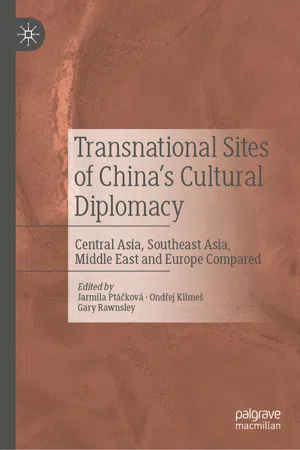
Transnational Sites of China’s Cultural Diplomacy
Central Asia, Southeast Asia, Middle East and Europe Compared
- English
- ePUB (mobile friendly)
- Available on iOS & Android
eBook - ePub
Transnational Sites of China’s Cultural Diplomacy
Central Asia, Southeast Asia, Middle East and Europe Compared
About this book
This edited volume presents the results of a three-year comparative study on Chinese cultural diplomacy (CD) across Europe, Central Asia, the Middle East, and Southeast Asia, which contributes to the broader theoretical debate on China`s increasing soft power in international relations. The study, 'China's Cultural Diplomacy and the Role of Non-State Actors' was conducted by a research team at the Oriental Institute of the Academy of Sciences of the Czech Republic from 2015 to 2018. This book pays special attention to China's localized forms of CD, focusing on the regional variations and involvement of non-state actors, especially local actors outside China. Local actors involved in Chinese CD diplomacy are characterized by their intermediary status as working for the aims of two states, while trying to bridge conflicts and enhance mutual understanding.
Information
© The Author(s) 2021
J. Ptáčková et al. (eds.)Transnational Sites of China’s Cultural Diplomacyhttps://doi.org/10.1007/978-981-15-5592-3_11. Introduction: The Soft Edges of China’s Hard Power
Jarmila Ptáčková1 , Ondřej Klimeš1 , Gary Rawnsley2 and Jens Damm3
(1)
Oriental Institute of the Czech Academy of Sciences, Prague, Czech Republic
(2)
University of Nottingham, Ningbo, China
(3)
Chang Jung Christian University, Tainan City, Taiwan
This book explores the contemporary cultural diplomacy of the People’s Republic of China (PRC). Cultural diplomacy can be defined as governmentally facilitated communication with a foreign audience through what is considered culture (Pánek Jurková 2018) or as an exchange of ideas, information, art, and other aspects of culture among nations and their peoples in order to foster mutual understanding (Cummings 2009). As a discipline of public diplomacy, cultural diplomacy generally allows for the involvement of actors that are not controlled by the state but can have a significant influence on the image-building of a society or a country.
The PRC’s public and cultural diplomacy, which for the ruling Communist Party of China (CPC) falls within the broader portfolio of ‘ideology and propaganda work’ (sixiang xuanchuan gongzuo), on the other hand, tends to make the participation of non-state actors conditional upon their conformity with the state’s narrative and policy (Xinhua 2018; Edney 2014; Passin 1963). According to the Deputy Minister of Cultural Affairs, Meng Xiaosi, the actors of cultural diplomacy are thus government agencies or those supported or promoted by the government (Meng 2005). These are major state institutions and media platforms such as the PRC’s diplomatic missions, China Cultural Centers, Confucius Institutes, China Global Television Network, China Radio International, and others, as well as various ‘people’s organizations’ (renmin tuanti) co-opted by the party-state. The concept of culture is an essential avenue of their engagement with foreign state institutions, non-state entities, transnational actors, and the general public with the aim of not only enhancing soft power and mutual understanding, but also implementing broader foreign policy objectives. It is also closely linked to domestic propaganda techniques and objectives (Edney 2014).
The CPC’s embrace of cultural diplomacy stems partially from the post-Maoist transformation of its politics. Following the implementation of the ‘reform and opening up’ (gaige kaifang) policy from 1978, Chinese academics and leaders gradually realized that states were more receptive to cultural exchange and cooperation than to a direct promotion of policy objectives (Ma 2010). In the Hu Jintao era (2002–2012), public diplomacy, national image, and soft power were identified by the CPC leadership as one of the PRC’s diplomatic priorities and, as in domestic propaganda, a wide range of themes from traditional Chinese ideology and discourse were adopted (Hu 2012; Yan 2011; Wang 2011; Callahan and Barabantseva 2011; Rabinovitch 2008; Kurlantzik 2007; People’s Daily Online 2007). CPC propaganda and public diplomacy’s thematization of culture, history, and tradition, as well as its embrace of Joseph Nye’s concept of soft power since the 1990s, simultaneously seek to overcome the negative impact inflicted on the country’s image by the 1989 Tiananmen massacre and build on the Mao-era diplomacy and united front work (Perry 2013; Nai 1992; Nye 1990).
Since Xi Jinping’s assumption of power in 2012, building ‘cultural soft power’ (wenhua ruanshili) through ‘external propaganda’ (duiwai xuanchuan), ‘cultural exchange’ (wenhua jiaoliu), and ‘public diplomacy’ (gonggong waijiao) has often been declared a key foreign policy objective. The CPC leadership hereby hopes to mitigate the stereotypes of China as a Communist dictatorship, a violator of human rights, and a producer of cheap and low-quality goods, and instead seeks to build a ‘national image’ (guojia xingxiang) as a relevant global authority. The CPC also seeks to solicit international acknowledgment for the PRC’s political and social order as a cultural and civilizational model. Public and cultural diplomacy promoting national consciousness and a feeling of cultural and moral superiority, building on China’s glorious past, are important tools to overcome the national trauma caused by the Western powers during the so-called century of national humiliation (bainian guochi), i.e., from the mid-nineteenth to the mid-twentieth century. The ‘Chinese dream’ (Zhongguo meng) of the ‘great rejuvenation of the Chinese nation’ (Zhonghua minzu weida fuxing) is one of the essential tropes of Xi Jinping’s policy and is meant to reinvigorate China’s international position and the legitimacy of the CPC (Zhu et al. 2019; Gil 2017; Yang 2017; Hartig 2016; Callahan 2015; Ford 2015; Wang 2014; Xinhua 2013a; Xi 2012).
Having only recently been perceived as a Third World country, in the last three decades the PRC has overwhelmed the international community with its impressive economic achievements. At the CPC’s Nineteenth National Congress in October 2017, Xi Jinping declared that in the upcoming era the PRC will aspire to ‘move closer to the center stage’ (zoujin shijie wutai zhongyang) of global politics and that it is willing to be the ‘preserver of international order’ (guoji zhixude weihuzhe; Xinhua 2017). According to the CPC, ‘Xi Jinping thought on socialism with Chinese characteristics for a new era’ (Xi Jinping xinshidai Zhongguo tese shehui zhuyi sixiang) is thus bound to become the guiding blueprint not only for domestic governance, but also in international affairs (State Council of the PRC 2019; Mardell 2017; Lam 2017). Such developments are in line with indications that the PRC would seek to expand its role in the global economy and politics from the beginning of the new millennium (Sutter 2019; Teufel Dreyer 2019; Shambaugh 2013; Xinhua 2013b, c; Zhu 2010). The CPC also seeks to increasingly extend its principles of domestic governance beyond the PRC’s borders as a more efficient and righteous alternative to the existing world order. To legitimize its regime as a global model of governance, China also points to the turbulent history and complicated present of ‘Western’ countries, interpreting multiple issues as a failure of democracy.
The PRC’s ascent on the global stage might somewhat obfuscate the CPC’s factual intentions. The broader objectives of the PRC’s cultural diplomacy and the proposed alternative world order are, in many ways, a conceptual and practical extension of its domestic governance (Rolland 2020; Callahan 2016; Wang 2014). The main internal propaganda themes, such as the allegedly ‘unique’ (dute) ‘cultural traditions’ (wenhua chua...
Table of contents
- Cover
- Front Matter
- 1. Introduction: The Soft Edges of China’s Hard Power
- 2. Cultural Diplomacy Today: A ‘Culture of Dialogue’ or a ‘Dialogue of Cultures’?
- 3. Xinjiang in China’s Public Diplomacy in Central Asia: Case Study of Almaty
- 4. China’s ‘Silk Road’ Public Diplomacy in Central Asia: Rethinking the ‘Network’ Approach to the Study of Public Diplomacy and Its Instrumentalism
- 5. Establishing a Common Ground—Admiral Zheng He as an Agent of Cultural Diplomacy in Malaysia
- 6. Two Confucius Institutes and a Cross-Border University as Sites of China’s Cultural Diplomacy in Malaysia: The Limitations of ‘Domestic Structures’
- 7. Attracting the Arabs? Promoting ‘Muslim’ China to Boost Regional Development in Ningxia Hui Autonomous Region
- 8. China’s Cultural Diplomacy in Berlin: The Impact of Transnational and Local Actors
- 9. Trajectory of Chinese Cultural Diplomacy: The Case of International Co-production of Documentaries
- Back Matter
Trusted by 375,005 students
Access to over 1.5 million titles for a fair monthly price.
Study more efficiently using our study tools.
Frequently asked questions
Yes, you can cancel anytime from the Subscription tab in your account settings on the Perlego website. Your subscription will stay active until the end of your current billing period. Learn how to cancel your subscription
No, books cannot be downloaded as external files, such as PDFs, for use outside of Perlego. However, you can download books within the Perlego app for offline reading on mobile or tablet. Learn how to download books offline
Perlego offers two plans: Essential and Complete
- Essential is ideal for learners and professionals who enjoy exploring a wide range of subjects. Access the Essential Library with 800,000+ trusted titles and best-sellers across business, personal growth, and the humanities. Includes unlimited reading time and Standard Read Aloud voice.
- Complete: Perfect for advanced learners and researchers needing full, unrestricted access. Unlock 1.5M+ books across hundreds of subjects, including academic and specialized titles. The Complete Plan also includes advanced features like Premium Read Aloud and Research Assistant.
We are an online textbook subscription service, where you can get access to an entire online library for less than the price of a single book per month. With over 1.5 million books across 990+ topics, we’ve got you covered! Learn about our mission
Look out for the read-aloud symbol on your next book to see if you can listen to it. The read-aloud tool reads text aloud for you, highlighting the text as it is being read. You can pause it, speed it up and slow it down. Learn more about Read Aloud
Yes! You can use the Perlego app on both iOS and Android devices to read anytime, anywhere — even offline. Perfect for commutes or when you’re on the go.
Please note we cannot support devices running on iOS 13 and Android 7 or earlier. Learn more about using the app
Please note we cannot support devices running on iOS 13 and Android 7 or earlier. Learn more about using the app
Yes, you can access Transnational Sites of China’s Cultural Diplomacy by Jarmila Ptáčková, Ondřej Klimeš, Gary Rawnsley, Gary Rawnsley,Jarmila Ptáčková,Ondřej Klimeš in PDF and/or ePUB format, as well as other popular books in Política y relaciones internacionales & Negocios en general. We have over 1.5 million books available in our catalogue for you to explore.