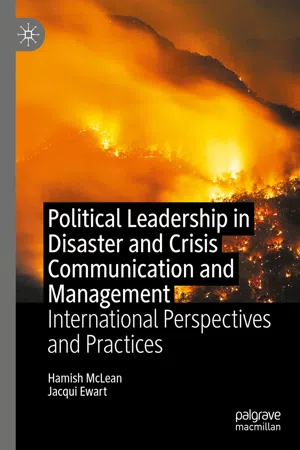
This book explores the role of elected leaders in disaster management. Filling a significant gap in disaster literature, the authors take a pragmatic approach to the relationships between the public under threat, the operational response, and the interests and actions of elected officials. Key tactics are explored, from the ways operational managers strategically deal with unreasonable political demands to what disaster officials argue is the responsibility of elected officials at all levels of government – that is, to ensure vital life-saving information reaches the people who need it most. The book draws on case studies such as the mismanagement of public perceptions by President George W. Bush during Hurricane Katrina in the United States and the widely acclaimed, heartfelt messages delivered by Queensland Premier Anna Bligh during the 2010–11 South-East Queensland floods in Australia. Drawing on a series of interviews with senior disaster managers in ten countries, this book is highly relevant for students, scholars and practitioners interested in disaster communication.
eBook - ePub
Political Leadership in Disaster and Crisis Communication and Management
International Perspectives and Practices
- English
- ePUB (mobile friendly)
- Available on iOS & Android
eBook - ePub
Political Leadership in Disaster and Crisis Communication and Management
International Perspectives and Practices
About this book
Information
© The Author(s) 2020
H. McLean, J. EwartPolitical Leadership in Disaster and Crisis Communication and Managementhttps://doi.org/10.1007/978-3-030-42901-0_11. Introduction
Hamish McLean1 and Jacqui Ewart1
(1)
Griffith University, Nathan, QLD, Australia
Keywords
Book outlineReconceptualizing researchResearch projectThis chapter is authored by Jacqui Ewart.
End AbstractIntroduction
This quote goes to the heart of what this book is about—that is, how politicians can demonstrate effective political leadership in disasters and crises. This book demonstrates the usefulness of academic research and the value that research can bring to those who manage and respond to disasters and crises. Through extensive interviews (listed in Appendix 1), we identify best practice for those managing the involvement of political actors in disasters and crises. These events are always political in nature, providing opportunities for politicians to capitalize on them in the hope that they will be re-elected; if an election is not looming, then they want to be seen to be helping their constituents. Our book brings to light the theoretical and practical factors that inform the management of the involvement of political actors in disasters. It addresses a largely unmapped area of disasters, which is how politicians might best engage with emergency organizations and various publics in the different stages of disasters and crises. In a disaster or crisis, the flow of timely and accurate information is regarded as a key factor in reducing harm to those caught up in and recovering from the event, and politicians can make an important and worthwhile contribution to this. We argue that bridging this significant gap in the disaster literature will help to build resilience across nations at all levels—local, state and federal. As we completed writing this book, the COVID-19 pandemic was in its first couple of months, and we noted with concern that some organizations had adopted an approach of business as usual. However, we argue that during a disaster or crisis such as this pandemic, a business as usual approach is not appropriate and indeed may have significant ramifications for businesses, organizations and, ultimately, people’s lives.I’ve very much got this thing, the more you can depoliticize disasters, the better. You’ll get better quality decision-making; otherwise you run it all around the noisy minorities and whomever the politicians think is the swinging voter. (SEM2, interview, 2013)
While we approach our book from the perspective that disasters are inherently political events, we also recognize that not all information provided during a disaster is political. For example, emergency management organizations are focused primarily on providing information that is aimed at preventing the loss of lives and, after the initial phase of a disaster, assisting with the recovery. The information provided to news media by those who witness or directly respond to disasters or crises is not driven by political concerns; however, various researchers have suggested that crises and disasters are ‘political events’ (Kelman 2012a; Liu 2007; Olson 2000; Olson and Gawronski 2010) and, as Kelman (2012b, p. 14) goes on to say, disasters are inherently political and it is ‘naïve to think otherwise’ (Kelman 2012b). Similarly, Wei et al. (2010, p. 1016) suggest that the type of information provided by official sources during a disaster is ‘always a political decision’. These researchers suggest that those managing disasters and crises are highly aware of the politicized nature of these types of events and also conscious that they can be seen as opportunities on which politicians can ‘capitalize’ if an election looms while shoring up their chances of re-election in the long term. The question that has not been explored by researchers is how those charged with managing planning and responses to disasters deal with the politicization of these types of events.
We were involved in crises and disasters management roles in our professional lives before joining academia. We have also been involved in researching and writing about disasters during our academic careers, and we have both been affected directly by natural disasters and crises, and also managed them. The project from which this book emerged involved interviews with a range of senior emergency managers in ten countries, and was prompted by a gap we identified in the existing research into disaster communication.
This book emerged from a research project that began in 2012 and continues today. We undertook dozens of interviews with top level emergency managers in Australia, New Zealand, Canada, the United States, the United Kingdom, Iceland, Mongolia, Germany, Norway and Sweden. While many of these interviewees were happy for their names to be used, others requested and were given anonymity for a variety of reasons, including that their reflections were made some time after they had left their relative positions and they did not want to appear to be speaking on behalf of the organization for which they had previously worked. They had been through a range of positive and sometimes negative experiences with politicians. We drew on their collective wisdom to inform various parts of our book and their combined wisdom will no doubt assist those managing disaster and crisis responses and politicians. Their wisdom also provides important lessons for political actors and their minders when confronted by a major emergency.
While researchers had approached the involvement of politicians in disasters from a political perspective—that is, by looking at whether they were re-elected following a disaster (e.g. see Abney and Hill 1966; Bodet et al. 2016; Healy and Malhorta 2009), we identified a major deficiency in relation to research about how they should perform and provide leadership in a disaster or crisis. We set out to address that with the help of our study participants, who had been involved in managing responses to disasters and crises for many years.
When we began our research project in 2012, we noticed that very little attention had been paid to analyzing how politicians behaved when communicating with the public during the various stages of disasters. This prompted us to begin to explore this issue, first in Australia where we are based and then, as opportunities arose, in other countries. While our interviews were often opportunistic, we were given access to some of the world’s leading disaster and emergency managers, who generously provided their time, expertise and insights into the questions that began to emerge from our research. Key among those questions was what effective political leadership looked like in disasters from the perspective of senior disaster and crisis managers. Our book focuses on this perspective because these people are frequently on the receiving end of demands from politicians, who are keen to capitalize on news media opportunities when disasters occur. Social media has also expanded opportunities for the aforementioned individuals to capitalize on disasters, while also presenting potential pitfalls and traps for them. The insights shared by our study participants in this book provide valuable tips and tools for those charged with managing politicians’ demands during the various phases of disasters. Conversely, their advice will be valuable for politicians who might be drawn into a disaster, regardless of whether they want to capitalize on the events or they are involved for other reasons.
We have discovered that relationships between politicians and disaster managers can be tenuous or strong. As Kuipers (2018, p. 186) explains, these relationships are symbiotic: ‘behind every great crisis leader there must be an institutional machinery that enables a decisive response’. However, sometimes the institutional machinery can break down when the desire of politicians to capitalize on a disaster overrides the need to ensure emergency managers have the space and resources to respond to the disaster and manage the aftermath. Given this, we take a pragmatic approach to our research, arguing that developing healthy and effective relationships between elected officials, emergency managers and communities when life and property are at stake during natural disasters requires more than theory: it demands practical tools and guidance.
Further, we have seen—and continue to see—that politicians often lack situational awareness when it comes to disasters and crises. At a time when disasters and crises are on the agendas of politicians and news media, and are increasingly prominent due to extremes in the intensity of natural disasters, we address a largely unmapped area of disasters. Urban and regional sprawl, coupled with sea and tree changers, has led to increasing numbers of people living in hazardous areas. Politicians have a key role to play in communicating about disasters and crises when the flow of timely and accurate information is regarded as a key factor in reducing harm to those caught up in and recovering from these events. In Australia and elsewhere in North America and the United Kingdom, there is a push from government to make individuals more resilient in relation to natural disasters. At a recent press conference, an Australian chief fire officer from Tasmania warned residents to prepare for the forthcoming bushfire season, telling them, ‘If you own the land you own the risk’ (Doyle 2018). Therefore, we take a pragmatic approach to developing healthy and effective relationships between elected officials, emergency managers and communities when life and property are at stake during natural disasters.
Drawing on our in-depth interviews, relevant research and examples, we focus on theoretical and practical factors that inform the management of political actors’ involvement in disasters. Themes that emerged from the data form the basis of a series of recommendations and a best practice model , both of which focus on improving the relationships between political leaders and emergency management personnel. We draw on key case studies that demonstrate the positive and negative influences of political actors on disaster responses and recovery, and how these influences are managed by various agencies. Each of the chapters in this book is designed to explore the issue at the heart of the book: how politicians can be effective leaders in disasters and crises. We aim to help bridge the working relationship gap between the tactical level—that is, the operational response—and the political level. We identify the issues that inform these responses and relationships, and offer solutions.
In Chap. 2, we discuss the politics of disasters, in particular why disasters are political events. While we know that not all people involved in a disaster find it a political event, the research has highlighted that many politicians view disasters as an opportunity to showcase their leadership and build momentum for re-election. We look at this issue for two reasons: disasters are increasingly affecting people and economies because more people are living in areas that are vulnerable to hazards; and politicians are increasingly getting involved in public communication at the critical stage—that is, when a disaster or crisis occurs. The economic costs of disasters are substantial. In 2017, for example, insurers around the world expected the cost of losses from natural disasters would be somewhere in the vicini...
Table of contents
- Cover
- Front Matter
- 1. Introduction
- 2. Extraordinary Politics in Catastrophic Times
- 3. Sampling Disaster Concepts
- 4. Political Leadership in Calamity
- 5. Frontline Realities
- 6. Managing Relationships
- 7. Voices of Reason
- 8. Minding the Minders
- 9. Lessons Learned and Best Practices
- Back Matter
Trusted by 375,005 students
Access to over 1.5 million titles for a fair monthly price.
Study more efficiently using our study tools.
Frequently asked questions
Yes, you can cancel anytime from the Subscription tab in your account settings on the Perlego website. Your subscription will stay active until the end of your current billing period. Learn how to cancel your subscription
No, books cannot be downloaded as external files, such as PDFs, for use outside of Perlego. However, you can download books within the Perlego app for offline reading on mobile or tablet. Learn how to download books offline
Perlego offers two plans: Essential and Complete
- Essential is ideal for learners and professionals who enjoy exploring a wide range of subjects. Access the Essential Library with 800,000+ trusted titles and best-sellers across business, personal growth, and the humanities. Includes unlimited reading time and Standard Read Aloud voice.
- Complete: Perfect for advanced learners and researchers needing full, unrestricted access. Unlock 1.5M+ books across hundreds of subjects, including academic and specialized titles. The Complete Plan also includes advanced features like Premium Read Aloud and Research Assistant.
We are an online textbook subscription service, where you can get access to an entire online library for less than the price of a single book per month. With over 1.5 million books across 990+ topics, we’ve got you covered! Learn about our mission
Look out for the read-aloud symbol on your next book to see if you can listen to it. The read-aloud tool reads text aloud for you, highlighting the text as it is being read. You can pause it, speed it up and slow it down. Learn more about Read Aloud
Yes! You can use the Perlego app on both iOS and Android devices to read anytime, anywhere — even offline. Perfect for commutes or when you’re on the go.
Please note we cannot support devices running on iOS 13 and Android 7 or earlier. Learn more about using the app
Please note we cannot support devices running on iOS 13 and Android 7 or earlier. Learn more about using the app
Yes, you can access Political Leadership in Disaster and Crisis Communication and Management by Hamish McLean,Jacqui Ewart in PDF and/or ePUB format, as well as other popular books in Social Sciences & Politics. We have over 1.5 million books available in our catalogue for you to explore.