Located at the intersection of world-literary studies and the environmental humanities, this book analyses how fiction and poetry respond to the ecological transformations entailed by commodity frontiers. Examining the sugar, cacao, coal, and oil frontiers in Trinidad, Brazil, and Britain, World Literature and Ecology shows how literary texts have registered the relationship between the re-making of biophysical natures and struggles around class, race, and gender. It combines a materialist theory of world-literature with the insights of the world-ecology perspective to generate compelling new readings of writers such as Rhys Davies, Yseult Bridges, Lewis Jones, José Lins do Rego, Ellen Wilkinson, Jorge Amado, Gwyn Thomas, and Ralph de Boissière. The book represents a timely intervention into a series of field-defining debates around peripheral realisms and modernisms, ecocriticism, and the energy humanities.
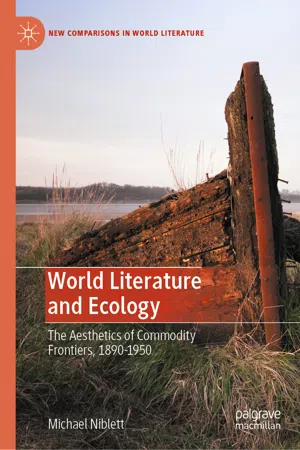
eBook - ePub
World Literature and Ecology
The Aesthetics of Commodity Frontiers, 1890-1950
- English
- ePUB (mobile friendly)
- Available on iOS & Android
eBook - ePub
About this book
Information
© The Author(s) 2020
M. NiblettWorld Literature and EcologyNew Comparisons in World Literaturehttps://doi.org/10.1007/978-3-030-38581-1_11. Introduction: Or, Fictions and Frontiers—The Making of the Modern World-Ecology
Michael Niblett1
(1)
Department of English and Comparative Literary Studies, University of Warwick, Coventry, UK
Consider four passages from four very different novels. First, José Américo de Almeida’s Trash (A Bagaceira, 1928), set on a sugar plantation in Paraíba in Brazil’s Northeast:
The grinding [of sugar-cane] continued, one might say, from midnight to midnight. The loose grinders vomited out pulp greater in volume than the cane it swallowed, while a steady jet of liquid spurted into the trough. […] [In the mill-yard], the workmen were stretched out in the sun like so many heaps of cane trash. (1978: 68–69)
Next, Ellen Wilkinson’s Clash (1929), which tells the story of the 1926 General Strike in Britain and its impact on the country’s coal mining communities:
Coal dust and the mud of the mines saturated the whole place. The coal-pit was the only thing in each village that mattered, the only part of life on which capital and care and brains were expended. Human beings were usually fed into its mouth at eight-hourly intervals, and just as regularly coughed up again. (2004: 146)
Third, Jorge Amado’s The Violent Land (Terras do sem-fin, 1943), an epic account of the cacao boom in the Brazilian state of Bahia in the early twentieth century:
The workers in the groves had the cacao slime on their feet, and it became a thick rind that no water could wash away. And they all of them – workers, jagunços, colonels, lawyers, doctors, merchants, and exporters – they all had that slime clinging to their souls. […] For cacao was money, cacao was power, cacao was the whole of life. […] Growing within them, it cast over every heart a malignant shade. (2013: 272)
Finally, Ralph de Boissière’s Crown Jewel (published in 1952, but first written in the 1930s), which narrates the industrial unrest by oilfield workers that precipitated a General Strike on the Caribbean island of Trinidad in 1937:
[Fyzabad] was a village of shacks set in an area from which oil was sucked day and night. A vampire desists when sated, but these pumps were never sated, they seemed to work without cease. Yet this and the workers’ shacks, some crumbling, […] others old and weathered, Popito took for granted, it was such an ordinary sight. (1981: 112)
Each of these passages describes a locality or region in which daily life is dominated by the production or extraction of a particular commodity. Despite differences in the historical and geopolitical contexts to which the four novels respond, there are clear similarities in their representation of the impact of the sugar, cacao, coal, and oil industries. Almeida’s image of the sugar mill remorselessly consuming cane, sucking out the energies of its workers until they resemble heaps of trash, is echoed in the ravenous maw of Wilkinson’s pit; in Amado’s invasive, debilitating cacao slime; and in the ceaseless, vampiric derricks and dilapidated shacks of de Boissière’s Fyzabad. There is a hint of the phantasmagoric about how all four writers figure this experience of exploitation. The commodities they refer to not only govern the organization of infrastructure and environment, but also saturate social relations and invade subjectivities, re-shaping thoughts, habits, and perceptions. Thus, the character of Popito in Crown Jewel has become so habituated to the sight of oil derricks and impoverished dwellings that he takes this landscape for granted. By exposing Popito’s acculturation to a world shaped by the production of oil, de Boissière’s novel draws attention to the specific configuration of human and extra-human natures on which such production depends. The same is true for the other texts cited here: in making visible the disruptive transformation of lives and landscapes characteristic of these sites of commodity production, each opens up a potential space for critique.
The above passages exemplify the central concerns of this book, which will explore the relationship between world-literature and commodity frontiers. How one defines a commodity frontier is (as we will see in Chapter 2) a complex issue. Provisionally, however, they can be described as zones of extraction or production that reorganize human and biophysical natures in such a way as to send vast reservoirs of relatively “cheap” food, energy, raw materials, and labour-power into the capitalist world-economy (Moore 2015: 53).1 By so doing, they help to reduce (or check) the tendentially rising value composition of capital, easing the pressure on systemic profit rates and advancing expanded accumulation. Propelled by capitalism’s endless quest for profit, however, they also tend to rapidly exhaust the socioecological conditions upon which their productivity depends. Indeed, frontier zones are peculiarly uneven and unstable phenomena, often combining advanced technologies with relatively archaic social modalities (forced labour, for example). Typically, too, they are sites in which processes of subject formation (such as the racialization or gendering of labour) occur in markedly overt or violent fashion—not least because they are frequently to be found in regions subject to imperialist domination.
My specific interest is in analysing fiction and poetry from 1890 to 1950 in terms of the ecological transformations through which the sugar, cacao, coal, and oil frontiers have developed. I will focus on work from three representative sites from across the world-system: Trinidad, the Northeast of Brazil, and Britain.2 My concern is with the way life- and environment-making processes have been registered not only at the level of content, but also at the levels of form, imagery, and style. To speak of “registration” is not to suggest that literary texts merely reflect or passively record the dynamics of commodity frontiers. Cultural practice is itself an ecological force, an integral pivot in humanity’s capacity to rework life, land, and the body. It is worth recalling here Raymond Williams’ exposition of Marx’s concept of “productive forces”: a “productive force,” writes Williams, is “all and any of the means of the production and reproduction of real life. It may be seen as a particular kind of agricultural or industrial production, but any such kind is already a certain mode of social co-operation and the application and development of a certain body of social knowledge” (1977: 91). Cultural forms, including literary works, can be grasped as productive forces in this sense, then: as a species of social knowledge fundamentally interwoven with the reproduction of material life. A novel or poem, that is, might not only depict a particular historical reality, but also help to produce it: narrative-making, we might say, is a mode of life- and environment-making.
Discussing the social impact of modernization in the early twentieth century, David Harvey contends that modernism in the arts provided “ways to absorb, reflect upon, and codify these rapid changes” (Harvey 1989: 23). Literary texts may well perform this kind of cultural work when it comes to the transformations engendered by commodity frontiers, supplying narratives that enable particular social groups to adjust to such transformations, or generating tropes and figures that help to imaginatively resolve specific socioecological antagonisms. But literature might intervene in more creative or critical ways too. As Williams writes: “sociology can describe social conditions more accurately, at the level of ordinary measurement. A political programme can offer more precise remedies, at the level of ordinary action. Literature can attempt to follow these modes, but at its most important its process is different and yet still inescapably social: a whole way of seeing that is communicable to others, and a dramatization of values that becomes an action” (1970: 58–59). The specific kinds of knowledge enabled by literary works can sensitize readers to the possibility of new types of social practice (including new ways of organizing nature) and new analytical optics. “A good novel,” claims Roberto Schwarz, “is a genuine event for theory” (2012: 22).
Schwarz’s understanding of the relationship between social reality and literary form is of central importance to the present study. Schwarz posits society in its relation to the literary object as “an internal force, encapsulated within a formal device that reconfigures itself autonomously” (2001: 31). “The material constraints of social reproduction,” he writes,
are themselves fundamental forms that, for good or ill, are impressed on the different areas of spiritual life, where they circulate and are re-elaborated in more or less sublimated or falsified versions: forms, therefore, working on forms. Or better – the forms discovered in literary works are seen to be the repetition or the transformation, with variable results, of pre-existing forms, whether artistic or extra-artistic. (2001: 25)
Literary form, in working on social (or socioecological) forms, will transform the latter in line with the logic of aesthetic practice. Thus, to take a relevant example, if we were to sift a novel or poem for signs of the ecological antagonisms of a particular commodity frontier, we might not find them at the level of thematic content, but they may well be present in transmuted form as, say, generic or stylistic discontinuities.
This book will probe the myriad ways in which the ecological realities of the sugar, cacao, coal, and oil frontiers have been reconstituted as a force internal to literary form. The particular historical and cultural contexts in which individual works originate, as well as the distinct political ecologies of these commodities, will impart an irreducible specificity to their fictional or poetic mediation. Nonetheless, it is my contention that the life- and environment-making dynamics of commodity frontiers provide fruitful grounds for a new form of world-literary comparativism.
* * *...
Table of contents
- Cover
- Front Matter
- 1. Introduction: Or, Fictions and Frontiers—The Making of the Modern World-Ecology
- 2. The Commodity Frontier and Its Secret
- 3. Fictions of Appropriation and the Nature of Frontier Romance
- 4. Romance, Realism, Modernism: Frontier Forms in the Work of Rhys Davies and José Lins Do Rego
- 5. The “Mangled” Body: Proletarian Writing and the Dialectic of Labour
- 6. “Stop the Oil!”: Narrative Energetics and the Political Ecology of Strikes
- 7. “We State the Facts”: Romance and Revolt in the Work of Jorge Amado and Gwyn Thomas
- Back Matter
Trusted by 375,005 students
Access to over 1.5 million titles for a fair monthly price.
Study more efficiently using our study tools.
Frequently asked questions
Yes, you can cancel anytime from the Subscription tab in your account settings on the Perlego website. Your subscription will stay active until the end of your current billing period. Learn how to cancel your subscription
No, books cannot be downloaded as external files, such as PDFs, for use outside of Perlego. However, you can download books within the Perlego app for offline reading on mobile or tablet. Learn how to download books offline
Perlego offers two plans: Essential and Complete
- Essential is ideal for learners and professionals who enjoy exploring a wide range of subjects. Access the Essential Library with 800,000+ trusted titles and best-sellers across business, personal growth, and the humanities. Includes unlimited reading time and Standard Read Aloud voice.
- Complete: Perfect for advanced learners and researchers needing full, unrestricted access. Unlock 1.5M+ books across hundreds of subjects, including academic and specialized titles. The Complete Plan also includes advanced features like Premium Read Aloud and Research Assistant.
We are an online textbook subscription service, where you can get access to an entire online library for less than the price of a single book per month. With over 1.5 million books across 990+ topics, we’ve got you covered! Learn about our mission
Look out for the read-aloud symbol on your next book to see if you can listen to it. The read-aloud tool reads text aloud for you, highlighting the text as it is being read. You can pause it, speed it up and slow it down. Learn more about Read Aloud
Yes! You can use the Perlego app on both iOS and Android devices to read anytime, anywhere — even offline. Perfect for commutes or when you’re on the go.
Please note we cannot support devices running on iOS 13 and Android 7 or earlier. Learn more about using the app
Please note we cannot support devices running on iOS 13 and Android 7 or earlier. Learn more about using the app
Yes, you can access World Literature and Ecology by Michael Niblett in PDF and/or ePUB format, as well as other popular books in Literature & Literary Criticism. We have over 1.5 million books available in our catalogue for you to explore.