eBook - ePub
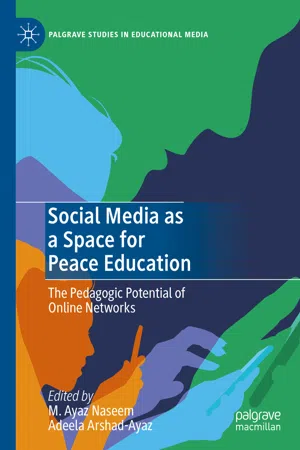
Social Media as a Space for Peace Education
The Pedagogic Potential of Online Networks
- English
- ePUB (mobile friendly)
- Available on iOS & Android
eBook - ePub
Social Media as a Space for Peace Education
The Pedagogic Potential of Online Networks
About this book
This book explores the potential of social media as a space for teaching and bringing about sustainable peace. Using cutting-edge research, the editors and authors analyze the fundamental transformations taking place in the digital and interactive public sphere, most recently with the advent of the 'post-truth' age and the impact of this upon young people's perceptions of 'friend' and 'foe'. Peace initiatives at almost every level recognize the importance of education for sustainable peace: this volume examines the opportunities emerging from these societal transformations for both formal and informal education. This book will appeal to students and scholars of social media, peace education and the post-truth age.
Information
Topic
ÉducationSubtopic
Éducation générale© The Author(s) 2020
M. A. Naseem, A. Arshad-Ayaz (eds.)Social Media as a Space for Peace EducationPalgrave Studies in Educational Mediahttps://doi.org/10.1007/978-3-030-50949-1_11. Introduction: Peace 2.0: Social Media as an Interactive and Participatory Space for Sustainable Peace Education
M. Ayaz Naseem1 and Adeela Arshad-Ayaz2
(1)
Department of Education, Concordia University, Montreal, QC, Canada
(2)
Educational Studies and Adult Education, Concordia University, Montreal, QC, Canada
The world that we live in is both dangerous and a hopeful place. The sheer scale of ongoing violent conflict is unprecedented. According to the global conflict tracker of the Council for Foreign Relations, there is conflict present in almost all inhabited parts of the world with the possible exception of Australia and New Zealand. The list of types of conflict on the Council for Foreign Relations global conflict tracker is long. It includes civil wars, interstate conflict, political instability, sectarian violence, territorial disputes, transnational terrorism, and unconventional conflicts (www.cfr.com). Most if not all of these conflicts are violent in nature; most if not all have been unchanging or getting worse over the past few years. The magnitude of violence in these conflicts can be gauged from the fact that four of these conflicts are categorized as ones with 10,000 deaths or more in the recent years. These include the war in Afghanistan, the Iraqi civil war, and the Syrian civil war. Furthermore, there are at least ten conflict regions where the death toll ranges between 1000 to 9999 deaths and 22 conflicts with around 1000 deaths in the current or past years.
Despite the sheer magnitude of destruction and violence, the desire for peace is also unprecedented. There are peace initiatives at almost every level; from United Nations’ initiatives to state level and from civil society to grassroots, interpersonal, and inter group levels. Actors and agents situated in and at the intersections of these initiatives realize that no one initiative on its own can bring about lasting and sustainable peace. They also understand that they must employ any and all means to combat the growing violence in the world. These actors and agents occupy (and use) all available spaces that can lead them to the goal of sustainable peace. One such space is the relatively new space provided by social media and interactive technology widely known as Web 2.0. Various social media, each with their own affordances and an essentially interactive nature, provide a space where people who were hitherto separated by physical distances, state controls, and other impediments can come together and interact reflectively and reflexively outside the space and structures provided to them by the nation-state discourses (among other discourses) in their respective countries (Naseem, this volume).
The dominant discourses including those of the state, education, media, defense, and foreign policies construct binaries between the self (national, religious, ethnic, etc.) and the national, religious, ethnic ‘other’. These discourses also create a binary between states (India-Pakistan; North and South Korea, etc.). Inherent in this binary construction is the inevitability of conflict. Unlike the statist discourses, social media potentially provides counter-hegemonic opportunities for resisting the dominant discourse. It also provides a space for interpersonal and intergroup interactions, and for contact outside of the dominant discursive institutions (Naseem, 2008; Naseem, 2015; Naseem, Arshad-Ayaz, & Doyle, 2017). The unmediated space provided by the social media also helps those who interact in this space in avoiding the experts’ gaze (Naseem, this volume). Hence, social media can be explored as a new space where subjects of states can converse without the mediation of state structures and the ‘gaze’ of the politicians, academics, clergy, and media. In this sense, social media can be seen as a space for sustainable peace education. We understand peace education not (only) as study of conditions that promote negative peace, that is, absence of conflict and violence, but as education that enables conditions for consciousness raising, collaboration, border-crossing, social and cognitive justice, and recognition of an ecology of knowledges.
Access to the Internet is a globally ubiquitous phenomenon. Whether the online environment is a new reality or merely the next step in human and social development is still undecided. However, there is no doubt that the online environments have spurned new forms of social, political, and economic networks and relationships. It will not be too far-fetched to say that the online world has a unique constitution and its own social and cultural capital. Social media users are not mere consumers/recipients of the discourses but also active producers of the discourses. Unlike the earlier understanding that the offline realities of the participants/subjects condition their online behavior and identity in the online environments, there is now a growing realization that the online realities and discourses condition the offline behaviors and identities of the subjects.
The omnipresence of the Internet and its offspring, social media, can be gauged from its wildfire popularity. According to some estimates, as of 2019, there are 3.84 billion social media users worldwide— approximately one-third of the global population (hootsuite.com). Out of these, a whopping 1.55 billion people have accounts and/or use Facebook for social networking. About 800 million people use Facebook Messenger to communicate with each other. Similarly, 320 million people use Twitter every month to communicate and/or to get their daily information, and 900 million users worldwide use WhatsApp.
Beyond the force of sheer numbers, social media have brought about changes in the social and political organization in societies, which has prompted some to think of it as a new reality that must be explored and researched in order to understand its full potential. For example, the use of social media in political and electoral campaigns has introduced a new scale of interactivity between the politicians (and their campaigns) and the voters/citizens (Poell & van Dijck, 2018; Tufecki, 2017; Tufekci & Wilson, 2012). While Barak Obama was called the ‘first social media president’ for his effective use of social media during his two presidential campaigns, Donald Trump’s use of social media to contact, mobilize, fundraise, and maintain contact with his electorate has been hailed as tremendous (Pain & Chen, 2019). President Trump’s use of Twitter to communicate policy decisions A.K.A. policy-by-tweet, and even for diplomacy has been unique even if controversial. Social media have also been implicated in meddling in national politics. A prominent (though contested) example is of the use of social media by Russia to allegedly manipulate the US election in 2016. A couple of reports commissioned by the US Senate note that Russia used social media (especially troll factories) in order to meddle in the US election by suppressing the African-American vote, promoting and/or vilifying particular candidates, and sowing disharmony in American public at large.
Furthermore, uni-directional traditional media such as newspapers and television channels have been forced to integrate interactive social media into their structures, thus creating a two-way exchange of ideas and feedback between the media and their readers/viewers. In this changed environment people are not merely consumers of news and ideas but also producers of ideas, thus prompting some to label them as ‘prosumers’ (Arshad-Ayaz, this volume). Last but not least, those involved in social movements have made effective use of the Internet and the social media to launch social and political action, to air grievances, to hold governments and authorities responsible, and to organize protests and rallies against and in support of social and political causes. Since the early 2010s a number of social movements have made significant use of social media to further their respective causes, to organize protest movements, and facilitate logistical and communicative networking. Some of the recent examples include (but are not limited to), the Arab Spring (2010s), the Occupy Movement (2011), printemps erable (the students’ movement in Quebec in 2012), Black Lives Matter (2012), and Idle No More (a Canadian First Nations’ Movement 2012). More recently, social movements such as the Me Too movement (2017), Times Up movement (2018), and the ongoing movement against citizenship legislation in India (2020) have relied heavily on different social media for logistical, communicative, and organizational purposes. While there is enough evidence to argue that social media was not the sole causal factor behind the emergence of these movements, it is also evident that the participants in these social movements made effective use of social media to mobilize and communicate.
At the micro level, individuals have used various social media to form new transnational communities that are based on common interests and issues. Due to their interactive nature, social media offer the users the space to transcend geographical boundaries and structures and be members of global publics (Bennett, Segerberg, & Yang, 2018; Bennett, Wells, & Freelon, 2011). As global publics, social media users actively engage in making political, social, and cultural meaning, both as producers and consumers (Arshad-Ayaz, this volume, Rheingold, this volume). Social media allow their users to participate in social, cultural, and political interactions through multiple genres and modes of participation (Ito et al., 2009; Nagle, 2017). The new media are also seen as spaces that help the marginalized by airing and discussing their particular grievances.
Notwithstanding the ubiquitous presence of social media in everyday life, they are not without their detractors and critics. Social media are seen by some as agents of new forms of cultural and knowledge imperialism, catering primarily to the interests of the developed world (Arshad-Ayaz, this volume, Fuchs, 2018). They are also seen as tools of a neo-liberal economic regime used to create a consumer culture that benefits the developed world (Fuchs, 2018). Social media are also seen as an arena where the forces of violence and peace are competing to gain the attention of the young (and older) social media users (Nagle,...
Table of contents
- Cover
- Front Matter
- 1. Introduction: Peace 2.0: Social Media as an Interactive and Participatory Space for Sustainable Peace Education
- 2. A Group of Youth Learn Why and How to Disrupt Online Discourses and Social Media Propaganda Around Syrian Refugees
- 3. Finding Ways to Connect: Potential Role of Social Media in Peace Education
- 4. From Head to Hand to Global Community: Social Media, Digital Diplomacy, and Post-conflict Peacebuilding in Kosovo
- 5. Educating for Sustainable Peace: Neoliberalism and the Pedagogical Potential of Social Media in Creating Conditions for Civic Engagement and Peace
- 6. Social Media for Peacebuilding: Going Beyond Slacktivim and Hashtagavism to Sustainable Engagement
- 7. Gendered Hashtactivism: Civic Engagement in Saudi Arabia
- 8. The Peace Educational Potential of Social Media: Multilogues of National Self-Regeneration in the Pakistani Blogosphere
- 9. Tavaana: E-Learning and the Online Civic Sphere in Post-Revolutionary Iran
- 10. Social Bots for Peace: Combating Automated Control with Automated Civic Engagement?
- Back Matter
Trusted by 375,005 students
Access to over 1.5 million titles for a fair monthly price.
Study more efficiently using our study tools.
Frequently asked questions
Yes, you can cancel anytime from the Subscription tab in your account settings on the Perlego website. Your subscription will stay active until the end of your current billing period. Learn how to cancel your subscription
No, books cannot be downloaded as external files, such as PDFs, for use outside of Perlego. However, you can download books within the Perlego app for offline reading on mobile or tablet. Learn how to download books offline
Perlego offers two plans: Essential and Complete
- Essential is ideal for learners and professionals who enjoy exploring a wide range of subjects. Access the Essential Library with 800,000+ trusted titles and best-sellers across business, personal growth, and the humanities. Includes unlimited reading time and Standard Read Aloud voice.
- Complete: Perfect for advanced learners and researchers needing full, unrestricted access. Unlock 1.5M+ books across hundreds of subjects, including academic and specialized titles. The Complete Plan also includes advanced features like Premium Read Aloud and Research Assistant.
We are an online textbook subscription service, where you can get access to an entire online library for less than the price of a single book per month. With over 1.5 million books across 990+ topics, we’ve got you covered! Learn about our mission
Look out for the read-aloud symbol on your next book to see if you can listen to it. The read-aloud tool reads text aloud for you, highlighting the text as it is being read. You can pause it, speed it up and slow it down. Learn more about Read Aloud
Yes! You can use the Perlego app on both iOS and Android devices to read anytime, anywhere — even offline. Perfect for commutes or when you’re on the go.
Please note we cannot support devices running on iOS 13 and Android 7 or earlier. Learn more about using the app
Please note we cannot support devices running on iOS 13 and Android 7 or earlier. Learn more about using the app
Yes, you can access Social Media as a Space for Peace Education by M. Ayaz Naseem, Adeela Arshad-Ayaz, M. Ayaz Naseem,Adeela Arshad-Ayaz in PDF and/or ePUB format, as well as other popular books in Éducation & Éducation générale. We have over 1.5 million books available in our catalogue for you to explore.