This edited volume examines cultural criticism in the digital age. It provides new insights into how critical authority and expertise in a cultural context are being reconfigured in digital media and by means of digital media, as the boundaries of cultural criticism and who may perform as a cultural critic are redefined or even dissolved. The book applies cross-media and cross-disciplinary perspectives to advance cultural criticism as a wide-ranging and multi-facetted object of study in the 21st century. Presenting a broad collection of case studies, including global cases such as the Golden Globe, the Intellectual Dark Web, YouTube, Rotten Tomatoes and Artsy and particular national contexts such as Britain, the Czech Republic, Denmark and the Netherlands, the book showcases the many theoretical and methodological approaches that may serve as useful frameworks for studying new critical voices in the digital age. It will be of interest to media, communication and journalism scholars as well as scholars from a range of aesthetic disciplines.
eBook - ePub
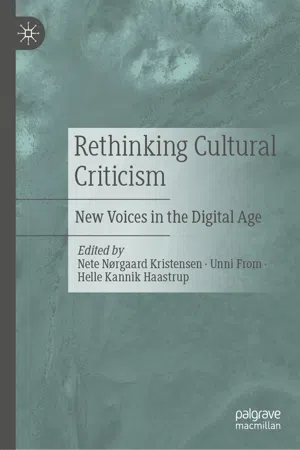
Rethinking Cultural Criticism
New Voices in the Digital Age
- English
- ePUB (mobile friendly)
- Available on iOS & Android
eBook - ePub
Rethinking Cultural Criticism
New Voices in the Digital Age
About this book
Information
Subtopic
Política© The Author(s) 2021
N. N. Kristensen et al. (eds.)Rethinking Cultural Criticismhttps://doi.org/10.1007/978-981-15-7474-0_11. Introduction: Rethinking Cultural Criticism—New Voices in the Digital Age
Nete Nørgaard Kristensen1 , Unni From2 and Helle Kannik Haastrup1
(1)
University of Copenhagen, Copenhagen, Denmark
(2)
Aarhus University, Aarhus, Denmark
Cultural criticism is constantly developing and diversifying. Institutional and technological media developments have enabled widespread public participation in debates about arts and culture over the past few decades. As a result, cultural criticism today comprises many different types of voices, which apply different stylistic formats and genres and which gain authority, visibility, and recognition across digital platforms in a wide variety of ways. These multiple cultural arbiters of taste, both old and new, address the cultural public sphere and its many sub-publics and communities in new and different ways, and these agents are situated at the complex intersections of agency and control within the connectivity afforded by platform society (van Dijck et al. 2018).
Being interdisciplinary, culturally diverse, and cross-mediated in scope, this edited volume investigates the complexity of contemporary cultural criticism and communication. It does so by bringing together scholars from different disciplines, including media studies, celebrity studies, journalism studies, cultural sociology, and cultural studies. The contributors to this volume thus apply various methodological approaches, among them historical perspectives, conceptual debates, qualitative textual analyses, surveys, and netnography, to study global cases such as the Golden Globe Awards, the Intellectual Dark Web, YouTube, Rotten Tomatoes, and Artsy.net. Some focus on particular national contexts, such as Britain, the Czech Republic, Denmark, and the Netherlands, while others focus on particular cultural domains, such as film, television, art, and wine, or on culture more generally. A common denominator is that all the chapters engage with cross-mediated cultural criticism, that is, the interactions of the (news) media industry, digital platforms, and social networking sites, situated within the hybrid media system (Chadwick 2013).
The book showcases how the increasingly heterogeneous group of cultural arbiters of taste perform critical authority and bring expertise to bear by combining emotional, experience-based, or subjective reactions to culture and cultural consumption that are typically produced bottom-up with the types of aesthetic knowledge and expertise about art and culture that have traditionally been exercised top-down (e.g., Kristensen and From 2015; Verboord 2014). This complex combination of voices and approaches means that communication and communicative performances of culture critical authority have changed considerably, which has challenged traditional cultural experts, such as intellectuals and journalists, and critical institutions, such as academia and the news industry. Digital media technologies have provided new platforms, such as social networking sites, file and video sharing sites, and aggregator sites, to produce and distribute cultural criticism, inviting users to adopt and develop the ever-changing digital media logics or platform vernaculars (e.g., Gibbs et al. 2015; van Dijck and Poell 2013).
Some scholars have lamented these developments in cultural criticism, highlighting the death of the critic (e.g., McDonald 2007), while others have emphasized them as examples of the constant uncertainties of cultural criticism (e.g., Chong 2020) or identified their innovative and democratizing potential (e.g., Frey 2015). This edited volume does not take sides in these debates. Rather than discussing these changes as opportunities or threats to critical cultural debate, it argues that the reconfigurations call for new types of research questions and cross-disciplinary approaches to advance cultural criticism in the digital age as a wide-ranging and multifaceted object of study in the twenty-first-century media landscape. Presenting a broad collection of case studies from various contexts, the book showcases the many theoretical and methodological approaches that may serve as useful frameworks for studying new culture critical voices in the digital age. On this basis, it provides new insights into how critical authority and expertise in a cultural context are being reconfigured in digital media and by means of digital media as the boundaries of cultural criticism, and who may perform as a cultural critic, are constantly renegotiated.
Studying cultural critics in the media is nothing new. Existing scholarship has provided single nation studies, especially within the Anglo-Saxon context (e.g., Blank 2007; Chong 2020; Frey and Sayad 2015; McDonald 2007; Orlik 2016; Rixon 2011); used specific disciplinary approaches or focused on a particular cultural domain or genre, e.g., film (Carroll 2009; Frey 2015; Frey and Sayad 2015; McWhirter 2016), literature (e.g., Chong 2020; McDonald 2007), or television (Bielby et al. 2005; Poole 1984; Rixon 2011); or examined cultural criticism on specific media platforms, e.g., newspapers (e.g., Purhonen et al. 2019), radio (Rixon 2015), or electronic media (Orlik 2016). By applying a cross-media, cross-disciplinary, and cross-national approach, this book aims to add to this existing literature by studying how cultural criticism is today performed across a range of interpretive, text-based and visual genres, platforms, and cultural fields.
In this introduction, we will first outline the book’s approach to its two key concepts, culture and criticism, which are both polysemantic and rich in meaning. Our goal is not to offer an exhaustive definition of either concept but to provide a context for the subsequent chapters and how they contribute new theoretical and empirical perspectives to current understandings of cultural criticism. Since cultural criticism is conceptually related to and encapsulates central aspects of critique and reviewing, we will also sketch how the chapters in the book engage with these dimensions of criticism. We then wish to contextualize the book in broader scholarly debates about changing notions of cultural authority and expertise occasioned by the hybrid media ecology and its intertwined mass media and social media logics, and how these developments reconfigure traditional valorization circuits and modes of performing cultural criticism. We will end by summarizing how the chapters in the book address these newer conditions for and dimensions of cultural criticism in the digital age.
Culture and Criticism
As the book centers on cultural criticism, it is relevant to briefly address our conceptualization of culture—a frequently used but also highly contested concept in and beyond humanistic research. A key reference in the literature is Raymond Williams, who identifies three definitions of culture in the modern understanding of the word (Williams 1976/1984, p. 90): The first refers to general processes of cultivation and to intellectual, spiritual, and aesthetic movements that originated in the eighteenth century. The second relates to culture as a particular way of life, “whether of a people, a period, a group, or humanity in general” (ibid.). The third relates to artistic activities, meaning that culture is music, literature, painting, sculpture, and film (ibid., p. 90). This book adopts the third definition of culture as artistic activities, which has become a dominant meaning in both everyday language and aesthetic scholarly debates. Historically, this definition conceptualized culture in a relatively narrow sense, as the arts, but, during the twentieth century, scholarly debates (also in media and journalism studies) broadened this definition of aesthetic culture to include popular culture as the boundaries between high art and popular culture have dissolved (e.g., Gans 1999; Purhonen et al. 2019). The chapters in this edited volume apply a...
Table of contents
- Cover
- Front Matter
- 1. Introduction: Rethinking Cultural Criticism—New Voices in the Digital Age
- 2. Public Intellectuals on New Platforms: Constructing Critical Authority in a Digital Media Culture
- 3. The Use of Wine as a Performance of a Style of Being: A Methodological Proposal to the Study of Persona-Driven Cultural Criticism
- 4. Fans, Fun and Homophobia: Mischievous Criticism on the Czecho-Slovak Film Database
- 5. When Golden Globes and Stars Align: The Awards Show as a Platform for Cultural Criticism
- 6. The Dual Strategic Persona: Emotional Connection, Algorithms and the Transformation of Contemporary Online Reviewers
- 7. How Has the Role of Newspaper-Based TV Critics Been Redefined in a Digital Media Landscape?
- 8. Digital Media in the Visual Art World: A Renewed Relationship with the Market
- 9. Young Voices, New Qualities? Children Reviewers as Vernacular Reviewers of Cultural Products
- 10. The Survival of the Critic: Audiences’ Use of Cultural Information and Cultural Reviews in Legacy Media
- 11. Where to Look Next for a Shot of Culture? Repertoires of Cultural Information Production and Consumption on the Internet
- Back Matter
Trusted by 375,005 students
Access to over 1.5 million titles for a fair monthly price.
Study more efficiently using our study tools.
Frequently asked questions
Yes, you can cancel anytime from the Subscription tab in your account settings on the Perlego website. Your subscription will stay active until the end of your current billing period. Learn how to cancel your subscription
No, books cannot be downloaded as external files, such as PDFs, for use outside of Perlego. However, you can download books within the Perlego app for offline reading on mobile or tablet. Learn how to download books offline
Perlego offers two plans: Essential and Complete
- Essential is ideal for learners and professionals who enjoy exploring a wide range of subjects. Access the Essential Library with 800,000+ trusted titles and best-sellers across business, personal growth, and the humanities. Includes unlimited reading time and Standard Read Aloud voice.
- Complete: Perfect for advanced learners and researchers needing full, unrestricted access. Unlock 1.5M+ books across hundreds of subjects, including academic and specialized titles. The Complete Plan also includes advanced features like Premium Read Aloud and Research Assistant.
We are an online textbook subscription service, where you can get access to an entire online library for less than the price of a single book per month. With over 1.5 million books across 990+ topics, we’ve got you covered! Learn about our mission
Look out for the read-aloud symbol on your next book to see if you can listen to it. The read-aloud tool reads text aloud for you, highlighting the text as it is being read. You can pause it, speed it up and slow it down. Learn more about Read Aloud
Yes! You can use the Perlego app on both iOS and Android devices to read anytime, anywhere — even offline. Perfect for commutes or when you’re on the go.
Please note we cannot support devices running on iOS 13 and Android 7 or earlier. Learn more about using the app
Please note we cannot support devices running on iOS 13 and Android 7 or earlier. Learn more about using the app
Yes, you can access Rethinking Cultural Criticism by Nete Nørgaard Kristensen, Unni From, Helle Kannik Haastrup, Nete Nørgaard Kristensen,Unni From,Helle Kannik Haastrup in PDF and/or ePUB format, as well as other popular books in Política y relaciones internacionales & Política. We have over 1.5 million books available in our catalogue for you to explore.