eBook - ePub
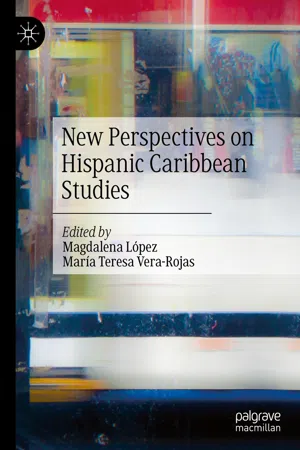
New Perspectives on Hispanic Caribbean Studies
- English
- ePUB (mobile friendly)
- Available on iOS & Android
eBook - ePub
New Perspectives on Hispanic Caribbean Studies
About this book
What are the main contributions of Hispanic cultural products and practices today? This book is a collection of essays on new critical trends in Hispanic Caribbean thinking. It offers an update on the state of Hispanic Caribbean studies through the discussion of diverse theoretical perspectives around notions of affect, archipelagic thinking, deterritoriality, and queer experiences and subjectivities. These eccentric Caribbean and aquatic imaginaries move beyond those that are circumscribed by identity, nation, insularity, and the colonial epistemologies derived from these conceptions. Due to its cultural and historical specificities, the Hispanic Caribbean constitutes a focus of study crucial to re-thinking global dynamics today.
Information
Print ISBN
9783030514976
© The Author(s) 2020
M. López, M. T. Vera-Rojas (eds.)New Perspectives on Hispanic Caribbean Studieshttps://doi.org/10.1007/978-3-030-51498-3_11. Introduction: New Theoretical Dialogues and Critical Reflections on Hispanic Caribbean Studies
Magdalena López1 and María Teresa Vera-Rojas2
(1)
Kellogg Institute for International Studies, University of Notre Dame, IN, USA
(2)
Departament de Filologia Clàssica, Francesa i Hispànica, Universitat de Lleida, Lleida, Spain
Keywords
Hispanic Caribbean studiesHispanic Caribbean literatureHispanic Caribbean cultureInsularismRaceDiasporaGenderSexualityUtopiaRevolutionIntroduction
What are the main contributions of Hispanic cultural products and practices today? New Perspectives on Hispanic Caribbean Studies explores new critical trends to the analysis of recent cultural phenomena. It offers an update on the state of Hispanic Caribbean studies through the discussion of theoretical perspectives around notions of affect, archipelagic thinking, deterritoriality, queer experiences and subjectivities, eccentric Caribbean and aquatic imaginaries instead of merely those circumscribed to identity, nation, insularity and colonial epistemologies derived from these conceptions.
This volume pursues two aims. Firstly, it examines diverse modes of experience in literature, film, visual arts and other cultural productions that impel us to re-evaluate the approaches of Hispanic Caribbean studies in the twenty-first century. And secondly, it explores the scope and limitations of transnational dialogues between Hispanic Caribbean studies and theoretical perspectives like postcolonial and decolonial studies, gender and sexuality studies, the posthegemonic turn and diaspora studies. We contend that, due to its cultural and historical specificities, the Hispanic Caribbean constitutes a focus of study crucial to re-thinking global dynamics today. Being the inaugural place of the multiples intersections and economic, imperial, ethnic, geographic and cultural flows that defined Western modernity, the Hispanic Caribbean outlines the complexity of the processes of so-called globalisation and its ambiguous consequences in vast segments of the world population.
Area studies emerged from the geopolitical knowledge dynamics of the Cold War. Starting in the 1960s, Latin American studies became an essential part of US and European academic landscapes. While area studies seem to suffer some exhaustion since the end of Cold War, we have witnessed in recent years a renewed interest in the analyses of the sociocultural dynamics of the Hispanic Caribbean. This has resulted in an increasing number of university courses and the funded research projects in this field, as well as expanding of congresses and dossiers in academic journals. As a location where diverse colonial, national, racial, gender, sexual, diasporic and even ecological issues converge, the Caribbean is today a particularly effective lens through which to consider complex and ever-changing cultural relations at both local and global levels.
The burgeoning interest in the Hispanic Caribbean contrasts with, and in a way responds to, the marginal position it has occupied in academia up to now. Traditionally, studies of the Hispanic Caribbean have been subsumed under the scope of Latin American Studies in the United States, and Hispanism in Europe. In both cases, and with the exception of Cuba, analyses of Hispanic Caribbean cultural productions have been overshadowed by other sources of interest, such as literature or audio-visual productions from Spain, Argentina or Mexico. Within the broader field of Caribbean studies, the cultural dynamics of Spanish-speaking territories have often suffered the same fate vis-à-vis their Anglophone and, to a lesser extent, French-speaking counterparts. Something similar occurs in postcolonial studies. Although the works of Anglo and French Caribbean authors such as C. L. R. James, Aimé Césaire y Frantz Fanon were key in the establishment the field, the Hispanic Caribbean region has been almost completely bypassed in critical debates, with notable exceptions, like Shalini Puri’s The Caribbean Postcolonial: Social Equality, Post-nationalism, and Cultural Hybridity (2004). Such invisibilisation responds to Anglo-cultural hegemony, but most importantly to the historical-cultural specificities that differentiate this region from most of its Latin American and Caribbean counterparts.
A central issue for the different contributions in this volume is the need to avoid the ontologisation of the Caribbean by means of different identitarian proposals. In this sense, it offers a critique to the different cultural categories under which the region has been defined, while it examines possible ways to think about the Caribbean in contingent, open-ended and mobile modalities. New Perspectives on Hispanic Caribbean Studies presents varied analytical approaches that de-territorialise conceptual frameworks for the study of the Hispanic Caribbean and its cultural productions. The different authors share a problematisation of the trends towards essentialisation, which has traditionally characterised approaches in area studies, and share the goal to conceive a Hispanic Caribbean “in relation to.” In his well-known book, Poetics of Relation (1997), Martinican writer Édouard Glissant proposes a “relational concept of being” to conceive the Caribbean away from any fixed notion, a sort of deconstruction of insularist and nationalist notions that have framed studies on the Caribbean. In line with Glissant, the different chapters of this book are informed by alternative notions to conceive Hispanic Caribbean studies, such as those that take into consideration bodies and affects, the unexpected and the sensorial, or even the materiality of a landscape to account for a different Caribbean, such as the “archipelago effect” as posited by Juan Carlos Quintero Herencia (2016); the notion of an eccentric Caribbean glimpsed by Juan Duchesne Winter (2012); and the experience of failure discussed by Magdalena López (2015). These authors propose a departure from the archive of the hegemonic Caribbean criticism, including its (de)colonial or insular determinants, the sugar plantation machine, the locus of mestizaje and the utopia of emancipation.
In this regard, contributions from the so-called posthegemonic, postsovereign or infrapolitical turn help us to delve into the Caribbean and its diverse cultural practices from a posthumanist, sensorial perspective from which to consider its politics beyond notions of representation, sovereignty and identity. In blurring geographic or national boundaries, the different chapters of this volume focus on the different networks and interrelations, with the effect that literary, conceptual and aesthetic debates, and debates about gender and sexuality, politics and social issues on the Hispanic Caribbean are also relevant for Latin America, Africa and the so-called Global South.
Identitarianism, Insularism and Liberationism in Hispanic Caribbean Studies
Latin American studies have often placed centre stage the colonial experience in America since the sixteenth century. A telling example is the by now canonical text El Caribe, frontera imperial (1970) by Juan Bosch, in which the region is determined by the imprint of European colonialism and US imperialism. More recently, so-called decolonial studies have updated an understanding of the colonial experience through “the coloniality of power,” a notion by Peruvian socialist Aníbal Quijano (1992) by which he accounts for the impact of the matrixes of global power of modernity on Latin American societies. In discussing the Caribbean, issues like the plantation economy and the related slave trade have been considered keys to unlock its sociocultural composition (Benítez Rojo 1992; Mintz 1986; Moreno Fraginals 1978) and its entry into global capitalist modernity (Buck-Morss 2009). These theoretical approaches are useful to understand the different historical power asymmetries in the system-world, but they have also implied certain degree of ontologisation, which in the Caribbean case has manifested in two ways: first, in the formulation of national, racial and insularist categories of identity, which solidify cultural dynamics; secondly, in the epistemic dependence of the Caribbean from Europe and in the historical development of the liberationist myth.
Alberto Moreiras (2015) has adverted about the identitarian obsession of Latin American literary and cultural studies, which answers to a humanist conception that understands the subject, and politics, in unitary and closed terms. The notion of a clearly defined Caribbean identity, even when the definition has embraced the region’s diversity, has permeated proposals that range from Martí’s mestizaje , Carpentier’s (1996) lo real maravilloso and Ortiz’s (1987) transculturación to Puri’s hibridity, Buscaglia-Salgado’s (2003) mulataje and Hall’s (1994) creolisation. These last three, the most recent of them, have certainly tried to provide certain dynamism but do not dispense from the defining notions often associated with national identities and racial paradigms.
Usually framed within debates about the nation and national identity (i.e., La raza cómica de Rubén Ríos Ávila (2002); Gay Cuban nation by Emilio Bejel (2001); and Escrituras del desencuentro en la República Dominicana by Nestor Rodríguez (2007)), Hispanic Caribbean studies have seldom concentrated on the social imaginaries...
Table of contents
- Cover
- Front Matter
- 1. Introduction: New Theoretical Dialogues and Critical Reflections on Hispanic Caribbean Studies
- 2. Towards an Archipelagic Effect ( ): Poetics, Politics and Sensorium in the Caribbean
- 3. Inland Caribbean: A Glance into Wayuu Space
- 4. Challenging a South Red Atlantic: A Post-Liberationist Critique of the Hispanic Caribbean
- 5. Place Becoming Space: Nation and Deterritorialisation in Cuban Narrative of the Twenty-First Century
- 6. Sea/See Fluids, Reimagined Landscapes: Looking into Lesbian Desire in Sand Dollars and Liz in September
- 7. Social Engagement and/against Creativity: Art Making, Collective Agency and the Politics of Urgency in the Hispanic Caribbean
- 8. The Queer Hispanic Caribbean: Contemporary Revisions of Its Genealogies
- 9. “Holland” in the Caribbean: Voids Between the Spanish-Speaking World and the Lower Countries
- 10. The Caribbean Without a Sea: Approaches to Caribbean Immigration in Madrid
- Back Matter
Trusted by 375,005 students
Access to over 1.5 million titles for a fair monthly price.
Study more efficiently using our study tools.
Frequently asked questions
Yes, you can cancel anytime from the Subscription tab in your account settings on the Perlego website. Your subscription will stay active until the end of your current billing period. Learn how to cancel your subscription
No, books cannot be downloaded as external files, such as PDFs, for use outside of Perlego. However, you can download books within the Perlego app for offline reading on mobile or tablet. Learn how to download books offline
Perlego offers two plans: Essential and Complete
- Essential is ideal for learners and professionals who enjoy exploring a wide range of subjects. Access the Essential Library with 800,000+ trusted titles and best-sellers across business, personal growth, and the humanities. Includes unlimited reading time and Standard Read Aloud voice.
- Complete: Perfect for advanced learners and researchers needing full, unrestricted access. Unlock 1.5M+ books across hundreds of subjects, including academic and specialized titles. The Complete Plan also includes advanced features like Premium Read Aloud and Research Assistant.
We are an online textbook subscription service, where you can get access to an entire online library for less than the price of a single book per month. With over 1.5 million books across 990+ topics, we’ve got you covered! Learn about our mission
Look out for the read-aloud symbol on your next book to see if you can listen to it. The read-aloud tool reads text aloud for you, highlighting the text as it is being read. You can pause it, speed it up and slow it down. Learn more about Read Aloud
Yes! You can use the Perlego app on both iOS and Android devices to read anytime, anywhere — even offline. Perfect for commutes or when you’re on the go.
Please note we cannot support devices running on iOS 13 and Android 7 or earlier. Learn more about using the app
Please note we cannot support devices running on iOS 13 and Android 7 or earlier. Learn more about using the app
Yes, you can access New Perspectives on Hispanic Caribbean Studies by Magdalena López, María Teresa Vera-Rojas, Magdalena López,María Teresa Vera-Rojas in PDF and/or ePUB format. We have over 1.5 million books available in our catalogue for you to explore.