This book examines the impact of Australian public opinion towards defence and foreign policy from the mid-twentieth century to the present day. For most of this period, the public showed little interest in defence and security policy and possessed limited knowledge about the strategic options available. The principal post-war exception to this pattern is, of course, the Vietnam War, when political divisions over Australia's support for the U.S.-led action eventually resulted in the withdrawal of troops in 1972. The period since 2001 has seen a fundamental change both in the public's views of defence and foreign affairs, and in how these issues are debated by political elites. This has come about as a result of major changes in the strategic environment such as a heightened public awareness of terrorism, party political divisions over Australia's military commitment to the 2003-11 Iraq War and the increasing overlap of economic and trade considerations with defence and foreign policies, which has increased the public's interest in these issues. Combining the expertise of one of Australia's foremost scholars of public opinion with that of an expert of international relations, particularly as pertains to Australia in Asia, this book will be a critical read for those wishing to understand Australia's alliance with the U.S., interactions with Asia and China, and the distinctive challenges posed to Australia by its geographic position.
eBook - ePub
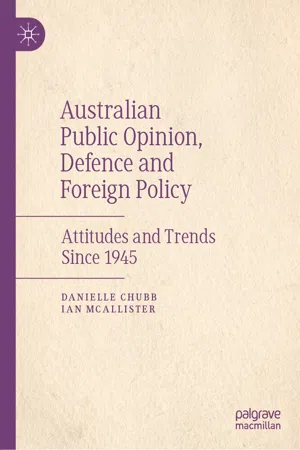
Australian Public Opinion, Defence and Foreign Policy
Attitudes and Trends Since 1945
- English
- ePUB (mobile friendly)
- Available on iOS & Android
eBook - ePub
Australian Public Opinion, Defence and Foreign Policy
Attitudes and Trends Since 1945
About this book
Information
© The Author(s) 2021
D. Chubb, I. McAllisterAustralian Public Opinion, Defence and Foreign Policyhttps://doi.org/10.1007/978-981-15-7397-2_11. Defence, Foreign Affairs and Public Opinion
Danielle Chubb1 and Ian McAllister2
(1)
School of Humanities and Social Sciences, Deakin University, Melbourne, VIC, Australia
(2)
School of Politics and International Relations, Australian National University, Canberra, ACT, Australia
For most of the twentieth century, with the exception of the two world wars, defence and foreign affairs were rarely the subject of vigorous political contestation. This has resulted in a long-running bipartisanship in Australian politics, which in practice has excluded these policy areas from robust political discussion or scrutiny. Such bipartisanship has sustained relatively low public interest in foreign and defence issues, and the public has for the most part possessed limited knowledge about the strategic options available and has expressed few firm views on defence policy, especially views that might stray from the orthodoxy. The principal postwar exception to this pattern was the Vietnam War and the eventual decision to withdraw troops in 1972. This event was at least partly due to political divisions over Australia’s support for the U.S.-led action.
The period since 2001 has seen a change in both the Australian public’s engagement with defence and foreign affairs issues, as well as how they are debated by political elites. A number of shifts in the strategic environment have contributed to this transformation, catalysed by a series of by now familiar events. The 11 September 2001 attacks in the U.S., followed in October 2002 by the Bali bombings which claimed the lives of 88 Australians, catapulted foreign affairs (and international terrorism) into mainstream political discourse. Australia’s military commitment to the Iraq War also raised the profile of defence policy, with major party divisions emerging over the government’s decision to support the 2003 U.S. intervention. This created a heightened public awareness of a policy area that usually attracts a great deal of bipartisanship.1 Alongside these major intervening events, globalisation has continued apace, bringing with it the overlapping of economic and trade considerations with defence and foreign policy and accordingly further increasing public interest in defence and foreign policy as it becomes more directly related to the everyday lives of Australians.
In parallel with these changes, advances in public opinion polling on issues related to foreign and defence policy have opened up opportunities to gain a stronger understanding of Australian attitudes. Prior to the late 1980s, defence and foreign affairs topics were rarely included in commercial polls. When they were, coverage was sporadic and the survey questions were often not repeated. This meant that any tracking of public opinion over an extended period was impossible. Since 1987 and the introduction of the Australian Election Study survey, and since 2005 and the introduction of the annual Lowy Institute survey on foreign affairs, such a database on public opinion has now become available for secondary analysis. For the first time, the systematic study of longitudinal trends in public opinion on defence and foreign affairs is possible.
This book utilises this wealth of public opinion poll data to examine ordinary Australians’ views about defence and foreign affairs in-depth, and over an extended period. The chapters that follow delve into the parliamentary debates, elite and public attitudes and media coverage of key moments in Australia’s foreign policy history. The aim is to provide a comprehensive understanding of the domestic imperatives that underpin defence and foreign policy decision-making in Australia and how they relate to public opinion. The analysis centres on three central questions: how has Australian public opinion towards defence and foreign policy evolved since 1945?; how responsive have successive governments been to public opinion?; and, finally, when and under what circumstances has public opinion shaped defence and foreign policy?
Foreign Policy and Public Opinion in International Relations
What the public thinks about foreign affairs, and whether foreign, defence or security policy is, or should be, shaped by public opinion, are questions that have been debated for many decades in the political science and international relations literature. Foreign policy realists, committed to foreign and defence policy that is shaped around material power considerations, tend to view public opinion as capricious and unpredictable, albeit potentially significant as a source of support for governments in their international pursuits (Morgenthau 1950: 100–104). For this group, public opinion is at best a distraction and at worst an impediment to effective policymaking.
In contrast, liberal perspectives place value in the potential for greater accountability and democracy to help create a more peaceful world, with public opinion playing a core role in this process. More recently, debate over the democratic peace grants gives explicit recognition to the link between public opinion and foreign policy outcomes (e.g. Owen 1994: 100–101). The idea that public opinion can place limits on the narrow pursuit of national interests is also found within liberal institutionalist strands of thought. Keohane and Nye (2001: 224) argue, for example, that the role played by the media in focusing the attentions of the public on certain human rights issues has influenced the responses of leaders, causing them to respond to one conflict rather than another.
These debates, interrogating as they do paradigmatic perspectives on the conduct of international relations, tell us very little about the nature of the opinion-policy link. The question of whether public opinion really matters in the formulation of foreign policy is one that is starting to attract some interest in the fields of international relations and Australian foreign policy, but has nonetheless received little systematic attention. The first section of this introductory chapter explores existing theories about public opinion and foreign policy, with a focus on competing explanations regarding the directionality of the opinion-policy relationship. Since this scholarship has been largely conducted within the scope of U.S. foreign policy, the second section turns the chapter’s attention to the question of how Australia fits into this picture, providing an overview of the politics of foreign policymaking in Australia and existing understandings about whether and how attitudinal factors are significant in the context of Australian defence and foreign policy.
Understanding the Foreign Policy-Opinion Relationship
What drives public opinion on foreign affairs? Is it inchoate, uninformed and unpredictable? Is the public mindset easily susceptible to elite views, or to partisan attachments? Do events drive opinion, which has a tendency to migrate towards outcomes that promise victory? Or do latent beliefs, values and principles form a strong basis from which public opinion towards foreign affairs is formed, similar to the processes that are seen to underpin opinion in the domestic policy space? Models of the role that public opinion plays in the foreign policy process tend to focus on either top-down or bottom-up explanations of the opinion-policy relationship.
In the decades following the Second World War, what has become known as the ‘Almond-Lippman consensus’ was widely accepted as self-evident: that public opinion on foreign policy is ill-informed, incoherent and as a result unlikely to exert significant influence over the foreign policymaking process (Holsti 1992: 443–445). This interpretation had its origins in more general postwar survey research which found that the public had little knowledge of politics, and had distinctly authoritarian tendencies. This led to the theory of democratic elitism, by which citizens should be permitted only to choose between competing political elites at regular elections. These elites would be the ‘carriers of the democratic creed’ and charged with defending minority rights and freedoms in the face of an intolerant mass public (Stouffer 1955; McCloskey 1964).
This consensus was seriously challenged during the Vietnam War and led, as discussed below, to the development of pluralist models of public opinion and foreign policy. The advent of sophisticated polling techniques also led to a refinement of new elite-driven understandings of the opinion-policy link. In these models, public opinion was now understood as mature (rather than inchoate), but was understood to find its substance in elite cues. This top-down understanding of public opinion puts events in the context of the information environment in which the public actually operates (Kertzer and Zeitzoff 2017: 545). Scholars such as Zaller (1990: 125, 200) argue that political awareness is an important element in the formation of public opinion and involves a process of socialisation, whereby elite cues and partisan loyalties help citizens who are politically aware translate information into various opinions. This top-down interpretation of public opinion finds predictability in the tendency of the public to interpret political debates through frames provided to them in the public sphere.
The first serious challenge to the elitist model of foreign policy and public opinion emerged with the Vietnam War, which served as a turning point for understanding the interaction between foreign policy decision-making and domestic political imperatives (Hudson 2008: 23): as the prospect of victory became ever more elusive, as casualties mounted, and as live footage from the battle was transmitted to televisions in households across the United States, public support for the war waned, and the U.S. government sought to disentangle itself from the conflict (Burstein and Freudenburg 1978). Influential works emerged to challenge the image of the public as both irrational and insignificant and have examined in detail the influence of elite and public opinion on the foreign policymaking process in the U.S., as well as decision making and outcomes (see, for example, Holsti 1992; Sobel 2001).
Out of these new pluralist models emerged work that acted as an optimistic rejoinder to the postwar cynicism of early thinkers (Kertzer and Zeitzoff 2017: 544). Here, data-driven political science underpinned by extensive survey research served as a counterpoint to received wisdom around public opinion (Holsti 1992: 445). Research found that, in fact, the public reacts in a pre...
Table of contents
- Cover
- Front Matter
- 1. Defence, Foreign Affairs and Public Opinion
- 2. Confidence in Defence and Foreign Policy
- 3. The Alliance with the United States
- 4. Forward Defence: Korea, Malaya and Vietnam
- 5. Overseas Deployments After Vietnam: East Timor and Iraq
- 6. Trade and Relations with Asia
- 7. Terrorism and Security
- 8. International Engagement
- 9. Conclusion
- Back Matter
Trusted by 375,005 students
Access to over 1.5 million titles for a fair monthly price.
Study more efficiently using our study tools.
Frequently asked questions
Yes, you can cancel anytime from the Subscription tab in your account settings on the Perlego website. Your subscription will stay active until the end of your current billing period. Learn how to cancel your subscription
No, books cannot be downloaded as external files, such as PDFs, for use outside of Perlego. However, you can download books within the Perlego app for offline reading on mobile or tablet. Learn how to download books offline
Perlego offers two plans: Essential and Complete
- Essential is ideal for learners and professionals who enjoy exploring a wide range of subjects. Access the Essential Library with 800,000+ trusted titles and best-sellers across business, personal growth, and the humanities. Includes unlimited reading time and Standard Read Aloud voice.
- Complete: Perfect for advanced learners and researchers needing full, unrestricted access. Unlock 1.5M+ books across hundreds of subjects, including academic and specialized titles. The Complete Plan also includes advanced features like Premium Read Aloud and Research Assistant.
We are an online textbook subscription service, where you can get access to an entire online library for less than the price of a single book per month. With over 1.5 million books across 990+ topics, we’ve got you covered! Learn about our mission
Look out for the read-aloud symbol on your next book to see if you can listen to it. The read-aloud tool reads text aloud for you, highlighting the text as it is being read. You can pause it, speed it up and slow it down. Learn more about Read Aloud
Yes! You can use the Perlego app on both iOS and Android devices to read anytime, anywhere — even offline. Perfect for commutes or when you’re on the go.
Please note we cannot support devices running on iOS 13 and Android 7 or earlier. Learn more about using the app
Please note we cannot support devices running on iOS 13 and Android 7 or earlier. Learn more about using the app
Yes, you can access Australian Public Opinion, Defence and Foreign Policy by Danielle Chubb,Ian McAllister in PDF and/or ePUB format, as well as other popular books in Politics & International Relations & Politics. We have over 1.5 million books available in our catalogue for you to explore.