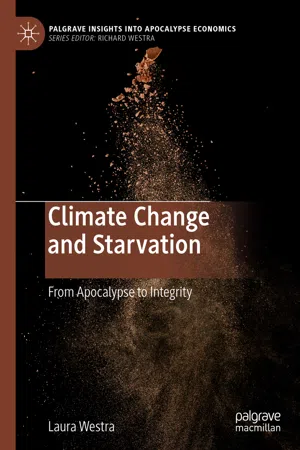
There is a lot written on climate change from various points of view, but this is the first work that demonstrates the connection between the hunger of the poor, the deprivation of safe and healthy food on the part of those who can afford it in the wealthy countries, but still face starvation in the sense of lack of nourishment, and climate change itself. It looks at the case law and the jurisdiction of the ICC, and adopts a thorough critical approach. This book is an excellent contribution to the development of the debate on climate change.
- English
- ePUB (mobile friendly)
- Available on iOS & Android
eBook - ePub
About this book
Information
© The Author(s) 2020
L. WestraClimate Change and StarvationPalgrave Insights into Apocalypse Economicshttps://doi.org/10.1007/978-3-030-42124-3_11. Introduction
Laura Westra1
(1)
Maple, ON, Canada
Laura Westra
Abstract
Westra uses the first chapter to explain the salient points of the situation. Climate change is now viewed widely as a crime against humanity, and the emphasis worldwide is on the power of young people, culminating in the crusade of Greta Thunberg, their spokesperson, but clearly visible through the media in the large peaceful but unyielding protests against the inaction of governments. The latter may agree in words but fail to act, as they pander to voters, be they coal miners, racists and migrant haters and non-white refugees. The central point of the work is the incapable connection between climate change and damages imposed by meat-based diets that inflict as much grave harms on the “haves” as they do on the “have nots”, albeit in a different manner. The combination of climate excesses and the ravages of hunger in all its aspects is nothing less than a veritable war, waged against the weakest and forest inhabitants of the world. The results of this war can be seen from the hordes of desperate migrants from South America to North Africa, to the Middle East. The food battle includes the fight against the corporate reliance on imposed GMOs and the toxic aspects of agribusiness. Forests and fields will be the most relevant part of the counteroffensive as will the protection of water and air: what is needed is a global governance that is aware of the reality on the group, not the correct reliance on weakened states unable to do more than close borders and walls against the desperate.
Keywords
Closed bordersIneffectual statesGreta ThunbergYoung people powerWar against the poor1.1 Climate Change and Starvation: From Apocalypse to Integrity
Climate change
is now openly called a crime against humanity, and at least in Europe, it is named as the most basic and important origin of new policies and goals for that continent. Children mount protests almost everywhere, and the originator of the children’s movements Greta Thunberg even sailed across the Atlantic to bring her message and that of the children in her movements to the White House. The 2019 G7 meetings debated it as well, while attempting to halt the most obvious sign of its presence, that is, the burning of the Amazon forests, and scientists join in signing declarations that proclaim that reality in all its manifestation while clearly indicting the guaranteed further disasters that await the world as a whole.
Yet each separate government, while proclaiming the truth of climate change in front of news cameras, still hesitates to eliminate their mines, whether at home or even abroad through their corporate citizens, and still continue to offer clear support to conservative political candidates, while denying their obligation to the migrants and refugees who, in order to escape the ravages of climate change, are forced to seek asylum, as melting glaciers, raising water levels, tsunamis, hurricanes, floods, wildfires and weather extremes everywhere confirm the presence of the situation state leaders still deny through their actions.
Equally missing from the main concerns of authorities, even those who are prepared to acknowledge climate change at least in principle, is the question of current diets, specifically the meat-intensive diets that the citizens of the affluent Western countries are led to believe are the only acceptable form of nourishment, while those in the poor countries elsewhere are aiming to achieve the same goal. But the question of food choices, as discussed in this Chap. 1, is too basic to be avoided: it will be the central point of this work.
Food production and consumption, as we will argue, is both a major causative agent of climate change and equally causative of many human rights breaches demonstrated by those affected: the obese. The obese, unhealthy people in wealthy countries, affected by multiple diseases, where cancer now has become the number one reason of death, beyond all cardiac problems. The effects of climate change are equally demonstrated by the starving, desperate refugees and migrants who are described erroneously as “attempting to better their economic conditions”, thus compared erroneously with those judged to be more deserving, as victims of a war situation. We will argue that what moves these people makes them essentially, whether it is from South American countries or countries in North Africa or the Middle East’ these people are essentially climate refugees, impelled to flee by starvation not the ideal of a future “better economic situation”.
In fact the results of Western choices in global governance, especially those related to food choices, are similar to what happens when a country invades another or an internal conflict arises, so the comparison, if not a true identification, with a war is totally appropriate. In addition, the “war” is waged by the wealthier and the stronger, against the weakest and most defenseless in the world. The means of these attacks may not be bombs, guns or other war implements as, we shall argue, the simple reliance on corporate power, especially that which is related to food production, is sufficient.
Of course the generally acknowledged sources of climate change are real and present, and we will examine them in turn, as we will discuss the retreat of the state in the face of the overwhelming power of corporate persons that control our air, water and the food we eat as well as, ultimately, climate itself. These entities are active globally but are not controlled by state laws as they exceed the state in power, nor are they controlled by international law, as they are not “nations”, but operate at another level altogether, a level international law has not yet been able to reach.
Hence we can conclude that non-state entities operate without any controls, so the damages they produce, no matter how grave, remain unpunished. This lack of control is particularly evident in the agricultural field, a field that is almost entirely in the hands of major corporations. These non-state entities control or at least direct North American states and extend that control through their monopoly of GMOs; related toxic products, intended to grow fodder; energy substitutes; and all the other products that produce harms from North to South America. Their control is partially extended to Europe, particularly North European countries.
The arguments provided to justify that noxious interference pander to the general ignorance of the public, their trust in their governments’ commitment to protect them and their (the agricultural corporations’) continued expressed falsehood: theirs, they say, is the only way to provide food for the world’s population. We have argued that rather than providing nourishment for the masses, as agribusiness asserts, their products deprive them of nourishment, while exposing them to a great number of physical and mental/emotional diseases from childhood and through to old age.1
In fact, the starvation that occurs from South America to North Africa, and which demonstrates their primary and ongoing role in climate change, originates precisely from agribusiness. Science, however, has indicated clearly a number of other sources of climate change, and we will detail each of these below, as they are, one and all, contributing factors; in fact each one has been emphasized in turn as the most significant in recent times. The role played by land and soil and by forests is the main theme discussed in 2019, as it is brought to the public attention by the terrible fires that burn the Amazon region. These forest fires emphasize precisely the main theme of this work: that is the primary role of agribusiness interests as it is the latter that are the main reason for those fires.
Then there is the role of water, equally central to agribusiness and certainly clear in the public eye because most of the obvious effects of climate change involve water, not only as melting glaciers but also as tsunamis, hurricanes and floods. Finally, air that is the basis of climate change is inquinated with constant toxic substances flowing from business operations and visibly changing the temperatures in ways that impose death of the most vulnerable.
In the next chapters, we will start with our personal responsibility defined: do we singly as world citizens and human beings have a real responsibility to work not only against climate change but also against starvation? After all science has been informing us, and knowledge builds first understanding and then responsibility. Science has been speaking clearly about all that is happening in the natural world, not through the authorities and government officials, but through the non-state movements and non-governmental organizations which are not constrained by the political ambitions of state leaders, but are prepared to address clearly the ecological realities on the ground. Lands and forests need to be understood and then respected for their double role, regarding both climate and hunger.
We will also review the issue of water, a basic necessity for agriculture, together with temperature extremes, a clear sign of all the disastrous effects of climate change. These direct climate change effects are combined with the indirect effects that originate from land grabs, which represent a related form of crimes against humanity, an equal contributor to climate change and to starvation as we shall see. It is at this level that the need for global governance is most urgent: our personal responsibility is acknowledged and ongoing, but radical changes in both international and local laws are urgent.
Global governance must acknowledge that the current legal regimes neither understand nor are prepared to approach some of the worst problems faced in almost all continents: the problem of desperate refugees attempting to escape both extreme climactic conditions and the starvation that faces them, as the two conditions are intimately connected. Nevertheless the legal systems, based on faulty understanding of the situation, confuse the means of the escape with the reasons for it. Hence, reacting to the problem with walls on the ground, closed ports on the seashores, rather than with joint national policies of aid and assistance that should transcend the politics of individual countries, is an additional crime in itself.
It is the starvation of these refugees that demands united, responsible and radically new treatment from existing legal regimes, a necessity based upon scientific evidence that is recent and thus exceeds the basis upon which previous legalities were founded. This was recognized by Judge Weeramantry who noted the same occurrences in his 1997 Separate Opinion in the Gabcikovo-Nagymaros Dispute.2 Judge Weeramantry
argued that as the science in 1997 had showed the environmental dangers involved in the project, decisions reached decades earlier could not stand: the law could not prescribe something that represented an attack on human rights, hence something against the principles of law itself.
Thus, the fact that humanity is one, north to south, east to west, now dictates that the scientific discoveries of recent times make the approach to legality of former times not only obsolete but morally wrong: today too, the law cannot and must not prescribe something that represents a direct attack on human rights. For that reason, on the final chapter, we will return to a principle I proposed twenty-seven years ago and have been clarifying and discussing for that length of time with a group of scholars in varied disciplines, united by a common understanding.
References
- Westra, Laura, 2018, On Hunger, International Press, Irvine, CA
- Gabcikovo-Nagymaros Project, IJC Reports 1996, J.C., Weeramantry Separate Opinion 1997
Footnotes
1
Westra, L. 2018, On Hunger, International Press, Irvine, CA.
2
Gabcikovo-Nagymaros Project, IJC Reports 1996, J.C., Weeramantry Separate Opinion 1997.
© The Author(s) 2020
L. WestraClimate Change and StarvationPalgrave Insights into Apocalypse Economicshttps://doi.org/10.1007/978-3-030-42124-3_22. Climate Change and Personal Food Choices
Laura Westra1
(1)
Maple, ON, Canada
Laura Westra
Abstract
Westra introduces the multifaceted argument of the work, connecting climate change and hunger and starting at the personal level. Each of us has a responsibility for the ongoing disasters following extreme climate situations which face us. Those who have the time and the interest to re...
Table of contents
- Cover
- Front Matter
- 1. Introduction
- 2. Climate Change and Personal Food Choices
- 3. Ecological Integrity and Climate Change
- 4. Aggravating Circumstances Corporate Power v. Democracy and Land Grabs for Fodder and Fuel While the Amazon Burns
- 5. Migrants and Refugees from South America to North Africa, Starvation and Climatic Conditions Not Acknowledged
- 6. The Principle of Integrity Revisited
- Back Matter
Trusted by 375,005 students
Access to over 1.5 million titles for a fair monthly price.
Study more efficiently using our study tools.
Frequently asked questions
Yes, you can cancel anytime from the Subscription tab in your account settings on the Perlego website. Your subscription will stay active until the end of your current billing period. Learn how to cancel your subscription
No, books cannot be downloaded as external files, such as PDFs, for use outside of Perlego. However, you can download books within the Perlego app for offline reading on mobile or tablet. Learn how to download books offline
Perlego offers two plans: Essential and Complete
- Essential is ideal for learners and professionals who enjoy exploring a wide range of subjects. Access the Essential Library with 800,000+ trusted titles and best-sellers across business, personal growth, and the humanities. Includes unlimited reading time and Standard Read Aloud voice.
- Complete: Perfect for advanced learners and researchers needing full, unrestricted access. Unlock 1.5M+ books across hundreds of subjects, including academic and specialized titles. The Complete Plan also includes advanced features like Premium Read Aloud and Research Assistant.
We are an online textbook subscription service, where you can get access to an entire online library for less than the price of a single book per month. With over 1.5 million books across 990+ topics, we’ve got you covered! Learn about our mission
Look out for the read-aloud symbol on your next book to see if you can listen to it. The read-aloud tool reads text aloud for you, highlighting the text as it is being read. You can pause it, speed it up and slow it down. Learn more about Read Aloud
Yes! You can use the Perlego app on both iOS and Android devices to read anytime, anywhere — even offline. Perfect for commutes or when you’re on the go.
Please note we cannot support devices running on iOS 13 and Android 7 or earlier. Learn more about using the app
Please note we cannot support devices running on iOS 13 and Android 7 or earlier. Learn more about using the app
Yes, you can access Climate Change and Starvation by Laura Westra in PDF and/or ePUB format, as well as other popular books in Economics & Development Economics. We have over 1.5 million books available in our catalogue for you to explore.