This book constructs a multidisciplinary approach to human security questions related to digitalisation in the European High North i.e. the northernmost areas of Scandinavia, Finland and North-Western Russia. It challenges the mainstream conceptualisation of cybersecurity and reconstructs it with the human being as the referent object of security.
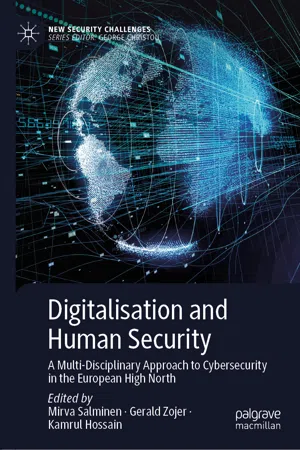
eBook - ePub
Digitalisation and Human Security
A Multi-Disciplinary Approach to Cybersecurity in the European High North
- English
- ePUB (mobile friendly)
- Available on iOS & Android
eBook - ePub
Digitalisation and Human Security
A Multi-Disciplinary Approach to Cybersecurity in the European High North
About this book
Information
Part IIntroduction
© The Author(s) 2020
M. Salminen et al. (eds.)Digitalisation and Human SecurityNew Security Challengeshttps://doi.org/10.1007/978-3-030-48070-7_11. A Human Security Perspective on Cybersecurity in the European High North
Mirva Salminen1 and Gerald Zojer1
(1)
Northern Institute for Environmental and Minority Law, Arctic Centre, University of Lapland, Rovaniemi, Finland
Digitalisation is rapidly changing both societies and human activities worldwide. This trend is also observable in the European High North, that is, in the northernmost parts of Finland, Sweden and Norway, as well as in north-western Russia. National and regional policies, as well as commercial endeavours, have been designed to advance digital development and/or to mitigate its harmful effects, although only limited attention has been paid to the interests, needs and fears of the people and communities experiencing this development. These efforts seek to sustain overall economic growth, to create cost-efficiency gains and/or profits, and to enhance national and/or organisational security. Yet, they mostly treat the people and communities living in the region as objects of development whose lives will be improved by digitalisation (Salminen & Hossain, 2018). By contrast, the primary aim of digitalisation and cybersecurity efforts should be the advancement of human wellbeing. This book addresses this recognised gap in both research and policy making. To justify the authors’ claim, the chapters focus on scrutinising digitalisation and security within the cyber-physical environment from a human security perspective. The concept of human security allows for a broader and deeper understanding of security by extending it to topics beyond mere state security through the inclusion of aspects such as environmental, economic, food, health, personal, community and political security, as well as by including other actors than states as both the objects and subjects of security production (Buzan & Hansen, 2009; Davi, 2009; Sheehan, 2005).
Following the end of the Cold War, the inter-, supra- and transnational security discourses have increasingly acknowledged the human being to be in need of protection and, hence, questioned the primacy of the state as the referent object of security. According to such a widened understanding of security, it is culture, human progress, identity and the physical integrity of individuals that need to be safeguarded (e.g. Commission on Human Security, 2003; Gasper, 2014; Martin & Owen, 2014). The 1994 United Nations Human Development Report contributed to the popularisation of the human security concept. The report, its successors and the work based on them acknowledge the interconnectedness as well as the potentially conflicting aspects of security with regard to human wellbeing and development (United Nations Development Programme [UNDP], 1994). The referent object of security is individuals and/or communities, who are suppressed not only due to the risks stemming from socio-cultural, environmental and economic stagnation, but also due to the inter-linked threats resulting from the practices of technological innovation. At the same time, the concept of human security offers a positive approach to understanding security, for example, through the utilisation of a wide range of opportunities to tackle security threats and to improve human wellbeing in an integrated manner.
While in a state-centred security approach powerful state actors, such as governments or policy-makers, define what is considered a security threat, the human security approach allows individuals and communities to define what they perceive to be threats and/or opportunities in relation to societal wellbeing (e.g. Salminen & Hossain, 2018). As such, a human security approach enables the affected people to voice their concerns, and it can also be used as a tool for empowerment (Hoogensen Gjørv, 2012). The concept of human security requires the endorsement of the linkages and interdependencies of issues, such as technological development and accessibility, societal inclusion, environmental threats, globalisation and human rights, as well as their connectedness to national security. It is inclusive of traditional security concerns, although it promotes a more comprehensive understanding of security (Hossain, Zojer, Greaves, Roncero, & Sheehan, 2017; Zojer & Hossain, 2017). The concept excels in assessing or studying human wellbeing in context-specific approaches in order to raise awareness of an issue or to motivate appropriate responses to it (Gómez & Gasper, n.d.). It provides added value when analysing the impacts of digitalisation on societies at the sub-state or interregional levels, such as the European High North and its particularities (Salminen & Hossain, 2018; Zojer, 2019). Yet, the main criticism levelled at the usefulness of the concept as an analytical tool is that human security is too wide to say anything substantial about security (Davi, 2009; Paris, 2001) and/or fails to challenge the hegemonic tendencies inherent in contemporary governance (Sahle, 2010). Regardless of such criticism, the authors of this book find a human security framework to be useful when analysing contextualised everyday (in)securities in the European High North, which often bring forth the effects of high-level decision-making in a very concrete manner.
While digitalisation can certainly be associated with societal impacts that are similar worldwide, regional peculiarities give rise to distinct sets of opportunities and challenges. The European High North is under scrutiny in this book because it has particular characteristics, such as socio-demographic differences when compared to the more southern parts of these countries, vast distances, a delicate balance between nature and human practices, limited resources and infrastructures, a harsh climate and vulnerability in the face of environmental threats. For instance, the population density in the north is significantly lower than the national average: in both Lapland and Norrbotten the population density is only about 10% of the nationwide population density.1 Due to this sparsity, there is less infrastructure in the north, meaning that some areas have poor mobile network connectivity, poor public transport and/or less health services. The distances to the nearest facilities can be vast, for example, both of the hospitals in Finnish Lapland are located in the southern part of the region (Rovaniemi and Kemi), which is several hundred kilometres and several hours drive away from the northernmost villages of the region. The population in the Nordic countries is generally decreasing, although northern urban areas are experiencing a population increase due to both immigration from outside and urbanisation processes within the region. Of those from within the region, women are more likely to move to urban areas than men, seeking better educational opportunities and more suitable employment. As a result, the rural areas in the north are dominated by a male population that is gradually decreasing (Heleniak & Bogoyavlenskiy, 2014; Rasmussen, Hovelsrud, & Gearheard, 2014). In general, the Nordic populations are ageing (Gassen & Heleniak, 2016), although the European High North has an even higher share of elderly people,2 a trend that is expected to intensify (Emelyanova & Rautio, 2012). In the northernmost areas, the gross domestic products are lower than the national averages.3 While in rural areas in particular non-marketed economic activities and subsistence remain important, the unemployment rates in the north are often higher than the national averages.4 Despite having lower household incomes and less labour market opportunities, many inhabitants of the circumpolar north rate their “satisfaction with life” as being high (Rautio, Poppel, & Young, 2014). Since parts of the European High North extend beyond the Arctic Circle, the winters are long and dark, and temperatures below −40 ℃ set the environmental conditions apart from those of the southern parts of the countries. Further, the European High North is the homeland of the Sámi, an indigenous people with several small linguistic groups.
These characteristics have only partially been recognised in the national digital frameworks of Finland, Sweden and Norway, or Russia (see Salminen, 2018). Aside from scrutinising the effects of top-down policies in terms of facilitating and securing digitalisation, it is important to investigate how the people and communities in the region interact among themselves. Such interactions will help to illuminate the associated needs and interests, as well as the fears, which people have with regard to intensifying digitalisation. Moreover, they will assist with generating ways and means to convey these needs, interests and fears in a bottom-up fashion, that is, to the decision-making processes through which the outlook for the digital European High North is framed.
The chapters included in this book depict both positive (enabling) and negative (threatening) potentials in relation to the regional digital development of the European High North. They focus on identifying ways to reinforce the positive potentials while diluting the negative ones. Moreover, in contrast to the dominant understanding of cybersecurity, as defined by governmental agencies or cybersecurity corporations, they allow room for local security perspectives. They highlight the societal cleavages that digitalisation brings forth or intensifies, while suggesting ways and means to overcome them. In the process, the chapters treat the people and communities living in the European High North as both the objects and subjects of digitalisation. People ought to have a say in, as well as an ability to influence, the transformations of their everyday living environment. Shifting the focus to the daily experiences of people and communities changes the definition of cyber threats and the resultant security measures. Rather than concentrating on technical and/or national security threats, threats to human wellbeing—as experienced by both individuals and communities—in the digitalising European High North are highlighted (Salminen, 2019; Zojer, 2019). The range of available security measures thus broadens to include, for example, active digital inclusion policies, cross-border infrastructural development and the innovative use of digital technology in anticipating food trends or animal disease outbreaks. This book does not, therefore, discuss mainstream cybersecurity topics such as cyberwar, digital espionage, recently detected advanced persistent threats or the technical specificities of a particular cyberattack.
The book presents some of the results of a three-year research project—Enablement Besides Constraints: Human Security and a Cyber Multi-disciplinary Framework in the European High North (ECoHuCy). The key theoretical and empirical interventions carried out during the project are threefold. First, to examine national digitalisation and cybersecurity policies together, rather than as two separate entities. The prevailing practice of principally associating digitalisation with economic benefits and opportunities, while framing cybersecurity in terms of threats to national security, renders the discussion regarding digital societal trajectories sporadic and spotty. Many important, perhaps even defining, phenomena may thus go unnoticed. Second, to position the human being at the heart of digitalisation, as discussed above. Third, to scrutinise the ongoing transformations in the context of the European High North. Both digitalisation and cybersecurity have thus far been only marginal research areas, for instance, in the field of Arctic studies—a state of affairs that this book aims to help change.
This edited volume is organised into five parts. It begins with this introduction and ...
Table of contents
- Cover
- Front Matter
- Part I. Introduction
- Part II. A Multi-Disciplinary Cybersecurity Approach
- Part III. Human Rights and Digital Infrastructure
- Part IV. Society and Environment
- Part V. Conclusions
Trusted by 375,005 students
Access to over 1.5 million titles for a fair monthly price.
Study more efficiently using our study tools.
Frequently asked questions
Yes, you can cancel anytime from the Subscription tab in your account settings on the Perlego website. Your subscription will stay active until the end of your current billing period. Learn how to cancel your subscription
No, books cannot be downloaded as external files, such as PDFs, for use outside of Perlego. However, you can download books within the Perlego app for offline reading on mobile or tablet. Learn how to download books offline
Perlego offers two plans: Essential and Complete
- Essential is ideal for learners and professionals who enjoy exploring a wide range of subjects. Access the Essential Library with 800,000+ trusted titles and best-sellers across business, personal growth, and the humanities. Includes unlimited reading time and Standard Read Aloud voice.
- Complete: Perfect for advanced learners and researchers needing full, unrestricted access. Unlock 1.5M+ books across hundreds of subjects, including academic and specialized titles. The Complete Plan also includes advanced features like Premium Read Aloud and Research Assistant.
We are an online textbook subscription service, where you can get access to an entire online library for less than the price of a single book per month. With over 1.5 million books across 990+ topics, we’ve got you covered! Learn about our mission
Look out for the read-aloud symbol on your next book to see if you can listen to it. The read-aloud tool reads text aloud for you, highlighting the text as it is being read. You can pause it, speed it up and slow it down. Learn more about Read Aloud
Yes! You can use the Perlego app on both iOS and Android devices to read anytime, anywhere — even offline. Perfect for commutes or when you’re on the go.
Please note we cannot support devices running on iOS 13 and Android 7 or earlier. Learn more about using the app
Please note we cannot support devices running on iOS 13 and Android 7 or earlier. Learn more about using the app
Yes, you can access Digitalisation and Human Security by Mirva Salminen, Gerald Zojer, Kamrul Hossain, Mirva Salminen,Gerald Zojer,Kamrul Hossain in PDF and/or ePUB format, as well as other popular books in Politics & International Relations & European Politics. We have over 1.5 million books available in our catalogue for you to explore.