This volume explores cross-cultural encounters with schooling among Chinese immigrant mothers in Canada. Using a narrative inquiry approach, the author sets out to spotlight the challenges facing immigrant parents and students as they begin to integrate into Western society and culture, specifically focusing on aspects of their experience including the intergenerational relationship between students and parents, home-school relations, and interactions with other Chinese immigrant parents. Chapters address intercultural differences as a reference point for understanding immigrant parents' views on schooling, moral education, and parenting practices.
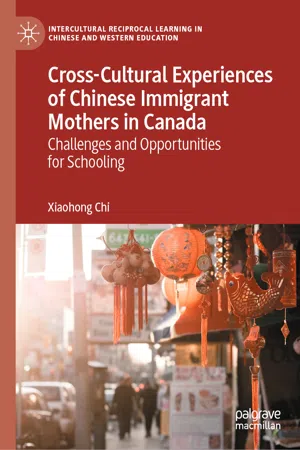
eBook - ePub
Cross-Cultural Experiences of Chinese Immigrant Mothers in Canada
Challenges and Opportunities for Schooling
- English
- ePUB (mobile friendly)
- Available on iOS & Android
eBook - ePub
Cross-Cultural Experiences of Chinese Immigrant Mothers in Canada
Challenges and Opportunities for Schooling
About this book
Information
Topic
EducationSubtopic
Comparative Education© The Author(s) 2020
X. ChiCross-Cultural Experiences of Chinese Immigrant Mothers in CanadaIntercultural Reciprocal Learning in Chinese and Western Educationhttps://doi.org/10.1007/978-3-030-46977-1_11. Introduction
Xiaohong Chi1
(1)
Department of English Education, Shanghai International Studies University, Songjiang, Shanghai, China
Xiaohong Chi
1.1 Prologue
This research is inspired by my personal experience in Canada. It is also closely linked with my academic training in both English literature and curriculum studies. As an international student from China, when I first started my student life at OISE, University of Toronto, a Canadian classmate commented, “China has such profound philosophy and culture, why would you want to study in Canada?” This is that kind of question that stays with you and the quest for an answer has accompanied my life as a foreign student. Upon graduation, I chose to go back to China and resumed my former teaching position at a university in Shanghai. Another question that was usually addressed to me by my friends and students is “Why do you choose to come back?” When I juxtapose these two questions together, I find that they actually embody a similar attitude: China vs. Canada. They are viewed as exclusive of each other. It has to be an either-or situation. This research, in some sense, tries to answer this question. From a personal point of view, I feel that the exchange of cultures is an act of reciprocity, and cultures grow and ripen by learning from each other. As part of the Reciprocal Learning book series, this book is also governed by the theoretical model developed by Connelly and Xu (2019), which views reciprocal learning as collaborative partnership. The liberating power of this approach lies in the fact that it breaks through the tradition of comparison and competition in cross-cultural and comparative studies, and goes one step further by asking the simple yet compelling question, “What are people learning from one another as they work together?” (p. 638). This is also what I try to find out in my research.
In fact, the concept of reciprocity is deeply rooted in both east and west cultural traditions. Ancient Roman philosopher Seneca (1995) described the Dance of the Graces in the following manner, “Why are the Graces three in number? …there is one to do the favor, a second to receive it and a third to return it… And what is the point of their holding hands in a dance that goes back on itself? That there is a sequence of kindness, passing from one hand to another, which comes back none the less to the giver, and that the beauty of the whole is lost if the sequence is anywhere interrupted, while it is loveliest if it hangs together and the succession is maintained” (p. 197). The harmonious and uplifting image of the dancing Graces epitomizes collaborative partnership. In Chinese culture, there has been the long-held tradition of viewing reciprocity as the foundation of various kinds of relationship. By tracing the major schools of philosophy in Chinese history, Yang (2009) summarized the essence of Chinese culture with the word “bao” (报 reciprocate and retribute). It can be regarded as a gluing force that connects the members of society together, while in the meanwhile, it serves as the guiding principle in the interaction between social members. The key is also mutually beneficial. Hayhoe’s (2007) portrait of influential Chinese educators also touches upon this feature in cross-cultural experience. When describing Xie Xide, the great scientist and educator who received education both in China and abroad, one of her colleagues notes, “Madam Xie seems to me a fine product of both Chinese and Western culture. She was like a shining ball – Westerners tended to see its Chinese side, while Chinese saw its Western side. She was actually a perfect combination or integration of these two” (pp. 202–203). Admittedly, Xie is an exceptional case, but obviously, the ability to learn from other cultures and internalize the newly acquired ideas into a harmonious wholeness with one’s native beliefs is deemed as an admirable trait. In the above comment, the person also emphasizes the balance and roundness of her character, which sets up an ideal for cross-cultural encounters. I am also fascinated by this phenomenon and have tried to shed light on potential ways of reciprocity between Canadian and Chinese cultures by taking a deep look into the parenting practice of Chinese immigrant families, thus echoing and complementing the research findings of Xu (2017) in the opening book of the Reciprocal Learning book series. To adapt to a new culture and thrive in this process demands a flexible and open attitude. I embark on this research with the intention of unraveling the cross-cultural experience of Chinese immigrants by scooping up their first-hand life stories.
During my doctoral study at OISE/University of Toronto, I was the tenant in a Chinese immigrant family. My landlord’s family immigrated to Canada from mainland China in 2000. Through daily interaction with the family, I noticed that the new environment poses challenges to the parents in their parenting practice and sometimes they even chose inaction since they, on the one hand, could not find a way to successfully communicate their ideas to their daughter, while, on the other hand, they were not sure if their way of parenting was suitable for a child living in a society different from mainland China in various aspects. This couple are not alone in this predicament. I have also made acquaintance with many other immigrants from mainland China. In our social gatherings, much of the conversation revolved around their children’s education and reflection on Canadian and Chinese school systems. Unanimously, the parents found Chinese school system highly demanding. Fierce competition and heavy workload leave the children barely no time for extracurricular activities. In the meanwhile, the schools in Canada do not exactly match the parents’ imagination. The parents have many concerns about their children’s school life in Canada, ranging from course content, ESL status, to school marks, social networking, university dropout, low motivation, and bullying issues. During these conversations, many Chinese parents stated that some aspects of the Canadian schools were different from or even ran counter to their expectation before they came here. The most coveted features of Canadian schools such as lighter workload, greater freedom, richer extracurricular activities, and greater chance of receiving post-secondary education, turned out to present new challenges for both the children and the parents. Some of these parents used to think that getting their children into a Canadian high school would guarantee admission to a post-secondary institute upon graduation. They regarded immigration as an alternative way for their children to get high-quality post-secondary education when their chances of passing the formidable gaokao (the National College Entrance Exam) seemed to be slim. The children going to universities would mean “mission accomplished” for the parents, but all of a sudden, some parents found themselves faced with the new situation where their children quit school in the middle of pursuing the bachelor’s degree, which proved to be the biggest nightmare for an immigrant family who has limited social capital in their adopted country. Bourdieu (1986) defined social capital as “the aggregate of the actual or potential resources which are linked to possession of a durable network of more or less institutionalized relationships of mutual acquaintance and recognition” (p. 248). And the “volume of the social capital possessed by a given agent…depends on the size of the network of connections he can effectively mobilize and on the volume of the capital (economic, cultural, or symbolic) possessed in his own right by each of those to whom he is connected” (p. 249). For Chinese immigrant parents who find their children drop out of school, there are not many resources for them to resort to in order to help their children find some alternative ways toward success.
According to the studies on immigrant families in Canada, many parents cite better education and career opportunities for their children as the major reason for immigrating (Anisef, Kilbride, Ochocka, & Janzen, 2001; Trueba, Cheng, & Ima, 1993). From my contact with many Chinese immigrant parents, their children’s school education more or less becomes the focal point of their life in Canada. Even for those who do not view their children’s schooling as a major factor in their decision to immigrate, their focus undergoes change as their families settle down in Canada. Their children’s induction into an educational system different from their own later proved to be an anchor for the whole family to stay put in the new place despite some maladjustment on the parts of the parents. These parents agree that continuity in their children’s education is very important. What’s more, there are many differences between the two systems, and if they pull their children out of their new school in Canada, they are afraid that their children would not be able to refit into the Chinese system. I heard many parents comment on this by saying, “If they (referring to their children) go back to a Chinese school, they will surely fail in their studies.” To ensure continuity of their children’s education, some parents choose to migrate between Canada and China. Such families are described in the literature as astronaut families, and the children are referred to as satellite children, or parachute children (Chiang, 2008; Goldstein, 2007; Lam, 1994; Tsang, Irving, Alaggia, Chau, & Benjamin, 2003; van den Hemel, 1996). “The astronaut family arrangement can be seen as a strategy of family survival to balance the multiple agendas of political security, developmental and educational needs of the children, financial well-being, family cohesiveness, and quality of life” (Tsang et al., 2003, p. 360).
In my research, two families lead such a life, but they would refer to this phenomenon as niulang (牛郎) and zhinv (织女), a life style that originates from a beautiful Chinese folklore story. In the story, the beautiful daughter of the Goddess of Heaven got tired of the life in heaven. She flew down to earth secretively and fell in love with niulang (牛郎), a cowherd. They enjoyed marital bliss and had two children. The Goddess was furious that zhinv married a mere mortal and forced her to go back to Heaven where she belonged. Niulang’s ox, who had magical power, helped him and his two children to fly up to the sky to look for zhinv. The Goddess used her hairpin to scratch a wide river yinhe (银河, which means Milky Way) in the sky to separate the lovers forever. But once a year, out of their deep sympathy, all the magpies in the world would fly up into the sky to form a bridge so that the lovers could be together for a single night, which is the seventh night of the seventh moon (You, 2000, pp. 70–73). The fact that the parents referred to themselves as niulang and zhinv bespeaks the emotional difficulties and the sense of helplessness in such a family life arrangement. Also, it shows their cultural background, and even their children may not know or understand the story behind the self-designation of niulang and zhinv.
1.2 Life in Transition
In the past two decades, mainland China has been one of the top source countries of immigrants in Canada (Citizenship and Immigration Canada, 2017). Among all the cities in Canada, Toronto is the number one landing place for newcomer families, topping the chart with the staggering number of 81,368 in 2016 (p. 25). In the meantime, with the surge in immigration, the Chinese community in Toronto is also undergoing rapid growth. Chinatown in downtown Toronto ...
Table of contents
- Cover
- Front Matter
- 1. Introduction
- 2. Cross-Cultural Perspectives on Chinese Immigrant Parents’ Experience
- 3. Multi-Faceted Stories of Chinese Immigrant Families
- 4. Intergenerational Relationships
- 5. Encounter with Canadian Schools
- 6. Interaction with Other Chinese Immigrant Parents
- 7. Major Findings
- Back Matter
Trusted by 375,005 students
Access to over 1.5 million titles for a fair monthly price.
Study more efficiently using our study tools.
Frequently asked questions
Yes, you can cancel anytime from the Subscription tab in your account settings on the Perlego website. Your subscription will stay active until the end of your current billing period. Learn how to cancel your subscription
No, books cannot be downloaded as external files, such as PDFs, for use outside of Perlego. However, you can download books within the Perlego app for offline reading on mobile or tablet. Learn how to download books offline
Perlego offers two plans: Essential and Complete
- Essential is ideal for learners and professionals who enjoy exploring a wide range of subjects. Access the Essential Library with 800,000+ trusted titles and best-sellers across business, personal growth, and the humanities. Includes unlimited reading time and Standard Read Aloud voice.
- Complete: Perfect for advanced learners and researchers needing full, unrestricted access. Unlock 1.5M+ books across hundreds of subjects, including academic and specialized titles. The Complete Plan also includes advanced features like Premium Read Aloud and Research Assistant.
We are an online textbook subscription service, where you can get access to an entire online library for less than the price of a single book per month. With over 1.5 million books across 990+ topics, we’ve got you covered! Learn about our mission
Look out for the read-aloud symbol on your next book to see if you can listen to it. The read-aloud tool reads text aloud for you, highlighting the text as it is being read. You can pause it, speed it up and slow it down. Learn more about Read Aloud
Yes! You can use the Perlego app on both iOS and Android devices to read anytime, anywhere — even offline. Perfect for commutes or when you’re on the go.
Please note we cannot support devices running on iOS 13 and Android 7 or earlier. Learn more about using the app
Please note we cannot support devices running on iOS 13 and Android 7 or earlier. Learn more about using the app
Yes, you can access Cross-Cultural Experiences of Chinese Immigrant Mothers in Canada by Xiaohong Chi in PDF and/or ePUB format, as well as other popular books in Education & Comparative Education. We have over 1.5 million books available in our catalogue for you to explore.