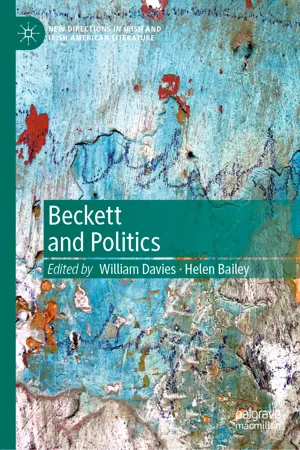
This collection of essays reveals the extent to which politics is fundamental to our understanding of Samuel Beckett's life and writing. Bringing together internationally established and emerging scholars, Beckett and Politics considers Beckett's work as it relates to three broad areas of political discourse: language politics, biopolitics and geopolitics. Through a range of critical approaches, including performance studies, political theory, gender theory, historicizing approaches and language theory, the book demonstrates how politics is more than just another thematic lens: it is fundamentally and structurally intrinsic to Beckett's life, his texts and subsequent interpretations of them. This important collection of essays demonstrates that Beckett's work is not only ripe for political engagement, but also contains significant opportunities for understanding and illuminating the broader relationships between literature, culture and politics.
- English
- ePUB (mobile friendly)
- Available on iOS & Android
eBook - ePub
Beckett and Politics
About this book
Information
Topic
LetteraturaSubtopic
Critica letteraria europea© The Author(s) 2021
W. Davies, H. Bailey (eds.)Beckett and PoliticsNew Directions in Irish and Irish American Literaturehttps://doi.org/10.1007/978-3-030-47110-1_11. Introduction
Helen Bailey1 and William Davies2
(1)
Loughborough College of Further and Higher Education, Loughborough, UK
(2)
University of Reading, Reading, UK
The notion that Beckett’s life and work can be understood in political terms has, for many decades, seemed a difficult and even contradictory prospect. His writing frequently depicts human pain, subjugation, isolation and disintegration—the collapse, even, of meaning itself—yet it often appears removed from the overtly political, positioning itself both textually and authorially as an exercise in atemporal, ahistorical and even apolitical utterances. Indeed, Beckett’s reputation and popularity have previously been founded on the perception of his work as resistant to politics: an intensely aesthetic body of work underpinned by an often radical, deracinated formalism, rather than any sort of politicism. Yet, as this volume and recent developments in the field demonstrate, there is no getting away from the political in Beckett. Politics shapes our world, the way we think, the way we act and the people, ideas and critical approaches we privilege over others. As such, the author, the work and the critic must all be ‘political’ in their own ways, even when they claim to be otherwise. As we will see, Beckett himself argued that the absence of political discourse in supposedly ‘apolitical’ writing was still, inescapably, a “political statement” (qtd. in Morin 249). In this way, while Harold Pinter was right in his encapsulation of Beckett’s work as a “body of beauty” concerned with the aesthetic possibilities of absence, desolation and hopelessness (“A Wake for Sam”), it is also clearly one of power, violence and manipulation, and the political conditions these entail. His work is as much concerned with the hegemonic implications of laughing in response to hopelessness, as it is with the pure depiction of that same hopelessness. The extent to which the question of aesthetics has remained distanced from political and historical readings shows that there is still much work to be done on the politics of Beckett’s writing.
Until recently, political engagements with Beckett’s work have largely been shaped by the writer’s own dismissive views around historical interpretations of art. His ambivalent comments and opinions about the historical, political and religious implications of his work are well documented, not only in terms of the historico-political conditions of his writing, but also his non- or even anti-political views when it came to the production of art. Writing in his review of Denis Devlin’s Intercessions, Beckett defined poetry (and art more generally) as a sphere of expression that should be “free to be derided (or not) on its own terms and not in those of the politicians, antiquaries […] and zealots” (Disjecta 91). When faced with the prospect of the political appropriation of art into narratives of national history or identity, his generally wary (and weary) rejection of historical readings would often escalate into much more virulent objections. This position contributed to his distancing from the cultural agenda of the Irish Revival and Irish Free State, as well as the national sensibilities of figures such as Thomas MacGreevy. Beckett expressed exasperation with MacGreevy’s historical approach to art and its incorporation into political narratives, lamenting that MacGreevy remained “Ireland haunted” and that the work he produced for publications such as The Father Matthew Record left Beckett “wishing again you [MacGreevy] were writing more for yourself and less for Ireland” (Letters II 75). This resistance to the political appropriation of art was by no means confined to Ireland. As France attempted to recover both culturally and intellectually from nearly half a decade of Nazi occupation and Vichy collaboration, Beckett strongly opposed the preoccupation French intellectuals and politicians had with various forms of humanism. He put this most starkly in terms of the potential “damage” that may be done to art and artistic interpretation, professing a clear suspicion of the humanistic rhetoric being “bandied around” (“La peinture” 131; trans. in Rabaté 19) by post-war French intellectual and cultural circles:
[…] For art should not to need cataclysms to be able to be practiced.
The damage is already considerable.
With “this is not human”, one has said it all. Throw it to the garbage can.
Tomorrow one will require that charcuterie be human. (“La peinture” 131; trans. in Rabaté 19)
Beckett’s concern with these intellectual-political forces demonstrates how his experience of occupied France and Vichy during the war refined the views he developed as a result of his encounters with the cultural and political agendas of pre-war Ireland and Nazi Germany. It was during his visit to the latter that he put it most succinctly, though: that the political co-option of art and writing could “start the vomit moving upwards” (qtd. in Nixon 87).
Alongside the often-disorientating effect of his aesthetic, Beckett’s views about the role of both history and politics in art have undoubtedly contributed to the obscured sense in which politics is imagined in his texts. However, thanks to the work of scholars attuned to the political and historical contexts often evoked in the author’s writing (including his letters and personal notes), we now have a much clearer sense not only of Beckett’s political activities but of the extent to which his political scruples shaped his writing. Contrary to his protests around the topic of historical interpretation and the traditional critical sense that Beckett wrote ‘outside’ of history (and so, seemingly, outside of politics), we now know that Beckett’s immersion in his contexts offered a significant well-spring for creative inspiration in his bid for abstraction and literary alienation. This manifests in various forms. Taking just one example, Seán Kennedy argues that the historical and political elements of Beckett’s work often appear by way of objects, place names and historical figures that emerge as “elements in flux that cannot be pinned down” (“Humanity in Ruins” 187), revealing a political awareness that nevertheless resists a straightforward representation of historical realities.
Later in life, Beckett became increasingly sympathetic to the political potential of art, even when it purported to contain no politics at all. As Emilie Morin reveals, Beckett’s attitudes often formed in direct response to the most significant historical and political events in the twentieth century:
Antonia Fraser recalls an evening with Beckett and Bray in 1979, during which Bray defended the slogan “everything is political”, which rallied the student and labour movements long after 1968. To this Pinter objected, “Nothing I have written, Barbara, nothing ever, is political”. And Beckett offered the reply familiar to any supporter of the 1968 movement: “This very absence of politics is in itself a political statement”. (249)
It is in the political potential of art qua art that we can locate a politics of creativity that Beckett may have sympathised with. To adjust Walter Pater’s axiom on the aesthetic encounter, this is the question of how far art can modify one’s own political nature (763)? Such a question reveals new ways of conceiving of the political in Beckett’s work. It also cautions us against the blind assumption that political inquiries into Beckett’s work require a predominantly historical focus. Indeed, the very nature of ‘politics’ requires us to use a much broader interpretive scope. Fundamentally centred around power structures, it encompasses a wide range of theoretical, biographical, social, historical, geographical, cultural, environmental and linguistic perspectives. As this volume demonstrates, political approaches to Beckett’s work reveal new vistas for exploring the relationship between historical criticism and vital theoretical and interdisciplinary approaches that begin to reckon with the full interpretive potential of his writing.
The ‘Political Turn’ in Beckett Studies
In early scholarship and criticism, explorations into the political aspects of Beckett’s works were broached by Darko Suvin (1967), Vivian Mercier (1977), Thomas Cousineau (1984), John Harrington (1991) and David Lloyd (1993). Harrington, Lloyd and Mercier’s studies foregrounded the uptake in later criticism of Beckett’s relationship with the history and politics of Ireland. Works such as Steven Connor’s Repetition, Theory and Text (1988, 2007 revised) also made clear the political potential of the post-structuralist strand of Beckett Studies at the time, revealing the inherent power dynamics at work in Beckett’s manipulation of language (188). However, it was not until after the publication of James Knowlson’s authorised biography in 1996 that the idea of a political Beckett gathered momentum. Here, it became clear that Beckett had encountered, first-hand, an unusually large number of political ideologies and events during his life. In the preface to Damned to Fame, Knowlson argues that the writer’s personal engagement with several political causes directly contradicts the ‘apoliticism’ often assigned to him:
When[,] as an Irishman, [Beckett] could have been neutral in the Second World War, he chose to join a Resistance cell of the British SOE and won the Croix de Guerre and the Médaille de la Reconnaissance Française. He was deeply committed to human rights; he firmly and totally opposed apartheid and was hostile from an early age to all forms of racism; he supported human rights movements throughout the world, including Amnesty International and Oxfam; he supported the freedom movement in Eastern Europe; and, although as a foreigner living in France he was wary of having his residential permit withdrawn, he was involved in a number of specific political cases. (xxii)
It has taken time for this picture of Beckett to be more widely accepted. Morin attributes the persistence of this ascription of apoliticism to Beckett to the fact that his political activities were not outspoken or radical enough to be of note to commentators and critics. They could not, for instance, be “shoe-horned into [the] familiar narratives of political literacy, activism and disenchantment” (23) that surrounded the likes of Sartre and Blanchot, because his outward gestures of political support were largely limited to causes that threatened the fundamental principles of his profession—namely, freedom of speech, freedom of movement and censorship—especially when those affected were known to him. Importantly, Morin notes, his support of these causes “almost exclusively benefited male artists and intellectuals with credentials that matched his own” (23).
Following the publication of Knowlson’s biography, the idea of a political Beckett began gathering pace in scholarly circles, with a section dedicated to Beckett, aesthetics and politics in the 2000 volume of Samuel Beckett Today /Aujourd’hui. The same year, Jennifer Birkett and Kate Ince published a reader on Beckett, which included significant commentaries on ‘political’ and ‘feminist’ Beckett, and traced previous critical attempts to unravel the political potential of Beckett’s work, from Darko Suvin and Raymond Williams, through Adorno, Deleuze and Guattari, to Julia Kristeva and Hélène Cixous (10–22). Here, Birkett and Ince brought together many of the early considerations of the political in Beckett, including Adorno’s famous appraisal of Endgame, Stephen Watt’s consideration of Beckett’s drama in light of his reading of Baudril...
Table of contents
- Cover
- Front Matter
- 1. Introduction
- Part I. Beckett & Language Politics: Editors’ Preface
- Part II. Beckett & Biopolitics: Editors’ Preface
- Part III. Beckett & Geopolitics: Editors’ Preface
- Back Matter
Trusted by 375,005 students
Access to over 1.5 million titles for a fair monthly price.
Study more efficiently using our study tools.
Frequently asked questions
Yes, you can cancel anytime from the Subscription tab in your account settings on the Perlego website. Your subscription will stay active until the end of your current billing period. Learn how to cancel your subscription
No, books cannot be downloaded as external files, such as PDFs, for use outside of Perlego. However, you can download books within the Perlego app for offline reading on mobile or tablet. Learn how to download books offline
Perlego offers two plans: Essential and Complete
- Essential is ideal for learners and professionals who enjoy exploring a wide range of subjects. Access the Essential Library with 800,000+ trusted titles and best-sellers across business, personal growth, and the humanities. Includes unlimited reading time and Standard Read Aloud voice.
- Complete: Perfect for advanced learners and researchers needing full, unrestricted access. Unlock 1.5M+ books across hundreds of subjects, including academic and specialized titles. The Complete Plan also includes advanced features like Premium Read Aloud and Research Assistant.
We are an online textbook subscription service, where you can get access to an entire online library for less than the price of a single book per month. With over 1.5 million books across 990+ topics, we’ve got you covered! Learn about our mission
Look out for the read-aloud symbol on your next book to see if you can listen to it. The read-aloud tool reads text aloud for you, highlighting the text as it is being read. You can pause it, speed it up and slow it down. Learn more about Read Aloud
Yes! You can use the Perlego app on both iOS and Android devices to read anytime, anywhere — even offline. Perfect for commutes or when you’re on the go.
Please note we cannot support devices running on iOS 13 and Android 7 or earlier. Learn more about using the app
Please note we cannot support devices running on iOS 13 and Android 7 or earlier. Learn more about using the app
Yes, you can access Beckett and Politics by William Davies, Helen Bailey, William Davies,Helen Bailey in PDF and/or ePUB format, as well as other popular books in Letteratura & Critica letteraria europea. We have over 1.5 million books available in our catalogue for you to explore.