- English
- ePUB (mobile friendly)
- Available on iOS & Android
eBook - ePub
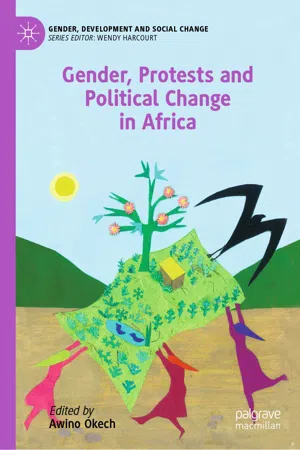
Gender, Protests and Political Change in Africa
About this book
This book brings together conceptual debates on the impact of youth-hood and gender on state building in Africa. It offers contemporary and interdisciplinary analyses on the role of protests as an alternative route for citizens to challenge the ballot box as the only legitimate means of ensuring freedom. Drawing on case studies from seven African countries, the contributors focus on specific political moments in their respective countries to offer insights into how the state/society social contract is contested through informal channels, and how political power functions to counteract citizen's voices. These contributions offer a different way of thinking about state-building and structural change that goes beyond the system-based approaches that dominate scholarship on democratization and political structures. In effect, it provides a basisfor organizers and social movements to consider how to build solidarity beyond influencing government institutions.
Chapters 3, 5, and 6 are available open access under a Creative Commons Attribution 4.0 International License via link.springer.com.
Frequently asked questions
Yes, you can cancel anytime from the Subscription tab in your account settings on the Perlego website. Your subscription will stay active until the end of your current billing period. Learn how to cancel your subscription.
No, books cannot be downloaded as external files, such as PDFs, for use outside of Perlego. However, you can download books within the Perlego app for offline reading on mobile or tablet. Learn more here.
Perlego offers two plans: Essential and Complete
- Essential is ideal for learners and professionals who enjoy exploring a wide range of subjects. Access the Essential Library with 800,000+ trusted titles and best-sellers across business, personal growth, and the humanities. Includes unlimited reading time and Standard Read Aloud voice.
- Complete: Perfect for advanced learners and researchers needing full, unrestricted access. Unlock 1.4M+ books across hundreds of subjects, including academic and specialized titles. The Complete Plan also includes advanced features like Premium Read Aloud and Research Assistant.
We are an online textbook subscription service, where you can get access to an entire online library for less than the price of a single book per month. With over 1 million books across 1000+ topics, we’ve got you covered! Learn more here.
Look out for the read-aloud symbol on your next book to see if you can listen to it. The read-aloud tool reads text aloud for you, highlighting the text as it is being read. You can pause it, speed it up and slow it down. Learn more here.
Yes! You can use the Perlego app on both iOS or Android devices to read anytime, anywhere — even offline. Perfect for commutes or when you’re on the go.
Please note we cannot support devices running on iOS 13 and Android 7 or earlier. Learn more about using the app.
Yes, you can access Gender, Protests and Political Change in Africa by Awino Okech in PDF and/or ePUB format, as well as other popular books in Politics & International Relations & African Politics. We have over one million books available in our catalogue for you to explore.
Information
Conclusion
How do you conclude a book with contributions that offer diverse accounts of very different contexts? The objective of this book was not to offer a set of policy propositions and my intention is not to summarise the conceptual pathways that each chapter may have opened up for a reader. However, a conclusion needed to be written so I have approached this task by identifying set of key themes explored by different chapters. Rather than treat each chapter in an isolated fashion, I draw out lessons based on what I consider shared analytical strands. These lessons are designed to speak to anyone interested in considering why gender disappears in discourses on youth-hood, protests and change or anyone who thinks about direct action as a critical tool for dissent.
In doing so, let me return to a moment that captures my approach to drawing out conclusions. In the summer of 2017, I travelled to Atlanta, Georgia where I visited the National Centre for Civil and Human Rights . In this well curated museum, visitors were taken through a visceral journey of the civil rights movement in the USA and the Jim Crow laws that shaped the resistance. One of the most well-known protest actions other than the bus boycotts were sit ins to protest segregated lunch counters in restaurants. In the museum, you listened to the preparation that protestors were given before embarking on the sit in. It was mental and physical preparation. Protestors were required to be mentally prepared for the racist abuse that would come their way and the physical harm that you were likely to face. In the museum, there was a lunch counter that simulated the experiences that those who signed up for the sit-ins had to go through. It was an invitation to step into the shoes of the brave civil rights activists. I sat down and followed the instructions before me. I put the headphones on, placed my hands on the counter, and closed my eyes. I was not prepared for what would follow because I felt every breath and every kick to the chair. It felt as though it was happening in real time. I did not last five seconds on the chair. It was all too much. I eventually returned to the counter simulation forty minutes later if only to prove to myself that I was strong enough to withstand the experience. It was not easier the second time around but I stuck it out. After that visit the tradition of organising that contemporary movements such as BlackLivesMatter became clearer to me. I understood why BlackLivesMatter had developed Healing Justice Healing Action and Conflict Resolution toolkits (n.d.). The Healing in Action toolkit centres an awareness of the self in relation to the collective and the demands that come with direct action. Both of these resources go into some fair detail about how roles are assigned, to the importance of food and hydration, to managing conflicts within the group and how those can harm action and the community resources to support protestors when they are arrested.
I return to this experience and memory because it speaks directly to a theme raised in four chapters in this book and this is the notion of preparation, safety and care for protestors. In Malebye’s chapter on South Africa, they raise the question of safety and care through an exploration of invisible labour and the militarised violence that protestors encountered as part of the FeesMustFall protests. The non-violent nude resistance by feminist dissenters as well as the insistence on acknowledging invisible labour was a conversation about whether movements account for the mental, physical and emotional costs that come with protesting. This is an issue that is also picked up by Felogene and Awuor in their chapter on Kenya. Granted a distinction needs to be made between large-scale protests that have different centres of organisational power and group-centred protests such as FeesMustFall where there are centralised sites of information dissemination and organisation. The key lesson articulated in both these chapters is not a question of better protest organisation but the fundamental silence about who protestors are and how the harms that are experienced on a physical and mental level are always shaped by gender, race and class. These chapters require us to think about the importance of factoring in a strategy for healing and support within political mobilisation processes. The underlying argument is that patriarchal logics often shape political mobilisation even where it is designed to achieve social transformation. The absence of collective care as a strategy for political organising and an inattentiveness to the legacies of structural exclusion on women and non-binary people is a direct result of the patriarchal underpinnings of protest movements. The emphasis on collective care is based on a longstanding feminist position that positions the gendered body as a political site (see Enloe 1990; Kandiyoti 1991; Yuval Davis 1997). By acknowledging the body as a political site means recognising that different regimes deposit their patriarchal anxieties on it and this often happens through material and discursive debates on respectability, morality, nature and societal order. Social justice movements reproduce these patriarchal anxieties, which makes the insistence by feminists on care as an important part of organising a radical act that disrupts patriarchy.
A second important lesson that is picked...
Table of contents
- Cover
- Front Matter
- Introduction
- Youth-Hood, Gender and Feminist Dissent
- Student Movements and Autocracies in Africa
- Fallist Feminist Futures in South Africa
- A Revolution Deferred: Sexual and Gender-Based Violence in Egypt
- The Revolution Continues: Sudanese Women’s Activism
- Women and the Anglophone Struggle in Cameroon
- Democratic Reversals in Burundi
- The Rise and Demise of the “New Dispensation” in Zimbabwe
- Embodying Protest: Feminist Organizing in Kenya
- Correction to: Gender, Protests and Political Change in Africa
- Back Matter