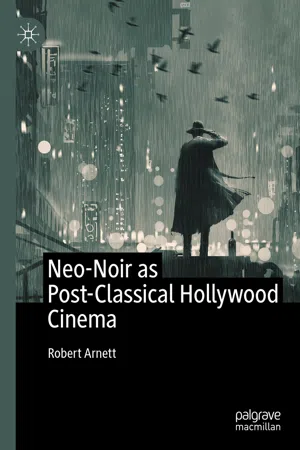
Neo-Noir as Post-Classical Hollywood Cinema suggests the terms "noir" and "neo-noir" have been rendered almost meaningless by overuse. The book seeks to re-establish a purpose for neo-noir films and re-consider the organization of 60 years of neo-noir films. Using the notion of post-classical, the book establishes how neo-noir breaks into many movements, some based on time and others based on thematic similarities. The combined movements then form a mosaic of neo-noir. The time-based movements examine Transitional Noir (1960s-early 1970s), Hollywood Renaissance Noir in the 1970s, Eighties Noir, Nineties Noir, and Digital Noir of the 2000s. The thematic movements explore Nostalgia Noir, Hybrid Noir, and Remake and Homage Noir. Academics as well as film buffs will find this book appealing as it deconstructs popular films and places them within new contexts.
- English
- ePUB (mobile friendly)
- Available on iOS & Android
eBook - ePub
Neo-Noir as Post-Classical Hollywood Cinema
About this book
Information
Subtopic
Film & Video© The Author(s) 2020
R. ArnettNeo-Noir as Post-Classical Hollywood Cinemahttps://doi.org/10.1007/978-3-030-43668-1_11. Introduction
The term neo-noir, representing a concept that binds together a group of films, has become diffused and simplified to the point of uselessness. Neo-noir developed an amorphous quality wherein it seems any film or television show featuring any combination of a detective, a crime, a handgun, a hat, and some moody lighting qualified as noir. Raiders of the Lost Ark (1981) (Abrams 2009, 12)? Die Hard (1988) (Bould 2005, 93)? If we attach “noir” to every genre, eventually it becomes pointless for both the subject genre, which could contain its own darker variations, and for noir as modifier. Much of the problem stems from using the term neo-noir as a vehicle for other critical concerns, such as international cinemas, issues of representation, other genres, marketing, and audience, all viable and worthy topics, but more concerned with the advancement of their non-noir topic than with an understanding of neo-noir. As Mark Bould points out, what qualifies as neo-noir became “fuzzier,” prompting the question, can one “talk about any film as noir if it is illuminating to do so, regardless of what one might consider its dominant generic tendency?” (92). In other words, neo-noir takes a backseat to another research agenda. Consequently, noir criticism lost sight of the purpose of neo-noir, and neo-noir as a concept became generalized, amorphous, and, ultimately, misunderstood.
How neo-noir became something “fuzzy” began during the transition from the classic noir period to the neo-noir period. Alain Silver and Elizabeth Ward, in their sweeping reference work, Film Noir: An Encyclopedic Reference to the American Style (1979), suggest, “Whatever the reasons, it could be said that the cycle of noir films never did conclude, as such, but rather diminished gradually … The few productions in the 1960s and 1970s from Manchurian Candidate [1962] to Hustle [1975] are not so much a part of that cycle as individual attempts to resurrect the noir sensibility” (6). Foster Hirsch, author of a preeminent work in neo-noir, Detours and Lost Highways : A Map of Neo-Noir (1999), notes neo-noir is “so widely dispersed that it can no longer claim an essence of its own, as a dilution of a historically grounded style, or as a figment of the imagination of journalists and scholars who have wished it into being” (5). Hirsch does contend that neo-noir exists and that it continues “themes and the look formulated in classic noir” (13). He also suggests neo-noir may “branch off into fertile or misguided new terrain,” but he also sees a “long neo period” (13). Bould et al. (2009) expand Andrew Spicer’s (2002) general notion of neo-noir breaking into two “cycles” (Bould et al. 2009, 4). The first cycle runs from the mid-1960s to the mid-1970s. For Spicer, 1967 to 1976 constituted a period “when film noir was resurrected as a part of the ‘Hollywood Renaissance’” and was kicked off by Point Blank (John Boorman 1967) (130). The second cycle “was inaugurated in the early 1980s by the success of The Postman Always Rings Twice (Bob Rafelson 1981) and Body Heat (Lawrence Kasdan 1981) [and] has never really ended” (4). Spicer calls Body Heat “the moment when this contemporary sense of film noir was first acknowledged and which inaugurated the current revival” (130). That is, then, one 10-year cycle and one bloated 45-year cycle. Neo-noir has been around for almost 60 years (classic noir lasted about 15–20 years), and accepting that neo-noir continued the same themes and look of classic noir no longer seems reasonable. Nor should we buy into two cycles—the second of which has not changed since Body Heat ? Can a noir film of 2020 really be all that “neo?” The answer is, oddly, yes, and the most interesting aspect is finding the “neo” in the films we suspect as neo-noir.
This book seeks to clarify the fuzziness and reclaim the idea of neo-noir. Further, it intends to disrupt common notions about what constitutes neo-noir in the post-classical Hollywood cinema, the Hollywood cinema that evolved from the classic Hollywood cinema and transformed into something entirely different, something still evolving today. Diffusion and simplification blurred the idea that neo-noir operates as a movement of films with a distinct purpose—contributing to a tradition of commenting on and reflecting the darker discourse of the social and cultural context in which the films were created. To reclaim the concept of neo-noir, I suggest an idea that runs counter to much noir criticism. Neo-noir critics like to refute the claim that noir ended in 1958 with Orson Welles’ Touch of Evil . Raymond Durgnat in 1970, for example, claimed noir as “perennial” (Naremore 1995–1996, 31).1 In 1974, Richard Jameson concluded, “film noir is still possible, and has no apologies to make to anybody” (205). Hirsch claimed, “noir remains a quantifiably distinct commodity” (13). Yet, some of the first noir criticisms, especially Paul Schrader’s seminal 1972 “Notes on Film Noir,” see classic film noir as “a specific period of film history, like German Expressionism or the French New Wave [and] refers to those Hollywood films of the Forties and early Fifties which portrayed the world of dark, slick streets, crime and corruption” (54). And by designating a specific time period, Schrader asserts, classic film noir ended. In the “Film Noir” episode of American Cinema (1995), Schrader referred to classic noir as a “historical movement” that ended. Hirsch cites Schrader and cinematographer Michael Chapman at a panel in 1997:
Hirsch refutes Schrader and Chapman and asserts that neo-noir does exist and noir (classic and neo) is a genre (4). But I contend Schrader and Chapman are correct: classic noir ended and neo-noir is a mirage. Seeing neo-noir as a mirage helps clarify our understanding of neo-noir, because in accepting that classic noir ended establishes a historical marker and accepting neo-noir’s status as a mirage establishes its illusory, oneiric nature, a key feature of neo-noir. Bould was on to something with the concept of two cycles of neo-noir, but failed to fully develop the idea. Take for example his first cycle, running from the mid-1960s with Seconds (John Frankenheimer 1966), Bonnie and Clyde (Arthur Penn 1967), and Point Blank to the mid-1970s with Chinatown (Roman Polanski 1974) and Taxi Driver (Martin Scorsese 1976). Then he claims a new cycle started in 1981 with The Postman Always Rings Twice and Body Heat . Similarly, Andrew Spicer (2010) suggests a “neo-modernist phase of film noir” began with Point Blank ; included the neo-noir work of the Hollywood Renaissance directors like Altman, Polanski, Penn, and Scorsese, along with a “separate development” of “noir crime thriller” Blaxploitation films; and ended in 1980 (xlvi). Again, in 1981 Body Heat and The Postman Always Rings Twice remake signal, for Spicer, a “new phase of neo-noir in which noir conventions were embraced rather than criticized” (xlvi). Spicer makes no indication that phase two ever ended. The detail missing is that like classic noir, and the first cycle, or Spicer’s first phase, the second cycle or phase also ended. The context, to use Naremore’s word, ended. A new context arose and a new cycle began. But, again, at some point that second cycle ended. In fact, as we will delve into later, Bould and Spicer miss the “cycles” to which The Postman Always Rings Twice and Body Heat belong, because the evidence suggests more than just one cycle/phase/movement possible in the late 1970s. Many, many cycles, in other words, constitute neo-noir, including time-specific ones that begin and end and ones bound together by thematic qualities. I suggest that neo-noir cycles end, just as classic noir began and ended. The context, for example, that allowed for a 1980s noir did not exist prior to that time and no longer exists. To claim that a single cycle/phase may account for all the issues or context of neo-noir from 1980 to the current moment is too simplistic to accept. The fragmentation of neo-noir is symptomatic of a larger story of Hollywood film history after the demise of the classical studio system, and that is why the notion of post-classical Hollywood cinema becomes crucial to understanding neo-noir.Paul Schrader claimed that noir was “a movement, and therefore restricted in time and place, like neorealism or the New Wave” and that the concept of neo-noir was therefore a mirage. Concurring in the “impossibility” of noir post-1958, [Michael Chapman] defined noir as “the answer to a historical situation which doesn’t exist anymore. The techniques used in noir are still available and used all the time—but the soul isn’t there”. (1)
A post-classical approach, or in Peter Kramer’s (2000) words, post-classicism, provides the critical perspective necessary to make our way through the mi...
Table of contents
- Cover
- Front Matter
- 1. Introduction
- Part I. Time-Specific Movements
- Part II. Thematic Movements
- Back Matter
Trusted by 375,005 students
Access to over 1.5 million titles for a fair monthly price.
Study more efficiently using our study tools.
Frequently asked questions
Yes, you can cancel anytime from the Subscription tab in your account settings on the Perlego website. Your subscription will stay active until the end of your current billing period. Learn how to cancel your subscription
No, books cannot be downloaded as external files, such as PDFs, for use outside of Perlego. However, you can download books within the Perlego app for offline reading on mobile or tablet. Learn how to download books offline
Perlego offers two plans: Essential and Complete
- Essential is ideal for learners and professionals who enjoy exploring a wide range of subjects. Access the Essential Library with 800,000+ trusted titles and best-sellers across business, personal growth, and the humanities. Includes unlimited reading time and Standard Read Aloud voice.
- Complete: Perfect for advanced learners and researchers needing full, unrestricted access. Unlock 1.5M+ books across hundreds of subjects, including academic and specialized titles. The Complete Plan also includes advanced features like Premium Read Aloud and Research Assistant.
We are an online textbook subscription service, where you can get access to an entire online library for less than the price of a single book per month. With over 1.5 million books across 990+ topics, we’ve got you covered! Learn about our mission
Look out for the read-aloud symbol on your next book to see if you can listen to it. The read-aloud tool reads text aloud for you, highlighting the text as it is being read. You can pause it, speed it up and slow it down. Learn more about Read Aloud
Yes! You can use the Perlego app on both iOS and Android devices to read anytime, anywhere — even offline. Perfect for commutes or when you’re on the go.
Please note we cannot support devices running on iOS 13 and Android 7 or earlier. Learn more about using the app
Please note we cannot support devices running on iOS 13 and Android 7 or earlier. Learn more about using the app
Yes, you can access Neo-Noir as Post-Classical Hollywood Cinema by Robert Arnett in PDF and/or ePUB format, as well as other popular books in Media & Performing Arts & Film & Video. We have over 1.5 million books available in our catalogue for you to explore.