eBook - ePub
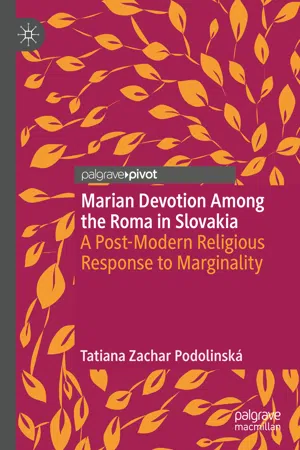
Marian Devotion Among the Roma in Slovakia
A Post-Modern Religious Response to Marginality
- English
- ePUB (mobile friendly)
- Available on iOS & Android
eBook - ePub
Marian Devotion Among the Roma in Slovakia
A Post-Modern Religious Response to Marginality
About this book
In this book Tatiana Zachar Podolinská explores how post-modern Marian devotion represents both the continuation and restoration of tradition in the modern world. Podolinská illuminates how Mary as a Great Enchantress has colonised the modern world and survived mandatory atheism in communist countries. The resilience of Marian devotion in the face of the secularising forces of modernity is due to how fluidly it mixes pre-modern and ultra-modern elements of beliefs and practices with the grassroot current of post-modern Christianity. At the same time, Podolinská elucidates how Mary has become the voice of peripheral ethnic groups and nations. This book specifically explains the devotion of the post-modern Mary among the Roma in Slovakia and explores how this community copes with marginalisation, creating islands of marginal centrality. By approaching the ethnicised and enculturated forms of the Virgin Mary (i.e. Chocolate Marys), the book illuminates her potential for helping the SlovakRoma on their own path from the periphery to the center.
Information
© The Author(s) 2021
T. Zachar PodolinskáMarian Devotion Among the Roma in Slovakiahttps://doi.org/10.1007/978-3-030-56364-6_11. Traces of the Virgin Mary in the Modern World
Tatiana Zachar Podolinská1
(1)
Institute of Ethnology and Social Anthropology, Slovak Academy of Sciences, Bratislava, Slovakia
Abstract
In this chapter, we will trace how the Virgin Mary herself has successfully managed her way ‘from the periphery to the centre’, becoming a pivotal figure of Catholic and Orthodox Christianity in the twentieth century. We will approach the Marian devotion as representing both the continuation of tradition, as well as the restoration of interrupted tradition, fluidly mixing pre-modern and ultra-modern elements of beliefs and practices with the grassroots stream of post-modern Christianity. We will seek testimonies of those who believe in her direct interventions in the world, causing, for example, miraculous healings and other miracles. We will explore how her messages impact the Church, including the popes and the highest clergy elite. We will examine the ways people believe in her potential to share her sacrum with shrines, statues, images, and other devotional objects. We will discover how Mary became the voice of those on the periphery, being the pillar of nation-building processes, fighting for the cultural and ethnic rights of peripheral ethnic groups and nations. We will illuminate, how She has successfully survived mandatory atheism in communist countries as well as liberalism, de-traditionalisation and secularisation of Western societies, keeping enchanting the world with her apparitions, miracles, and wonders.
Keywords
Marian devotionModern MaryPost-modern religiosityPost-communist MaryTraditional MaryAlthough Jesus had only one Mother, and there is only one Virgin Mary, tracing her mundane faces and varieties of her devotion across the centuries and continents has led us to the conclusion that there are as many Marys as there are people and nations who are devoted to her. Along with the spread of Christianity, her role through the ages has become more central, her presence more visible, and her voice more audible.
With the help of mass-media communication, new forms of transport, and the ever-growing ease of mobility in the twentieth century, She, as the Mother of Jesus, has become the leading figure of global missionary activities, captivating the world with her public and globally addressed messages (Chapman 2000). Her popularity at the beginning of the twenty-first century is sometimes compared to those of pop-culture ‘megastars’ (Hermkens et al. 2009, p. 1).
From a strictly scientific point of view, the Virgin Mary, being herself a transcendent entity, cannot be traced. Anyhow, we can trace her based on her mundane ‘imprints’ in the ‘real world’ and human lives. Thus, we can talk to people and seek testimonies of those who believe in her direct interventions in the world, causing, for example, miraculous healings and other miracles. We can follow statistics of how many people in the world are on the move because of Mary. We can explore how her messages impact the Church, including the popes and the highest clergy elite. We can examine the ways people believe in her potential to share her sacrum with shrines, statues, images, and other devotional objects. We can explore how her devotion has changed the symbolic map of the world, giving importance to the places which were formerly considered nowhere. We can trace the ways of her enculturation by local people, being venerated as a European, Indian, African, Asian, or Roma woman, or the intriguing ability of people to accommodate her in nearly every place, time, condition, or circumstance. Therefore, tracing the implicit faces of Mary mirrored in the mundane world, we also trace the faces of the people who believe in her as the Divine Mother of Christ and ultimate Love.
‘The Virgin Mother’: The Conceptual Roots of Tradition
Her person is veiled with the mystery of being both the Immaculate (ever) Virgin and the human Mother of Jesus, who is also the Son of the Celestial Father (God). The enigma of her being both a Virgin and a Mother has compelled scholars of religious studies to make multiple phenomenological comparisons with other pre-Christian and non-Christian female deities of the Great Mother Goddess type.
In this context, it is also interesting that the Third Ecumenical Council (431 A.D.) was held at the Church of Mary in Ephesus, Anatolia, the former important centre of the cult of Artemis. The council condemned the teachings of Nestorius on the Virgin Mary for being only the Christotokos [Gr., ‘The Christ-bearer’] and proclaimed her to be the Theotokos [Gr., ‘The God-bearer’]. Some scholars believe that Mary was declared the Mother of God and was allowed to be venerated as such because of the urgent need of the post-Hellenistic world for a heavenly feminine principle as a compromise with pagans so that Christianity could become acceptable.
In her study, M. Rigoglioso (2010, pp. 51–65) noted that various female deities of Graeco-Roman antiquity were conceived as Virgin Mothers in the earliest layers of their cults. The Christian idea of Mary as the Virgin Mother of God has many similarities to the Graeco-Roman concept of the Great Goddess as the simultaneous embodiment of three female aspects—the Ever-Virgin, Holy Bride/Wife of the Father (God), and the Great Mother of the Son of God—unified in one divine person.
The figure of the Virgin Mary has also been explored in the post-conquest Maya context as a hybridised form of the pagan concept of ritual sexuality, as well as the Christian formulation of virginity prescribed by colonial Spanish Catholicism. In this context, P. Sigal (2000) explored how the Moon Goddess of Yucatec Maya was culturally conflated with the Virgin Mary, thus becoming a hybrid Christian symbol. Sigal speaks about conceptual translation and describes how the Maya Moon Goddess lost her original meaning and how the Spanish Virgin Mary was reformulated into the final hybrid Goddess figure—The Unvirgin Virgin.
On the European continent, the Virgin Mary has flexibly absorbed the elements and ritual functions of many local female pre-Christian goddesses; just to mention the cult of Baba [Srb., ‘the Great Mother’] in Serbia (Petrović 2001), or the connection of Mary with the so-called Boldogasszony [Hung., ‘Blessed Woman’] in Hungary, which is a special Hungarian denomination of the Virgin Mary and also the alleged Mother Goddess of the ancient Hungarians (Kis-Halas 2019).
The Traditional Virgin Mary
Traditionally, Mary was perceived to be a powerful Protector and Healer, mediating celestial protection and miraculous healings. In this respect, She is connected ...
Table of contents
- Cover
- Front Matter
- 1. Traces of the Virgin Mary in the Modern World
- 2. Romani Christianity in Slovakia: Religiosity of Those on the Periphery
- 3. Marian Devotion Among the Roma in Slovakia: Ethnicised and Enculturated Mary
- 4. Marian Apparitions Among the Roma: From the Periphery to the Centre
- Back Matter
Trusted by 375,005 students
Access to over 1.5 million titles for a fair monthly price.
Study more efficiently using our study tools.
Frequently asked questions
Yes, you can cancel anytime from the Subscription tab in your account settings on the Perlego website. Your subscription will stay active until the end of your current billing period. Learn how to cancel your subscription
No, books cannot be downloaded as external files, such as PDFs, for use outside of Perlego. However, you can download books within the Perlego app for offline reading on mobile or tablet. Learn how to download books offline
Perlego offers two plans: Essential and Complete
- Essential is ideal for learners and professionals who enjoy exploring a wide range of subjects. Access the Essential Library with 800,000+ trusted titles and best-sellers across business, personal growth, and the humanities. Includes unlimited reading time and Standard Read Aloud voice.
- Complete: Perfect for advanced learners and researchers needing full, unrestricted access. Unlock 1.5M+ books across hundreds of subjects, including academic and specialized titles. The Complete Plan also includes advanced features like Premium Read Aloud and Research Assistant.
We are an online textbook subscription service, where you can get access to an entire online library for less than the price of a single book per month. With over 1.5 million books across 990+ topics, we’ve got you covered! Learn about our mission
Look out for the read-aloud symbol on your next book to see if you can listen to it. The read-aloud tool reads text aloud for you, highlighting the text as it is being read. You can pause it, speed it up and slow it down. Learn more about Read Aloud
Yes! You can use the Perlego app on both iOS and Android devices to read anytime, anywhere — even offline. Perfect for commutes or when you’re on the go.
Please note we cannot support devices running on iOS 13 and Android 7 or earlier. Learn more about using the app
Please note we cannot support devices running on iOS 13 and Android 7 or earlier. Learn more about using the app
Yes, you can access Marian Devotion Among the Roma in Slovakia by Tatiana Zachar Podolinská in PDF and/or ePUB format, as well as other popular books in Social Sciences & Christian Denominations. We have over 1.5 million books available in our catalogue for you to explore.