The recent rise of "Medicare for All" in American political discourse was many years in the making. Behind this rise is a movement composed of grassroots activists and organizations that have been working for more than three decades to achieve the goal of establishing a single-payer healthcare system in the United States. In the past decade, the Single Payer Movement has grown and garnered more public and political support than ever before. This relative success cannot be attributed to any one political figure or political era. The story of how this happened, and how it is tied to a turn against establishment politics on both the left and right, as well as the rise of outsider politicians such as Senator Bernie Sanders, takes place during the Clinton, G.W. Bush, Obama, and Trump administrations. During each of these eras, activists experienced shifting opportunities that they interpreted through the telling of stories. These narratives of opportunity encouraged participationin particular forms of grassroots mobilization, which then affected the outcome of each era. This has had lasting effects on the development of healthcare policy in the United States. In this book, Hern conducts a political ethnographic analysis in which she uses historical records, interviews, and participant observation to tell the story of the Single Payer Movement, establish the lessons that can be learned from this history, and develop a framework—the Environment of Opportunity Model—that involves a holistic understanding of social movement activity through the analysis of narrative practice.
eBook - ePub
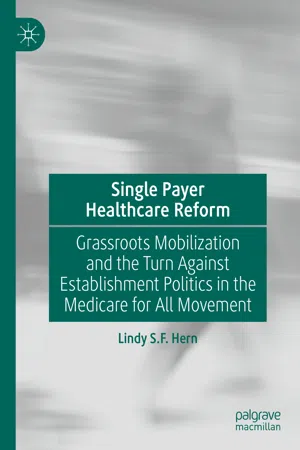
Single Payer Healthcare Reform
Grassroots Mobilization and the Turn Against Establishment Politics in the Medicare for All Movement
- English
- ePUB (mobile friendly)
- Available on iOS & Android
eBook - ePub
Single Payer Healthcare Reform
Grassroots Mobilization and the Turn Against Establishment Politics in the Medicare for All Movement
About this book
Information
© The Author(s) 2020
L. S. HernSingle Payer Healthcare Reformhttps://doi.org/10.1007/978-3-030-42764-1_11. “A Single Prayer for Single Payer”: Opportunity and Narrative Practice in the Single Payer Movement
Lindy S. F. Hern1
(1)
Department of Sociology, University of Hawaii at Hilo, Hilo, HI, USA
I’d like to tell you a story. I’d like to tell you a story about ants. You see, there was this community of ants. It was a normal community, like any other community, with ants going about their little ant business. Some ants were teachers, some ants were janitors, some ants were doctors, and yes, one ant was the President. Although a few enjoyed abundance in this community, many more suffered due to their lack of access to the basic resources needed for living. One day, a small segment of this ant community determined that they could solve this problem if they could only climb to the tippy top of the tallest building, (which was really just a table leg), because in that place there were enough resources for the entire ant community. If they could only get to the top. So, they decided to climb. Most of the ant community did not notice the mission of this segment of the ant community until they were high enough to be visible above the hustle and bustle of the rest. Once they did notice, after first ignoring them in the hopes that this minor annoyance would just go away, they began to laugh saying “You silly ants! You are too weak. You are too small. And that building is far too tall for you to ever possibly be able to get to the top! Come back down and perhaps we will give you a scrap to eat.” Although it was difficult, most of the climbing ants chose to ignore this, but some did go back down to the floor with hopes of coming to a compromise. As time went on, and the ants got higher and higher, the laughter of the ants on the ground turned to jeers of anger. “You idiots” they said, “how could you possibly expect to reach the tippy top when you are SO WEAK, you are SO SMALL, and that building is far too TALL. You might as well come back down, you must be tired, and just look at the sweet things we are eating down here!” And indeed, many of the climbing ants were tired, and began to believe that they were too weak to go on. Some dropped back down to the floor in defeat, waiting for the scraps that would supposedly quell their hunger for the time being. As time went on, and the ants got higher and higher, more and more of the climbing ants fell, succumbing to the jeers of the ants on the floor. But, one little ant, the littlest ant indeed, kept climbing. Even as the others screamed “you are TOO WEAK, you are TOO SMALL, and the building is far, far, far TOO TALL” the little ant kept climbing. Eventually, the tiny tired ant reached the tippy top of the tallest building, which was really just a table leg, proving to the others that it could be done, even by a DEAF little ant like her.
I first heard the story of the ants when Mimi Signor addressed the attendees of the 2009 Healthcare NOW national strategy meeting in St. Louis, Missouri, and then again as she accepted the Paul Wellstone Award for Community Activism on behalf of Missourians for Single Payer (MoSP ) at the 2010 meeting of the Association for Applied and Clinical Sociology. As the legislative chair and vice president of MoSP, Mimi knew how the little ants were feeling as she accepted this award over a year after she had first told this story to a conference hall full of activists attempting to redirect the healthcare reform debate that was raging in D.C. at that time. She later explained to me that she had told the story just as much for Julia, then president of MoSP (who was also there to accept the award), as she had told it for the crowd of sociologists from the Association for Applied and Clinical Sociology (which was giving the award). This storytelling took place in October of 2010, after the passage of the Patient Protection and Affordable Care Act, now commonly referred to as the Affordable Care Act (ACA), or more simply as “Obamacare,” and on the eve of a mid-term election that would likely return power to the Republican Party. In other words, during a time in which the chances of successfully achieving their goal of single-payer healthcare seemed very bleak.
I decided to start with the telling of this story because it not only symbolically summarized for Mimi the story of the Single Payer Movement (SPM) or because it illustrates the relationship between opportunity and action, but also because it draws attention to the important role that narrative story-telling plays in the SPM. In the story, the little ant is met with an impossible task but succeeds anyway because the little ant ignored all of those saying that the goal was impossible. The SPM is a collection of activists and organizations that have continued to mobilize even within a context in which the dominant narrative was that their goal of creating a single-payer healthcare system in the United States was impossible. They continued to act with the belief that “It always seems impossible until it’s done.”1
I will examine the role that narrative plays in the lives of grassroots social movements and the ways in which narrative practice can result in grassroots mobilization that can change political realities. Academic literature dealing with healthcare reform primarily forms a state-centered account of periods in which healthcare reform is a primary focus within the political sphere of federal-level policy change. Popular writing about healthcare reform typically focuses on federal-level actors participating in this process when there is movement toward healthcare reform at the federal level. Reading this, one might conclude that mobilization for healthcare reform occurs only when political leaders decide that the time is ripe for it. I will show instead that the movement for universal health care, and indeed the SPM, has a relatively long history that transcends specific presidents, periods, or political epochs and is as connected to factors that lie outside of the political realm as it is to factors that lie within it.
I completed the writing of this book during a time period in which the United States was at a crossroads. The heavy stone of progress that had been slowly rolling toward a truly just and inclusive society that would protect the rights of all groups of people had almost been pushed to the “tippy top” of the hill of social justice. For centuries, groups of individuals with shared ideas about social change had taken on the task to expand a democratic system of rights to more groups of people. The expansion of civil rights to previously excluded populations during the twentieth century represented progress toward the goal of creating a society that would justly support the “life, liberty, and pursuit of happiness” of all members, just as the abolition of institutionalized slavery had 100 or so years before. It seemed that a bit more effort could push that heavy stone of progress over the summit of the hill and start it rolling down the other side—quickly moving as an unstoppable force toward a society that would protect the social and human rights of everyone in all areas, including health care. At the same time, the rise of anti-establishment politics that resulted in a wave of grassroots organizing for progressive social change on the left also resulted in the rise of radical right-wing populism, which led to the election of Donald Trump. This wave of authoritarian politics threatens to not only halt the forward momentum of the heavy stone of social justice but to also force it back down the slope with a retraction of the rights secured over the past 200 years—turning the fight for a socially just society into a Sisyphean tale of progression and regression. The analysis presented here, of one progressive social movement, sheds some light onto how we arrived at this crucial point in our collective history. As I finish this book there is anger, fear, and despair over the efforts to roll back rights in the areas of reproductive choice, immigration, and LGBTQ civil liberties among others. Yet, there is also powerful hope that we can and will continue to move forward as a community by pushing that stone down the path that will lead us to a truly just society that not only protects the rights of all but also provides a framework in which all people have the support and opportunities needed to achieve their goals. How did we get to this point? And how do progressive movements continue to produce hope that a brighter future is possible even in a context of such uncertainty? How does a social movement that has experienced so many years of failure with its primary goal not achieved, continue to mobilize in order to produce the lesser social changes that will create a path toward its ultimate goal? In this analysis of the past thirty years of the SPM, I will develop answers to these questions.
A Single Prayer for Single Payer
When I first began my work with the SPM, there was a great deal of confusion about the term “single payer.” At one of my early field trips—to the annual meeting of an organization called Missourians for Single Payer (MoSP )—in November of 2004, the hotel at which the meeting was taking place had enthusiastically welcomed meeting attendees on their front marque saying “Welcome Missourians for Single Prayer.” The then President of the organization, Julia, remarked that the sign was partially right—that they did have one prayer for one thing—creating a single-payer system (SPS) in Missouri and beyond. I also recall being at a national meeting of single-payer activists a few years later, in the fall of 2007, in Chicago. At breakfast, assuming that those assembled were supportive of the goals of the meeting, I asked a young woman at my table how she thought that the movement would achieve the goal of creating a single-payer system in the United States. She responded with “You know, I really think that something needs to change, but I just don’t think that single people should be paying for health care for everyone.” I explained to her that in a single-payer system, everyone, not just singles, would pay into the same health assurance system through taxes (instead of premiums, co-pays, and deductibles) which would finance the health care of everyone in the country. In the early years of this field study, confusion over the term single-payer often resulted in debates within activist circles about whether they should use the term at all—especially in organizational names. Activists often shared the sentiment that “the name is hard to understand for people, you know they don’t understand what single-payer means.”2
This confusion was understandable, while healthcare reform debates in the 1970s did include support for movem...
Table of contents
- Cover
- Front Matter
- 1. “A Single Prayer for Single Payer”: Opportunity and Narrative Practice in the Single Payer Movement
- 2. “First They Ignore You”: The Clinton Era of Healthcare Reform
- 3. “Newtered”: The Contract with America Era
- 4. “American Sickos”: The Rise of Digital Mobilization During the G.W. Bush Administration
- 5. Resisting “Politics as Usual”: The Obama Era of Healthcare Reform
- 6. “War with the Whitehouse”: Redefining the Enemy During the ACA Era
- 7. “Bernie Will”: Narratives of Hope and Resistance During the Anti-Establishment Era
- 8. “Everybody In! Nobody Out!”: Achieving Success with Grit and Resilience
- 9. “Reality-Based Hope”: Lessons Learned in the Single Payer Movement
- Back Matter
Trusted by 375,005 students
Access to over 1.5 million titles for a fair monthly price.
Study more efficiently using our study tools.
Frequently asked questions
Yes, you can cancel anytime from the Subscription tab in your account settings on the Perlego website. Your subscription will stay active until the end of your current billing period. Learn how to cancel your subscription
No, books cannot be downloaded as external files, such as PDFs, for use outside of Perlego. However, you can download books within the Perlego app for offline reading on mobile or tablet. Learn how to download books offline
Perlego offers two plans: Essential and Complete
- Essential is ideal for learners and professionals who enjoy exploring a wide range of subjects. Access the Essential Library with 800,000+ trusted titles and best-sellers across business, personal growth, and the humanities. Includes unlimited reading time and Standard Read Aloud voice.
- Complete: Perfect for advanced learners and researchers needing full, unrestricted access. Unlock 1.5M+ books across hundreds of subjects, including academic and specialized titles. The Complete Plan also includes advanced features like Premium Read Aloud and Research Assistant.
We are an online textbook subscription service, where you can get access to an entire online library for less than the price of a single book per month. With over 1.5 million books across 990+ topics, we’ve got you covered! Learn about our mission
Look out for the read-aloud symbol on your next book to see if you can listen to it. The read-aloud tool reads text aloud for you, highlighting the text as it is being read. You can pause it, speed it up and slow it down. Learn more about Read Aloud
Yes! You can use the Perlego app on both iOS and Android devices to read anytime, anywhere — even offline. Perfect for commutes or when you’re on the go.
Please note we cannot support devices running on iOS 13 and Android 7 or earlier. Learn more about using the app
Please note we cannot support devices running on iOS 13 and Android 7 or earlier. Learn more about using the app
Yes, you can access Single Payer Healthcare Reform by Lindy S.F. Hern,Lindy S. F. Hern in PDF and/or ePUB format, as well as other popular books in Politics & International Relations & Pharmaceutical, Biotechnology & Healthcare Industry. We have over 1.5 million books available in our catalogue for you to explore.