This book investigates adaptations of The Lady of Shalott and Elaine of Astolat in Victorian and post-Victorian popular culture to explore their engagement with medievalism, social constructions of gender, and representations of the role of art in society. Although the figure of Elaine first appeared in medieval texts, including Malory's Le Morte Darthur, Tennyson's poems about the Lady and Elaine drew unprecedented response from musicians, artists, and other authors, whose adaptations in some cases inspired further adaptations. With chapters on music, art, and literature (including parody, young people's literature, and historical fiction and fantasy), this book seeks to trace the evolution of these characters and the ways in which they reinforce or challenge conventional gender roles, represent the present's relationship to the past, and highlight the power of art.
- English
- ePUB (mobile friendly)
- Available on iOS & Android
eBook - ePub
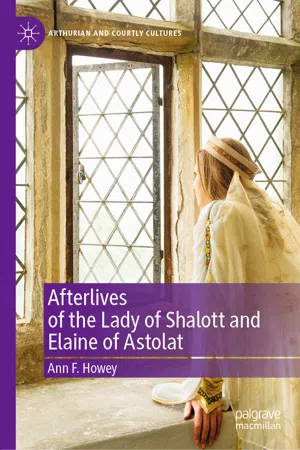
Afterlives of the Lady of Shalott and Elaine of Astolat
About this book
Information
© The Author(s) 2020
A. F. HoweyAfterlives of the Lady of Shalott and Elaine of AstolatArthurian and Courtly Cultureshttps://doi.org/10.1007/978-3-030-47690-8_11. Introduction
Ann F. Howey1
(1)
Brock University, St. Catharines, Canada
1.1 The Topic
When Ellie Harrison, the first-person narrator of Meg Cabot’s teen novel Avalon High (2006), explains that her parents have named her after the legendary Elaine of Astolat, she complains, “It’s not exactly cool to be named after someone who killed herself over a guy.” She has apparently argued this point with her “parents, but they still don’t get it” (p. 7). I open Afterlives of the Lady of Shalott and Elaine of Astolat with Cabot’s novel and Ellie’s complaint because they demonstrate three important features of the Lady of Shalott and Elaine of Astolat figures. First, these characters are often conflated, as in Cabot’s novel, which foregrounds a possible connection between Elaine of Astolat’s circumstances and Ellie’s own while quoting repeatedly from Alfred, Lord Tennyson’s poem “The Lady of Shalott” (1842). Second, they remain a cultural presence in the twenty-first century, as witnessed by their 2006 appearance in the work of a bestselling author for teens. Third, their interpretation shifts: Ellie’s parents by virtue of naming her Elaine would seem to have a different view of that character than Ellie herself does; at issue in these differing interpretations, Ellie’s complaint suggests, is the way we are to read the female figure’s death. Although fictional characters hold differing views of the Lady and Elaine in Cabot’s novel, adaptations of and allusions to the Lady of Shalott and Elaine of Astolat in Victorian and post-Victorian popular culture reveal that Ellie and her parents are not alone in their debate over the significance of these women and their stories.
Afterlives treats the Lady and Elaine as both individual and conflated characters because of their production and reception history. Tennyson’s “The Lady of Shalott”—a ballad of nineteen nine-line stanzas divided into four parts—appeared first in 1832; its final form, substantially revised, appeared in 1842.1 Over a decade later, Tennyson once again represented a woman dying for love of Lancelot in the idyll “Elaine,” which was published in 1859 along with “Enid,” “Vivien,” and “Guinevere” as Idylls of the King. 1418 lines in its final version, the Elaine idyll (which took on its title of “Lancelot and Elaine” in 1870) is the story not just of the “Lily Maid” of Astolat, but also of the knight Lancelot and his relationships with King Arthur and Queen Guinevere. As Chapter 2 argues, the Lady and Elaine differ most significantly in the isolation they experience and the degree to which the art they practice constitutes their identities. Despite significant variations between them, the Lady of Shalott and Elaine of Astolat have often been treated as identical figures, and I will thus use the short-form “Lady/Elaine” throughout this study. Bibliographies, which often combine the two in their indexing, reflect the reality that authors, critics, and reviewers have previously conflated the characters, as Cabot’s novel does.
The two women’s greatest similarity is the iconic feature of their narratives that makes identification of a Lady/Elaine text possible: both are women whose unrecognized or unrequited love for Lancelot is followed by death, and whose bodies thereafter travel by boat to King Arthur’s court at Camelot. Afterlives analyzes representations of the Lady/Elaine in Victorian and post-Victorian popular culture in order to trace the extent to which audiences, past and present, accept or reject these characters and narratives about them as romantic, tragic, somehow ideal representations of female passion, will, and fidelity, and to explore the implications of linking these qualities to the image of the dead woman. Producers of texts that adapt or allude to the Lady/Elaine inevitably and sometimes explicitly engage with these issues, and their responses range from confirmation of the inherent beauty of the narratives and of the logic of their ideologies of femininity to outright rejection of them. As a result, whether literary, musical, or visual, representations of the Lady of Shalott and Elaine of Astolat act as sites where conflicting social constructions of gender and art can be productively negotiated, particularly since Tennyson’s canonical articulation of their stories.
Studying the Lady/Elaine happens at the intersection of a number of theoretical perspectives. My overall approach is feminist, broadly defined: a primary concern in my analyses of texts is the way characters’ gender affects their representation and the meanings made available by these representations. Because the iconic moment of these female characters’ lives tends to be their death scene, this introduction first outlines feminist theories of death and representation. The apparent celebration of femininity as passivity (the dead body) in Lady/ Elaine texts demands consideration of agency, particularly since that death follows active expression of will and desire; this introduction defines agency, while later chapters consider its manifestations (such as voice, vision, or action) in individual texts. The female characters whose agency is at issue, however, originate within a literary tradition, so the introduction surveys the Arthurian legend’s historical development as it affects the Lady/Elaine and situates the legend’s Victorian revival in the context of medievalism. Medievalism constructs a relationship between past and present, and Lady/Elaine texts often foregrou...
Table of contents
- Cover
- Front Matter
- 1. Introduction
- 2. The Lady and Elaine: Medieval Literature and Victorian Adaptation
- 3. Singing Her Own Song: The Lady/Elaine in Music
- 4. “She Hath a Lovely Face”: The Lady/Elaine in Art
- 5. Patterns and Parody: The Lady/Elaine in Literature
- 6. Reading and Resisting: The Lady/Elaine in Young People’s Literature
- 7. Desire and Art: The Lady/Elaine in Historical Fiction and Fantasy
- 8. Postscript
- Back Matter
Trusted by 375,005 students
Access to over 1.5 million titles for a fair monthly price.
Study more efficiently using our study tools.
Frequently asked questions
Yes, you can cancel anytime from the Subscription tab in your account settings on the Perlego website. Your subscription will stay active until the end of your current billing period. Learn how to cancel your subscription
No, books cannot be downloaded as external files, such as PDFs, for use outside of Perlego. However, you can download books within the Perlego app for offline reading on mobile or tablet. Learn how to download books offline
Perlego offers two plans: Essential and Complete
- Essential is ideal for learners and professionals who enjoy exploring a wide range of subjects. Access the Essential Library with 800,000+ trusted titles and best-sellers across business, personal growth, and the humanities. Includes unlimited reading time and Standard Read Aloud voice.
- Complete: Perfect for advanced learners and researchers needing full, unrestricted access. Unlock 1.5M+ books across hundreds of subjects, including academic and specialized titles. The Complete Plan also includes advanced features like Premium Read Aloud and Research Assistant.
We are an online textbook subscription service, where you can get access to an entire online library for less than the price of a single book per month. With over 1.5 million books across 990+ topics, we’ve got you covered! Learn about our mission
Look out for the read-aloud symbol on your next book to see if you can listen to it. The read-aloud tool reads text aloud for you, highlighting the text as it is being read. You can pause it, speed it up and slow it down. Learn more about Read Aloud
Yes! You can use the Perlego app on both iOS and Android devices to read anytime, anywhere — even offline. Perfect for commutes or when you’re on the go.
Please note we cannot support devices running on iOS 13 and Android 7 or earlier. Learn more about using the app
Please note we cannot support devices running on iOS 13 and Android 7 or earlier. Learn more about using the app
Yes, you can access Afterlives of the Lady of Shalott and Elaine of Astolat by Ann F. Howey in PDF and/or ePUB format, as well as other popular books in Literature & Film & Video. We have over 1.5 million books available in our catalogue for you to explore.