eBook - ePub
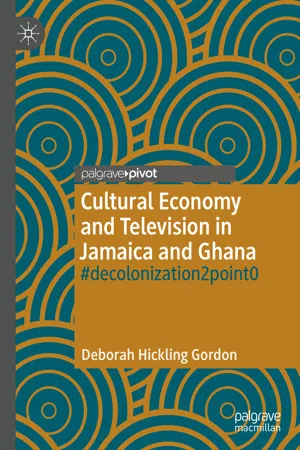
Cultural Economy and Television in Jamaica and Ghana
#decolonization2point0
- English
- ePUB (mobile friendly)
- Available on iOS & Android
eBook - ePub
About this book
This book proposes contemporary decolonization as an approach to developing cultural economies in the Global South. It presents the account of the transformation of television in Jamaica and Ghana to audiovisual subsectors; from cultural institutions to cultural industries and then subsectors of emerging cultural economies as representative case studies. 'Glocal' changes are presented within five organizing phenomena: philosophical, ideological, and economic change, and their impact on governance and the operational transformation of the television sectors of Jamaica and Ghana. This book represents the first critical examination and comparison of cultural and creative industries (CCI) and economy concepts in the Caribbean and Africa. It is an original contribution to the development of strategies that influence processes, structures, and policies related to the cultural economy concept and those required to improve television industries. This process of describing culturally specific characteristics of CCI is designed to be applicable to the CCI of developing countries including those in Africa and the Caribbean, where interpretations and implementation suited for advanced industrial nations have been insufficiently questioned and challenged.
Information
© The Author(s) 2020
D. Hickling GordonCultural Economy and Television in Jamaica and Ghanahttps://doi.org/10.1007/978-3-030-38065-6_11. Introduction: Time Changes
Deborah Hickling Gordon1
(1)
The University of the West Indies, Kingston, Jamaica
Abstract
In this chapter the author, an audiovisual producer and lecturer of cultural and media studies, shares elements of the reflexive journey from Jamaica’s Public Service Broadcasting to Commercial Broadcasting eras, and on to the emergent Cultural Economy era. She argues that in the emerging cultural economies of the Global South, the production and trade of screen-based content are central to development positioning and geostrategic planning for nations like Jamaica and Ghana. The author presents #decolonization2point0 (d2k) as a cultural economy methodology for nations of the Global South that seeks to “personify” the cultural economy process through culturization rather than “disembody” it through marketization. Audiovisual production and trade in Jamaica and Ghana are presented as “metaphors of transformation” and as case studies to test the application of the South Star Policy Model she proposes for cultural economy policy development in the Global South. This model focuses on sustainable development objectives rather than exploitative and extractive intentions to guide planning for cultural and creative economy growth. It encourages a fundamental rethinking and radical redesign of the processes to integrate cultural economy thinking into development planning, in countries of the Global South with an emphasis on growing the audiovisual sector, particularly in Jamaica.
Keywords
DevelopmentTimeTelevisionPublic serviceCold warPoliticsContentDevicesWIFI signalAudio visual sectorsAudio visual zeitgeistColonizationDecolonizationIndependenceMedia liberalizationBroadcastingCreative industriesCultural economy policyEconomic systemsDemocratic socialismDivestmentCultural ecosystemsGovernanceTrajectories of transitionCapitalist commercialismIdeologyEconomyTraditionAfricannessJamaicanessNeoliberalismTV Sign On!
1980: It is one minute to four on a Jamaican afternoon, the longest minute on any given weekday. Three prepubescent siblings knew that when the clock struck four, the next few hours would be spent between homework, afternoon chores and the television set. A master controller sat in Jamaica’s sole broadcaster, the public service, free-to-air television station, the Jamaica Broadcasting Corporation (JBC) at South Odeon Avenue in its capital, Kingston. Every day at this hour he prepares to switch over from the hard page of stabilizing bars in tones of grey and to end the piercing, pure reference kilowatt tone seen all day on local TV, meant to calibrate audio and video levels on television sets. The clock strikes four. He flicks the switch. The orchestral version of the National Anthem followed—a prayer, played as audio-bed to the daily “sign on” montage featuring faded footage of the fluttering black, green and gold of the Jamaican flag. Its children and all those in earshot mouth subconsciously, “Eternal Father bless our land. Guard us with thy mighty hand”. Evening activities began in communities. The country took stock of itself—its place amid chilling winds of the Cold War, black power and civil rights, its development path and the persistent plague of political division and economic strife. My two siblings and I, and every child with a television set in Jamaica, settled in for the evening. Television ran until midnight when the flag flew again and the anthem played, a cycle to be repeated the next day. At 4 p.m., across the nation the gleeful whisper would be repeated from household to household, “TV sign on”, like a national game of Chinese Telephone. You could set your clock by it. Many Jamaicans did.
2020: Forty years have passed since those three siblings waited for the clock to strike five and television to “sign on”. Things and times had changed. The television we set our clocks by changed from a clunky box with “rabbit ears” for an antenna to flat screens in mega and palm sizes. Public service content to educate, empower and entertain became commercial, monetized content carried by converged conduits serviced by creative workers and consumer-participants, available at will. Now, devices never turn off. They are pre-programmed and digitally regulated, rendering master controllers an endangered species. Offspring of the 1980s sibling spend all day watching endless audiovisual content. They switch from program to program, format to format, platform to platform, activity to activity and device to device—from phone to watch to tablet and big-screen television—watching content from countless sources available 24 hours per day. Personal amplifiers shaped around their heads or as buds in each ear satisfy the aural. Consumed content hails from every continent, places once only available through the reaches of imagination. From the safe-apathy of their middle-class vantage points they produce social media stories on the same gadgets through which they consume content. An available Wi-Fi signal is their most significant asset. Its absence is a challenge. Through this conduit the stream of content is constant. Between 1980 and 2020 things and times had changed. This is a story about a veritable zeitgeist, seen on and through the changing screens of time.
Creative Zeitgeist
My fascination with the notion of creative zeitgeists began with my exploration of the impact of the liberalization of broadcast media and content production on the Jamaican society, where I was born. I propose that a creative zeitgeist is the change seen in the content, production processes and distribution of a creative sector at the end of a natural zeitgeist. This juncture is examined through the lens of philosophical, ideological, economic, governance and operational change within the sector and its sub sectors. I chronicled its occurrence in the audiovisual sector in Jamaica and my interest soon extended to countries of the Global South. My grounding in cultural studies and Pan-African orientation led me to a new understanding of the nuances, invisibilities and intangibles embedded in changes in the content creation process and in content products in former colonies, as compared with their Northern, predominantly colonial and imperial neighbors. The dialectics of “colonizer and colonized” met “spirit and matter” at the heart of a complex materialist debate about television’s transition from public service broadcasting to commercial industry. Inherent contradictions in the creative and cultural industries concept in the Global South (Hickling Gordon) still remain unsettled but often unchecked in former colonies of the British Empire. These are central to understanding the changing audiovisual sectors in former colonies. Decolonization, or undoing the effects of colonialism and neocolonialism, remains at the core of the struggle by countries of the Global South to arrive at synthesis in these complex dialectics.
This volume traces the trajectory of transition of the audiovisual sectors of two former British colonies with a view to understanding the convergence and change that took place in their cultural economies—ecosystems of production, distribution and consumption of cultural goods and services in relation to their social, economic and political context (De Beukelaer and Spence 2018). The comparison of the trajectories in Jamaica and Ghana reveal cultural nuances that provide context for understanding the role of culture and creativity in economic planning, preparation and decision making for the uncertainties of the future.
This volume argues that the close of the second decade of the twenty-first-century marks the end of a global zeitgeist, seen, in large part, as neoliberalism morphed into global populism. The end of the zeitgeist was marked dramatically and definitively with global insights brought by the harrowing COVID-19 pandemic. Within the context of a pandemic, the growing importance of the social, economic, political, and cultural roles of the audiovisual sub-sector of the global cultural economy became exceedingly clear. During the trajectory of transition of the audiovisual sub-sector from the twentieth century into the twenty-first, the ideological duality of public service and commercial media worldwide became more distinct. Widening global inequality, and changing patterns in public thinking and behavior reflected and represented wavering sustainable development imperatives and increasing commercial ones. To meet the development needs of the peoples of the Global South will require transformational thinking. To that end, and given the significance of the global cultural and creative sector, this volume encourages postcolonial developing nations to integrate Orange and Purple Economy in their development planning. Arguably, a global rebalance of power has begun to acknowledge, if not completely accept, the emergence of developing countries and to take their cultures and creativity into account. As this shift happens by natural selection, it is being televised. Programming and data is being produced in large volumes and transported between developed and developing countries at light speed through the Internet as conduit, curated by mainstream platforms and is consumed in copious quantities globally. It is for developing countries of the world to plan for and grasp the emergent opportunities and begin to plan clear geo-strategies. This volume proposes that the twenty-first-century process of rethinking be considered the next phase of decolonization thinking. In this volume, decolonization 2.0 met the fourth industrial phase of global development and became a hashtag, #d2k. To embark on the #d2k journey, requires the acknowledgment that a series of cultural and creative zeitgeists occurred in the twentieth century into the twenty-first. This understanding arms decision makers in countries of the Global South with the insight required to make the best of the opportunity to “reset” the ways in which they approach development, through the design of their cultural and creative economies. The case studies of transition in the audiovisual sub-sectors of the cultural economies of Jamaica and Ghana, two former colonies of Britain, reveal a century of trauma that took place within what had become a new triangular trade route. The cargo has changed. The trade in black bodies for labour has become an exchange of products of the imagination and culture, processed into that valuable global commodity known as data. The balance of power must shift to favor the South if sustainable development is to be achieved. In this volume, the journey towards development begins with considering the impact of the changes over time and addressing the trauma of the transition starting with liberalization, out of which the cultural and creative economy concepts emerged on the eve of a new Millennium.
Reflexive Liberalization
The media liberalization journey in Jamaica and my professional trajectory are reflective and representative of each other. Libertine zeitgeist occurred during the half century that is my life. Both my parents worked in the public service radio and television broadcaster, the Jamaica Broadcasting Corporation (JBC). JBC was a veritable University. A training ground. An Institution grounded in the ideological push and pull between the democratic socialism through which it was formed and the capitalist conservatism that manifest as the Cold War. Before the JBC closed its doors, my parents’ lives were steeped in the global activism and advocacy of the 1970s and the 1980s. My father was fired while on air, ostensibly because of political differences with Jamaica’s Minister of Information of the day. As I researched the period I happened upon several anecdotes about my mother’s activism in the labor movement at JBC. Awe and reve...
Table of contents
- Cover
- Front Matter
- 1. Introduction: Time Changes
- 2. Sankofa’s Song
- 3. From TV to AV in Jamaica: Commerce, Copyright, Convergence and Conduits
- 4. From TV to AV in Jamaica: Creative Work, Content and Consumption
- 5. From TV to AV in Ghana: Commerce, Copyright, Convergence and Conduits
- 6. From TV to AV in Ghana: Creative Work, Content and Consumption
- 7. #decolonization2point0: Follow the Star
- 8. South Star for Jamaica
- Back Matter
Trusted by 375,005 students
Access to over 1.5 million titles for a fair monthly price.
Study more efficiently using our study tools.
Frequently asked questions
Yes, you can cancel anytime from the Subscription tab in your account settings on the Perlego website. Your subscription will stay active until the end of your current billing period. Learn how to cancel your subscription
No, books cannot be downloaded as external files, such as PDFs, for use outside of Perlego. However, you can download books within the Perlego app for offline reading on mobile or tablet. Learn how to download books offline
Perlego offers two plans: Essential and Complete
- Essential is ideal for learners and professionals who enjoy exploring a wide range of subjects. Access the Essential Library with 800,000+ trusted titles and best-sellers across business, personal growth, and the humanities. Includes unlimited reading time and Standard Read Aloud voice.
- Complete: Perfect for advanced learners and researchers needing full, unrestricted access. Unlock 1.5M+ books across hundreds of subjects, including academic and specialized titles. The Complete Plan also includes advanced features like Premium Read Aloud and Research Assistant.
We are an online textbook subscription service, where you can get access to an entire online library for less than the price of a single book per month. With over 1.5 million books across 990+ topics, we’ve got you covered! Learn about our mission
Look out for the read-aloud symbol on your next book to see if you can listen to it. The read-aloud tool reads text aloud for you, highlighting the text as it is being read. You can pause it, speed it up and slow it down. Learn more about Read Aloud
Yes! You can use the Perlego app on both iOS and Android devices to read anytime, anywhere — even offline. Perfect for commutes or when you’re on the go.
Please note we cannot support devices running on iOS 13 and Android 7 or earlier. Learn more about using the app
Please note we cannot support devices running on iOS 13 and Android 7 or earlier. Learn more about using the app
Yes, you can access Cultural Economy and Television in Jamaica and Ghana by Deborah Hickling Gordon in PDF and/or ePUB format, as well as other popular books in Social Sciences & Film & Video. We have over 1.5 million books available in our catalogue for you to explore.