- English
- ePUB (mobile friendly)
- Available on iOS & Android
eBook - ePub
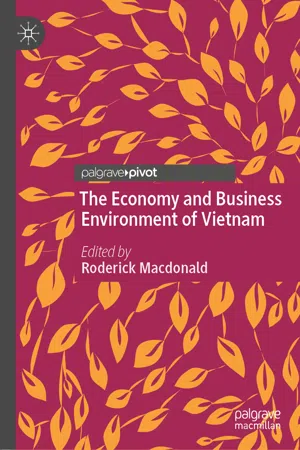
The Economy and Business Environment of Vietnam
About this book
This Palgrave Pivot provides an introduction to the economy and business environment of Vietnam, a member of the ASEAN Economic Community whose economy is rapidly growing. The introduction argues that though there may be perceived disadvantages in investing in Vietnam, there are a number of benefits as well, such as the country's openness to trade and foreign direct investment, the increasing ease of doing business there and the dynamism of the economy. The book then provides an overview of Vietnam's economic policy since 1975, covering reunification, attempts at a command economy, and finally renovation under Doi Moi Policy. Further chapters cover the expansion of the private sector, interest in foreign investment, and the peculiarities of marketing and finance in Vietnam. As an edited volume with chapters written by Vietnamese scholars across economics, history, and business, this book is critical reading for researchers studying Vietnam and other Asian economies and for businesses interested in expanding into that market.
Information
© The Author(s) 2020
R. Macdonald (ed.)The Economy and Business Environment of Vietnamhttps://doi.org/10.1007/978-3-030-49974-7_11. Vietnam, Land of Opportunity
Roderick Macdonald1
(1)
University of Quebec at Montreal, Montréal, QC, Canada
Abstract
Vietnam has overcome internal and external difficulties in the twentieth century to create a very inviting business environment as testified both by GDP per capita growth and by foreign direct investment in the twenty-first century. This chapter briefly touches on the different aspects of this environment that are detailed in subsequent chapters: economic policy and performance, participation in value chains, privatization, the market and financial services. It also provides an overview of the history and geography of the country.
Keywords
GDP per capitaFDIEconomic freedomEase of doing businessEnterprise surveyPolicy1.1 Introduction
Vietnam experienced a very difficult twentieth century. It started the century as a French colony. After the French were repulsed in 1954, Vietnam experienced an internal struggle for power at the same time as one party in that struggle (mostly the North with some support located in Central and Southern Vietnam) fought against the American “helpers”. Both the French and American opponents were militarily superior, and the Northern Vietnamese won by accepting an incredibly high number of casualties. This meant that any industrial base acquired under the French was decimated. Although the “American war” ended more than 40 years ago, the US-led embargo dragged on for another two decades. The first 94 years of the century were economically horrendous. Since then, the country has had barely 25 years of normality to build up an industry and skills base. The wars of the twentieth century have also left a legacy of (fading) tension between the hierarchy-oriented North and the market-oriented South. Also, as in many countries in Southeast Asia, locals of Chinese descent are prominent in the economy.
Vietnam’s government used the years under embargo to test and discard several doctrinaire communist methods borrowed from Russia and China for dealing with economic policy, from communal farming to command economics. While it is still true that local and central governments can be heavy handed towards their citizens and there is also some evidence of state-related actors carrying out cyber warfare on behalf of well-connected private sector actors (Carr 2017; Lyngaas 2019; Mitre 2019), successive administrations have been realistic and pragmatically visionary in creating an environment that is business-friendly and allows entrepreneurs to flourish. Several chapters in this book detail this, especially Chapter 2 on the evolution of economic policy in Vietnam, Chapter 3 on the privatization process and Chapter 6 on financial services.
Vietnam now has become a land of business opportunity for locals and for foreigners. Vietnam is worthy of consideration by any business looking to expand internationally, particularly into Asia.
Southeast Asia is a fast-growing region and, of the larger economies in that region, Vietnam and the Philippines are the fastest growing. Cambodia, Laos and Myanmar are also growing as quickly, but have small economies that are far less developed. Of the more advanced economies in the region, only Malaysia exhibits a comparable growth rate. Between Vietnam and the Philippines, who are neck and neck in economic growth, Vietnam is clearly far friendlier towards foreign business investment than the Philippines. Since their devastating experience of free trade with the United States at the time of independence, the Philippine business elite has influenced government policy to limit foreign competition and ownership. The “People Power Revolution” did not change this. Since the early 1990s, Vietnam has gradually done the opposite, both opening up to foreign investment and increasing the portion of the economy that is market oriented. There is increasing opportunity in Vietnam.
Vietnam does indeed have a communist government. However, governments are run in practice and not in theory. The contrast with regimes in other countries is that the politicking is done within the Communist Party. Although the quest for power involves instances of sponsor–patron relationships, it is far less damaging than the feudal-like patronage to be found in countries such as the Philippines. Politics in Vietnam also appears to be less dumbed down than it appears to be in countries like Canada and the United States. Finally, the fading memories of the poverty of the previous century perhaps mean that more politicians are patriotic than in other countries. Whatever the reasons, the track record of Vietnam’s government is one of enlightened economic policies and respect for the property of foreign firms. Government management of the COVID-19 pandemic illustrates its competence and willingness to act as necessary, although no one foresees what the state of the pandemic will be when these words are read. Bereft of the resources that allowed Singapore, Korea and Taiwan to do extensive testing, the government of Vietnam was the first to act outside of mainland China and Taiwan. A few local lockdowns were imposed in early January 2020. There was effectively no classroom instruction after mid-January because the government interdicted it after Tet, the Lunar New Year holiday. Most schools moved quickly online, and the government informed citizens how to slow the transmission of the virus from hand washing to separation and masks, including a catchy video clip that went viral in several countries.
Tourists arriving by air from abroad who apply for visa on arrival are surprised to see uniformed men and women processing their documents. They may think they have landed in a police state. However, the...
Table of contents
- Cover
- Front Matter
- 1. Vietnam, Land of Opportunity
- 2. The Road to Doi Moi in Vietnam
- 3. State-Owned Enterprises in Vietnam: Challenges Hindering the Privatization Process
- 4. Participating and Upgrading in Global Value Chains: The Case of Small and Medium Enterprises in Vietnam
- 5. Marketing in Vietnam
- 6. Financial Services in Vietnam
- Back Matter
Trusted by 375,005 students
Access to over 1.5 million titles for a fair monthly price.
Study more efficiently using our study tools.
Frequently asked questions
Yes, you can cancel anytime from the Subscription tab in your account settings on the Perlego website. Your subscription will stay active until the end of your current billing period. Learn how to cancel your subscription
No, books cannot be downloaded as external files, such as PDFs, for use outside of Perlego. However, you can download books within the Perlego app for offline reading on mobile or tablet. Learn how to download books offline
Perlego offers two plans: Essential and Complete
- Essential is ideal for learners and professionals who enjoy exploring a wide range of subjects. Access the Essential Library with 800,000+ trusted titles and best-sellers across business, personal growth, and the humanities. Includes unlimited reading time and Standard Read Aloud voice.
- Complete: Perfect for advanced learners and researchers needing full, unrestricted access. Unlock 1.5M+ books across hundreds of subjects, including academic and specialized titles. The Complete Plan also includes advanced features like Premium Read Aloud and Research Assistant.
We are an online textbook subscription service, where you can get access to an entire online library for less than the price of a single book per month. With over 1.5 million books across 990+ topics, we’ve got you covered! Learn about our mission
Look out for the read-aloud symbol on your next book to see if you can listen to it. The read-aloud tool reads text aloud for you, highlighting the text as it is being read. You can pause it, speed it up and slow it down. Learn more about Read Aloud
Yes! You can use the Perlego app on both iOS and Android devices to read anytime, anywhere — even offline. Perfect for commutes or when you’re on the go.
Please note we cannot support devices running on iOS 13 and Android 7 or earlier. Learn more about using the app
Please note we cannot support devices running on iOS 13 and Android 7 or earlier. Learn more about using the app
Yes, you can access The Economy and Business Environment of Vietnam by Roderick Macdonald in PDF and/or ePUB format, as well as other popular books in Business & Business internazionale. We have over 1.5 million books available in our catalogue for you to explore.