eBook - ePub
Bodily Fluids, Chemistry and Medicine in the Eighteenth-Century Boerhaave School
- English
- ePUB (mobile friendly)
- Available on iOS & Android
eBook - ePub
Bodily Fluids, Chemistry and Medicine in the Eighteenth-Century Boerhaave School
About this book
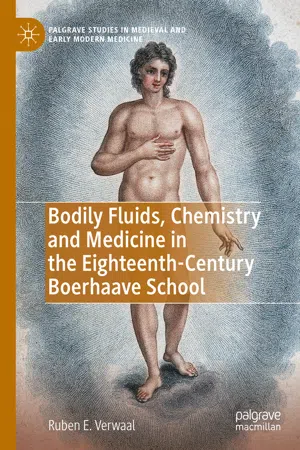
This book explores the importance of bodily fluids to the development of medical knowledge in the eighteenth century. While the historiography has focused on the role of anatomy, this study shows that the chemical analyses of bodily fluids in the Dutch Republic radically altered perceptions of the body, propelling forwards a new system of medicine. It examines the new research methods and scientific instruments available at the turn of the eighteenth century that allowed for these developments, taken forward by Herman Boerhaave and his students. Each chapter focuses on a different bodily fluid – saliva, blood, urine, milk, sweat, semen – to investigate how doctors gained new insights into physiological processes through chemical experimentation on these bodily fluids. The book reveals how physicians moved from a humoral theory of medicine to new chemical and mechanical models for understanding the body in the early modern period. In doing so, it uncovers the lives and works of an important group of scientists which grew to become a European-wide community of physicians and chemists.
Information
© The Author(s) 2020
R. E. VerwaalBodily Fluids, Chemistry and Medicine in the Eighteenth-Century Boerhaave SchoolPalgrave Studies in Medieval and Early Modern Medicinehttps://doi.org/10.1007/978-3-030-51541-6_11. Introduction
Ruben E. Verwaal1
(1)
Institute for Medical Humanities, Durham University, Durham, UK
In a chemistry class on the nature of blood, Herman Boerhaave (1668–1738), professor of medicine, botany, and chemistry at Leiden University, shared a hazardous incident in the laboratory with his students. ‘I had long entertain’d an opinion that phosphorus might be procured from human blood’, he explained. In an attempt to confirm his idea, Boerhaave had taken a quantity of blood and let it separate into the red and watery parts through coagulation. He had then started distilling the serum in a retort, that is, a glass container with long neck, so that it would yield salt on the sides of the receiver, and yellow oily liquor at the bottom of the vessel, called ‘the spirit of human blood’. Boerhaave was called away during the experiment. At night, when he returned with a candle to see the effect, he saw that the neck of the retort was completely blocked with a thick matter. He immediately backed away and left the room. And not a moment later, the force of the ascending oil burst the vessel into a million pieces and set the whole laboratory on fire. ‘Had I been by, I had doubtless perish’d’.1
The fact that Boerhaave performed chemical experiments was nothing out of the ordinary. Leiden had a chemical laboratory in its botanical garden since 1669, and at the turn of the eighteenth century, all universities in the Low Countries cultivated chemistry by establishing laboratories and chairs in the medical faculty. This correlated with the growing interest in new remedies and chemical preparations. Still this anecdote raises numerous questions: why did Boerhaave subject bodily fluids like blood to a chemical examination? If medical students needed to know the normal functioning of the body, it would make sense for them to visit an anatomical theatre to learn about the body’s internal structures. But why would they also be sent into smoke-filled chemical laboratories and be covered in ash while maintaining fires, distilling fluids, and synthesising substances? What results did they gain from their practice, and how did they use this knowledge to better understand the functioning of the body?
It is important to note that this anecdote was not communicated by Boerhaave himself, but by his students.2 Boerhaave’s students diligently wrote down their professor’s lectures, and even published their lecture notes as textbooks, thus playing a key role in the dissemination of knowledge. Furthermore, a plethora of medical dissertations and treatises preserve the thoughts and actions of these physicians’ work with fluids in the laboratory.3 From this rich corpus of sources it is not only clear that bodily fluids played an essential role in medical education, but also that early modern physicians in the Dutch Republic were seriously reconsidering the nature and function of blood and other bodily fluids. And rightly so. For these natural flows and fluids performed crucial tasks in the healthy functioning of the human body. Saliva lubricated chewing and swallowing food; blood continuously nourished all parts of the body; the bladder collected and stored urine until it was released through the urethra; mothers expressed their milk to feed their new-borns; perspiration exuded through the innumerable pores of the skin; and at moments of sexual climax, male bodies emitted the reproductive fluid of semen. That the discharges and interflows of bodily fluids were directly related to the body’s vital functions had been known for centuries. But it was at the turn of the eighteenth century that physicians like Boerhaave took a new interest in the fluids and investigated them with a new set of instruments and ideas.
This book argues that at the turn of the eighteenth century, new research methods and instruments crucially changed the perception of bodily fluids and that this contributed to a new system of medicine. For centuries physicians had based their knowledge on the ancient humoral pathology, which had its origins in the writings of Hippocrates (c. 460–377 BC) and Galen (129–c. 210 AD), and was further developed in the medieval period by scholars such as Ibn Sina (known as Avicenna, 980–1037). The humoral theory proposed that there were four bodily humours—blood, phlegm, black and yellow bile—which needed to be balanced in relation to each other to sustain health. Blood regularly expelled via nosebleeds, haemorrhoids, menstruation, or surgically by phlebotomy, to sustain the humoral balance. In the Renaissance, however, physicians started questioning the humoral theory. While some progressed learned medicine by emulating the ancients, others protested against the establishment of Galenic medicine.4 Most notably Theophrastus von Hohenheim (1493–1541), better known as Paracelsus, presented a rival model based on three primary substances of salt, sulphur, and mercury, envisioned disease as having external causes and presented a new set of more drastic remedies that included mercury, antimony, and arsenic.5 In the seventeenth century, Galenic medicine received another blow when influential figures such as René Descartes (1596–1650), Giovanni Alfonso Borelli (1608–1678), Marcello Malpighi, and Archibald Pitcairne (1652–1713), reduced bodily processes to motion and mechanical actions, anatomical structures, and mathematical calculation. In their hydraulic analyses of bodily streams, organs like hearts and kidneys were referred to as pumps and sieves.6 In the early modern period, in other words, new anatomical observations, mathematics, and chemical theories of the body transformed the ways in which philosophers and physicians thought about the functioning of the healthy, living body.7 But while Paracelsian and Cartesian theories had completely dismissed the humoral theory, Boerhaave and his students developed a new appreciation for the nature of the fluids. Indeed, the application of new instruments and chemical methods to bodily fluids led to an extraordinary set of changes, which reinvented ancient humoral theory and established a new and irenic physiology of the fluids.
Histories of Physiology and Chemistry
When in the 1770s it came to defining physiology in a new edition of Noël Chomel’s (1632–1712) famous household dictionary, the French-Frisian editor Jacques de Chalmot (c. 1730–1801) came straight to the point: ‘The best books on physiology in Latin are those of Boerhaave’.8 The word physiology derived from the Greek physis (‘nature’) and logia (‘knowledge’), and therefore initially referred to the philosophical inquiry into the nature of things. In the early modern period, however, physiology came to be specifically applied to the field of medicine, explaining the conditions of life and health, also known as the doctrine of the animal oeconomy.9 Boerhaave’s students learned that
De Chalmot might have mentioned any of a large number of physiologists, such as Friedrich Hoffmann (1660–1742) or Albrecht von Haller (1708–1777), but it was no accident that he chose to highlight Boerhaave. In De Chalmot’s lifetime groundbreaking developments had occurred, originating with Boerhaave and his successors. They had developed new instrument...By physiology we mean that part of medicine which explains the nature of the entire animal machine, consider’d in its natural state, when its operations are perform’d in greatest perfection; or in a state of health; which depends upon a just balance of the solids and fluids.10
Table of contents
- Cover
- Front Matter
- 1. Introduction
- 2. Savouring Alchemy
- 3. The Nature of Blood
- 4. Piss Prophets and Urine Matters
- 5. Crying Over Spilt Milk
- 6. Sweat It Out
- 7. Semen in Flux
- 8. Conclusion
- Back Matter
Trusted by 375,005 students
Access to over 1.5 million titles for a fair monthly price.
Study more efficiently using our study tools.
Frequently asked questions
Yes, you can cancel anytime from the Subscription tab in your account settings on the Perlego website. Your subscription will stay active until the end of your current billing period. Learn how to cancel your subscription
No, books cannot be downloaded as external files, such as PDFs, for use outside of Perlego. However, you can download books within the Perlego app for offline reading on mobile or tablet. Learn how to download books offline
Perlego offers two plans: Essential and Complete
- Essential is ideal for learners and professionals who enjoy exploring a wide range of subjects. Access the Essential Library with 800,000+ trusted titles and best-sellers across business, personal growth, and the humanities. Includes unlimited reading time and Standard Read Aloud voice.
- Complete: Perfect for advanced learners and researchers needing full, unrestricted access. Unlock 1.5M+ books across hundreds of subjects, including academic and specialized titles. The Complete Plan also includes advanced features like Premium Read Aloud and Research Assistant.
We are an online textbook subscription service, where you can get access to an entire online library for less than the price of a single book per month. With over 1.5 million books across 990+ topics, we’ve got you covered! Learn about our mission
Look out for the read-aloud symbol on your next book to see if you can listen to it. The read-aloud tool reads text aloud for you, highlighting the text as it is being read. You can pause it, speed it up and slow it down. Learn more about Read Aloud
Yes! You can use the Perlego app on both iOS and Android devices to read anytime, anywhere — even offline. Perfect for commutes or when you’re on the go.
Please note we cannot support devices running on iOS 13 and Android 7 or earlier. Learn more about using the app
Please note we cannot support devices running on iOS 13 and Android 7 or earlier. Learn more about using the app
Yes, you can access Bodily Fluids, Chemistry and Medicine in the Eighteenth-Century Boerhaave School by Ruben E. Verwaal in PDF and/or ePUB format, as well as other popular books in History & European History. We have over 1.5 million books available in our catalogue for you to explore.