This book explores the politics associated with the exercise of the legislative power of impeachment as intended by the drafters of the Constitution in Nigeria. It interrogates the exercise of the power of impeachment with reference to the intended purpose and examines its failures in the cases of impeachment in the country. It analyzes the interplay of power in the governing institutions in Nigeria's political system, which involved the understanding of a web of interactions among elites within a political structure relating with others outside its sphere of operation. It presents an analysis of the politics associated with impeachment within the framework of the activities of different political actors operating in different political structures assigned to perform certain statutory roles in the political system.
The book shows how the selective use of impeachment provisions as instrument of political vendetta and harassment has weakened the potency of this oversight power of the legislature thereby engendering accountability problem in the Nigerian presidential system.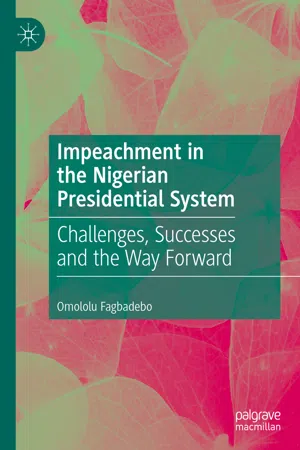
eBook - ePub
Impeachment in the Nigerian Presidential System
Challenges, Successes and the Way Forward
- English
- ePUB (mobile friendly)
- Available on iOS & Android
eBook - ePub
Impeachment in the Nigerian Presidential System
Challenges, Successes and the Way Forward
About this book
Information
© The Author(s) 2020
O. FagbadeboImpeachment in the Nigerian Presidential Systemhttps://doi.org/10.1007/978-981-15-6041-5_11. Introduction: Power and Politics in Presidential Systems
Omololu Fagbadebo1
(1)
Department of Public Management and Economics, Durban University of Technology, Durban, KwaZulu-Natal, South Africa
Keywords
PowerAccountabilityLegislaturePresidential systemImpeachmentIntroduction
Early political thinkers considered power as a crucial element in society. For instance, Thomas Hobbes, in his conception of the state of nature, emphasized the uncontrolled exercise of the disparate power of the individuals as the driver to anarchy, which he sought to rectify through the Leviathan. In this way, the emergence of the Leviathan was a necessary mechanism to ensure the control of the power of the individual in a manner that its exercise would provide for a collective security of all. Bertrand Russell, in his classic book, Power: A New Social Analysis, published in 1938, defined power as “the production of intended effects” (Russell 1938, p. 35). In other words, the ultimate result of the exercise of power is to achieve predetermined and expected outcomes. Russell likened power to energy, with different forms and shapes, to include material wealth, weapons of war, political and civil authority, influence on opinion, all with a measure of independence to function in determining desirable outcomes. In his 1979 work, Denis Wrong sought to expand on Russell’s definition of power, and defined it as “the capacity of some persons to produce intended and foreseen effects on others” (Wrong 1979, p. 2).
Subsequent studies and writings on the concept of power have expanded further the conceptualization of power. Scholars, such as Floyd Hunter, C. Wright Mills, Robert Dahl, and classical liberalists, developed and conceptualized power from different perspectives. Hunter (1953) and Mills (1956) looked at power within the context of organizational and institutional structures, while the classical liberals and the Marxists emphasized the individuals and groups, and class, respectively, as the locus of power (Domhoff 2017). Hunter is associated with what he called the “Power Structure,” Mills wrote about “The Power Elite” and Marx called it classes. Floyd Hunter identified a power structure with associational, clique, or institutional patterns that maintain the general social structure and generate new policy initiatives (Hunter 1953).
Mills’ the power elite comprise individuals with common experience, occupying leadership positions in the major hierarchical structures of the institution of government in the pursuit of similar interests. Unlike the conceptualization of power within the context of the individual or institutions of government, Robert Dahl submitted that government officials were the most significant power figures. He added that different groups in society influence the activities of public officials (Lukes 2015; Stinebrickner 2015). Two distinct features common to the exercise of power emerged from these different perspectives. These are the individuals/group and the institution. Thus, different individuals or groups, who occupy different positions within the institutional and organizational structures, exercise power with a view to influencing decisions in a particular way. All they want is to achieve predetermined desired goals or ends to advance their interests. This generic conceptualization encompasses all forms of power in the private or public sector. Thus, in the governing of society, power is the key.
Power, is therefore, central to the governing of any society. Thus, the central focus of the political scientists in the study of the state and government is power. With “a legitimate monopoly of coercive power” exercised within a defined territory, the state is concerned with how to generate and employ power (Fukuyama 2015, p. 12). The direction of the exercise of power, therefore, was towards the promotion of the public interests. The definitions of politics by Harold Lasswell and David Easton point to the primacy of power in the promotion of the common interests of citizens. According to Lasswell, politics determines “who gets what, when and how” (Lasswell 1958). Thus, at the heart of politics is the decision on the distributive power of the state, defining the relationships between the government and the members of the public. Similarly, David Easton’s conception of politics as the “authoritative allocation of values for the society” (Easton 1965), centers on the exercise of power. In this respect, an authoritative decision that would be binding on all citizens, irrespective of status, evolves from the intricacies of politics. The focus of the political scientists, therefore, is to investigate how the “actions and beliefs, social profiles, and overall configurations” of the actors that comprise the elite “affect political regimes and policies” (Higley 2011, p. 760). In other words, they are interested in how the elite exercise the power of the state for the benefit of the general society.
The preoccupation of the political scientists, essentially, is to interrogate and monitor the exercise of power in society (Francis 2011). The general perception of the activities of the political elite is the ability to impose limits on the possibilities in the political process. According to Francis, political scientists could define power through the lens of the prevailing institutional framework in the political system. Thus, as Suzanne Francis has noted, studies of the way in which people in positions of authority exercise, accumulate and temper power by a multiplicity of actors in a variety of institutional settings, provided the substance from which the political scientists define and recognize the nature of power (Francis 2011). This development often means that politics becomes “fierce power struggles between ambitious, blinkered, and insecure elites” (Higley 2011, p. 760). Kolstad and Wiig (2015) have attributed this to the self-serving character associated with the elites in most political systems.
The exercise of power is subjected to control in order “to ensure that the government acts in the interests of the whole community, rather than simply in the self-interest of the rulers” (Fukuyama 2015, p. 12). Within this, the rule of law is of paramount importance, as a set of rules that reflects the values of the community “that are binding not just on citizens, but also on the elites who wield coercive power. If law does not constrain the powerful, it amounts to commands of the executive and constitutes merely rule by law” (Fukuyama 2015, p. 12). Every society has binding rules that guide the actions of the leaders. These rules manifest the values of society. Ideally, in any democratic state, the exercise of power is to promote the public good. In other words, the political elite, entrusted with power by the public, are responsible for exercising the same in a manner that would provide more benefits to the people. Fukuyama (2015) explains this from the liberal democratic principle, where the state exercises power within the confines of the rule of law with a view to promoting accountability. The primary concern of the state, therefore, is to employ and deploy power for the provision of the basic public goods that enhance human development.
The exercise of this power is not absolute; it is sandwiched by legitimate and binding constraints placed upon those who hold power, by certain rules that reflect the values of the community (Fukuyama 2015). In Europe and other developed countries, for instance, power constraining institutions define the behavior of the members of the executive. This countervailing power is a design to act as a restraint against the excessive abuse and misuse of power against the population. In essence, the consciousness of political accountability pervades the process of state building. In addition, the culture of the rule of law is a norm in society. Thus, adherence to the rule of law in the exercise of power is a design to make the political elite responsible to the public, in the discharge of their responsibilities. The rule of law, as conceptualized by Fukuyama (2015), encompasses a set of rules, which reflects the binding values of the community. Such rules bind on both citizens and “the elites who wield coercive power”, and “if law does not constrain the powerful, it amounts to commands of the executive and constitutes merely rule by law” (Fukuyama 2015, p. 12).
The essence of democratic accountability, therefore, is “to ensure that government acts in the interests of the whole community, rather than simply in the self-interest of the rulers” (Fukuyama 2015, p. 12). The relationships that exist between and among government officials and institutions in the exercise of power are very important. Hence, the necessity for constraining measures to ensure that the exercise of power is devoid of abuse and misuse.
Presidential systems promote these constraining measures with the features of separation of powers and checks and balances in the exercise of power by the three branches of the government: the legislature, the executive and the judiciary. This is necessary in a state with a neo-patrimonial culture like Nigeria, where the politicians, even though democratically elected by the people, exercise powers in a manner that would ensure sharing of state resources within the networks of their supporters, with no distinction between the interests of the public and the pecuniary interests of the elites. Thus, their major motivation, for political participation and the quest for power, was to advance personal interests. In a bid to ensure accountability, therefore, it is expedient to prevent the consequential effects of the manifestation of personalization of state power. The core objective of the notion of separated but shared power associated with presidential systems is visible in the institutional designs that provide the necessary measures to constrain the exercise of power in a manner that is contrary to the rule of law.
Francis (2011) in her study of the provincial legislature of KwaZulu-Natal, South Africa, identifies the legitimate relationship of the elected government officials to institutions of power as a distinguished feature of the political elite who operate within the confine of constitutional and institutional constraints. She defines the political elite “as a group of individuals whose legitimate relationship to the institutions of power enables them to possess the key political influence or take the most important political decisions about that environment” (Francis 2011, p. 2). The political elite, as conceptualized in this book, is a group of individuals who exercise a large amount of influence, authority, and power within the political system. They are a set of people whose sphere of operation within the formal and informal institutions of government influences governance. In Nigeria, the political elite extends beyond the confines of the legislative, executive and judicial structures, to include individuals in the external environments of these governmental institutions, who exert considerable influence on public policy process.
In a presidential system, power is a central focus in the relationships between and among the various institutions of government. The concept of separation of powers and the doctrine of checks and balances are institutional designs to control power relations among the three branches of government: the legislature, the executive and the judiciary. This presupposes that there is the need to control power, as a vital accountability instrument in a presidential system, in a bid to achieve the purpose of the state. As a governing system, a presidential...
Table of contents
- Cover
- Front Matter
- 1. Introduction: Power and Politics in Presidential Systems
- 2. Impeachment in Presidential Systems: Comparative Features and Characteristics of Purpose and Practice
- 3. Structures, Actors, and Impeachment in the Nigerian Presidential System: Content and Context
- 4. Impeachment Cases in Nigeria’s Fourth Republic
- 5. Experience Turned Sour: Impeachment Episodes in Osun State
- 6. The Judiciary and the Politics of Impeachment in Nigeria’s Political System
- 7. Patron-Client Politics and the Politics of Impeachment in Nigeria’s Fourth Republic
- 8. From Parliamentary to Presidentialism: Different Governing Systems and Practice with Similar Outcomes
- 9. The Failure of Impeachment in Nigeria’s Fourth Republic: Sacred Cows and the Scourge of Gross Misconduct
- 10. Conclusion: Making Impeachment an Instrument of Accountability and Good Governance in the Nigeria’s Presidential System
- Back Matter
Trusted by 375,005 students
Access to over 1.5 million titles for a fair monthly price.
Study more efficiently using our study tools.
Frequently asked questions
Yes, you can cancel anytime from the Subscription tab in your account settings on the Perlego website. Your subscription will stay active until the end of your current billing period. Learn how to cancel your subscription
No, books cannot be downloaded as external files, such as PDFs, for use outside of Perlego. However, you can download books within the Perlego app for offline reading on mobile or tablet. Learn how to download books offline
Perlego offers two plans: Essential and Complete
- Essential is ideal for learners and professionals who enjoy exploring a wide range of subjects. Access the Essential Library with 800,000+ trusted titles and best-sellers across business, personal growth, and the humanities. Includes unlimited reading time and Standard Read Aloud voice.
- Complete: Perfect for advanced learners and researchers needing full, unrestricted access. Unlock 1.5M+ books across hundreds of subjects, including academic and specialized titles. The Complete Plan also includes advanced features like Premium Read Aloud and Research Assistant.
We are an online textbook subscription service, where you can get access to an entire online library for less than the price of a single book per month. With over 1.5 million books across 990+ topics, we’ve got you covered! Learn about our mission
Look out for the read-aloud symbol on your next book to see if you can listen to it. The read-aloud tool reads text aloud for you, highlighting the text as it is being read. You can pause it, speed it up and slow it down. Learn more about Read Aloud
Yes! You can use the Perlego app on both iOS and Android devices to read anytime, anywhere — even offline. Perfect for commutes or when you’re on the go.
Please note we cannot support devices running on iOS 13 and Android 7 or earlier. Learn more about using the app
Please note we cannot support devices running on iOS 13 and Android 7 or earlier. Learn more about using the app
Yes, you can access Impeachment in the Nigerian Presidential System by Omololu Fagbadebo in PDF and/or ePUB format, as well as other popular books in Politics & International Relations & African Politics. We have over 1.5 million books available in our catalogue for you to explore.