eBook - ePub
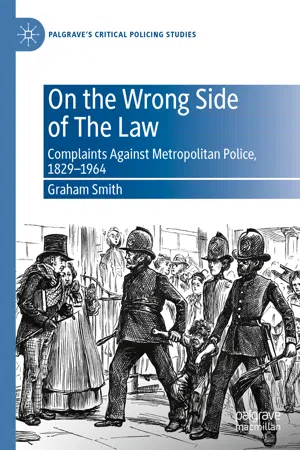
On the Wrong Side of The Law
Complaints Against Metropolitan Police, 1829-1964
- English
- ePUB (mobile friendly)
- Available on iOS & Android
eBook - ePub
About this book
This book, the first of a two volume study, provides an historical account of complaints against Metropolitan police officers between formation of the force in 1829 and codification of remedies for misconduct under the Police Act 1964. A complainant centred standpoint is developed to counteract the marginalization of the interests of victims, which is held to demonstrate that the drive for effective and efficient law enforcement has overshadowed the public interest in holding officers to account for misconduct. After officer accountability before the criminal courts diminished in the nineteenth century, missed opportunities to reform complaints procedures following commissions of inquiry in 1906-08, 1928 and 1960-62 are discussed. The second volume of the study, Combating Impunity: Complaints Against Metropolitan Police, 1964-2021, will examine the part played by complainants and civil society organisations in combating police impunity in the citizen oversight era.
Information
Topic
Scienze sociali© The Author(s) 2020
G. SmithOn the Wrong Side of The LawPalgrave's Critical Policing Studieshttps://doi.org/10.1007/978-3-030-48222-0_11. Standpoint
Launched on 8 January 2018 the Independent Office for Police Conduct (IOPC) is the fourth body established in England and Wales with a remit to oversee the police complaints system. Over the course of the last half-century or so police misconduct and the remedies available to victims have attracted public criticism and there has been major legislative reform on five occasions.
The police complaints system was first codified under the Police Act 1964. In the late 1950s there was an absence of transparency surrounding internal investigations of police misconduct, and the climate of secrecy contributed to widely held perceptions that police officers were not accountable for their conduct. Following a series of scandals around the United Kingdom, and eventually triggered by disquiet surrounding settlement by the Commissioner of the Metropolitan Police (commonly referred to as the Met) of a civil action against a constable which was not accompanied by disciplinary proceedings against the officer, the Royal Commission on the Police (1960–62 Commission 1962) was appointed. The primary purpose of the Commission was to consider arrangements for the governance of police, and much of the 1964 Act was devoted to implementing the recommendation of the Commission to establish a tripartite arrangement between the chief officer of police (Chief Constable of a provincial force and the Commissioner in the case of the Metropolitan and City of London forces), local police authority and Home Secretary. Under their terms of reference the 1960–62 Commission were also asked to consider police public relations and procedures for handling public complaints against the police. Acknowledging the decline in deference to authority that together with an increasing awareness of civil rights had begun to define police public relations, the Commission recognised the need for legislative reform. On the recommendation of the majority of Commissioners a statutory internal police complaints system modelled on the Met system was created under Section 49 of the 1964 Act. The chief officer of police, who served as disciplinary authority for all officers below chief officer rank,1 was given responsibility for the investigation of complaints. In addition, provision was made for the Director of Public Prosecutions (DPP) to determine whether, following investigation of a complaint, criminal proceedings should be brought against an officer. Under Section 48 of the Act a vicarious liability rule in the laws of tort was introduced which permitted victims to claim damages from the chief officer of police, and Section 50 required police authorities and inspectors of constabulary to keep themselves informed of the way in which complaints were handled.
Significance attaches to the Police Act 1964 for introducing a misconduct package under sections 48 to 50 which set out remedies in criminal, civil and administrative proceedings and provided for oversight. Since formation of the Met as the first modern police force under the Metropolitan Police Act 1829, the two legal remedies were available to victims of misconduct at common law, and police regulations provided for discipline and complaints procedures. In the mid-nineteenth century victims would bring criminal charges against constables by application to a police court magistrate for a summons or indictment; officers were occasionally to be found in the civil courts having to defend themselves against a claim for damages; and records show that constables were regularly punished for offences against discipline. In the absence of records, it is not known what the outcomes were of public complaints that were handled internally. By the mid-twentieth century criminal and civil remedies were largely inaccessible to victims and officers were rarely brought before the courts, quasi-judicial disciplinary proceedings with the right of appeal to the Home Secretary2 were less frequent and there was no evidence to suggest the operation of an effective complaints system. Alongside the internal complaints system, inclusion in the 1964 misconduct package of statutory roles for the DPP in criminal proceedings and chief officers of police in civil proceedings were presented as means by which victims of serious misconduct could access legal remedies. Decisions on criminal proceedings would be made by the DPP independently of the police, and the chief officer would be liable in civil proceedings regardless of whether the claimant knew the identity of the constable responsible for the damage they had suffered.
Three members of the 1960–62 Commission were not persuaded that the public interest in tackling police misconduct could be sufficiently met by legislating for police investigations of complaints that were not independently monitored. Concerned that police would not be able to reassure the public that internal procedures were effective and fair to both complainants and officers, the minority recommended appointment of a Commissioner of Rights to oversee the complaints system (1960–62 Commission 1962). Rejected by government, the minority proposal represented an early contribution to what has developed into a highly contested international complaints discourse, in which the proposition that police cannot be trusted to impartially investigate police is countered by the assertion that only police can effectively investigate police (Prenzler and Ronken 2001).
In accordance with Section 50 of the 1964 Act, the Chief Inspector of Constabulary (1964) and Met Commissioner (1965) commenced regular publication of complaints statistics in their annual reports of 1963 and 1964, respectively. The figures confirmed the perception that complaints against officers were rarely substantiated and seldom resulted in criminal or disciplinary proceedings. Allegations of police racism, which had come to the fore in the late 1950s and were to escalate in the 1960s (Hunte 1966; Lambert 1970), were increasingly met by African Caribbean and Asian communities mobilising in support of their members (Humphry and John 1971; Sivanandan 1982; Trew 2015). The Home Office quickly revisited the operation of the complaints system and appointed a Police Advisory Board Working Party, which reported in 1970,3 and the Select Committee on Race Relations (1972) urged the government to consider introduction of an independent element to the system. Created by the Police Act 1976 and launched on 1 July 1977, with limited powers to review completed reports of police investigations of complaints and direct a chief police officer to bring disciplinary charges against an officer, the Police Complaints Board (PCB) was to survive for eight years as the first independent oversight body.
The PCB was criticised for rarely resorting to their disciplinary powers (Hewitt 1982), and the clamour for complaints reform continued unabated. Black and ethnic minority communities were particularly vocal and campaigns were launched in response to a spate of controversial deaths during or following contact with the police (Benn and Warpole 1986; Scraton and Chadwick 1986), and in opposition to stop and search and ‘Sus’, the power of police to arrest and charge a suspected person under Section 4 of the Vagrancy Act 1824 (Demuth 1978). An inquiry by Lord Scarman (1981) into the Brixton and other inner city disturbances of 1981, a Working Party chaired by the Chairman of the PCB, Lord Plowden (1981) and an inquiry by the House of Commons Home Affairs Committee (HAC 1982) were each to conclude that greater independence in the police complaints system was required.
At the same time that momentum was gathering for further complaints reform, police powers and responsibilities to investigate crime and prepare criminal prosecutions were under scrutiny. Appointed to inquire into a 1972 investigation by Met officers into the death of Maxwell Confait and the prosecution of three young men, whose convictions were subsequently overturned by the Court of Appeal, Sir Henry Fisher (1977) found that the Met investigation and prosecution were seriously flawed. He proposed that a more general examination of the criminal justice process was required and the Royal Commission on Criminal Procedure (1981) was subsequently appointed to examine police criminal investigation responsibilities, safeguards for suspects and the conduct of prosecutions. On their recommendation police powers, which had previously been developed at common law, were codified by the Police and Criminal Evidence Act 1984.4 In addition, Part IX of the Act provided for the PCB to be replaced by the Police Complaints Authority (PCA) with additional powers to supervise police investigations of complaints. Launched on 1 April 1985, and despite widespread public concern with PCA effectiveness at a time when the Court of Appeal was overturning a succession of convictions that relied on tainted police evidence (Walker and Starmer 1999), the much-criticised oversight body lasted for 19 years.
From a low baseline when publication of figures commenced in the mid-1960s, annual complaints and discipline statistics, which were collated and published by the Home Office between 1990 and 2003/04, revealed a declining substantiation rate across England and Wales reaching a low of 2% of the total number recorded in 1995/96 and the following four years (Povey and Cotton 2001). In contrast, with claimants relying on Section 48 of the Police Act 1964 civil actions emerged as a viable remedy for police misconduct. In the three years 1994/95 to 1996/97, 863 claims against the Met Commissioner (1997) were successfully concluded with more than £6 million paid out to claimants in settlements and court awards. In the same three years three Met officers were convicted of a criminal offence and disciplinary charges were proved against 50 officers arising from public complaints (excluding traffic offences). Furthermore, in 1997 decisions by DPP Dame Barbara Mills not to prosecute police officers after two people died following contact with Met officers and the ‘plastic bagging’ of a suspect by West Midlands officers were challenged in three joined judicial reviews (Smith 1997, 2001). The DPP agreed to review decisions in the two death in custody cases and was directed by the Divisional Court to review the plastic bagging decision (R. v. DPP Ex parte Treadaway [1997] EWHC Admin 741).5 The HAC (1998) took notice of these developments and recommended urgent reform of police disciplinary procedures, and that the Home Office commission feasibility research on independent investigation of complaints (KPMG 2000).6 These proposals were endorsed by the Council of Europe Committe...
Table of contents
- Cover
- Front Matter
- 1. Standpoint
- 2. Disciplined Force
- 3. The Police and Public Vigilance Society and Royal Commission upon the Duties of the Metropolitan Police
- 4. Resort to the Home Secretary
- 5. Adjusted Responsibilities of the Home Secretary and Met Commissioner (Fisher v. Oldham Corporation and Constabulary Independence)
- 6. Internal Affairs
- 7. To Be Continued
- Back Matter
Trusted by 375,005 students
Access to over 1.5 million titles for a fair monthly price.
Study more efficiently using our study tools.
Frequently asked questions
Yes, you can cancel anytime from the Subscription tab in your account settings on the Perlego website. Your subscription will stay active until the end of your current billing period. Learn how to cancel your subscription
No, books cannot be downloaded as external files, such as PDFs, for use outside of Perlego. However, you can download books within the Perlego app for offline reading on mobile or tablet. Learn how to download books offline
Perlego offers two plans: Essential and Complete
- Essential is ideal for learners and professionals who enjoy exploring a wide range of subjects. Access the Essential Library with 800,000+ trusted titles and best-sellers across business, personal growth, and the humanities. Includes unlimited reading time and Standard Read Aloud voice.
- Complete: Perfect for advanced learners and researchers needing full, unrestricted access. Unlock 1.5M+ books across hundreds of subjects, including academic and specialized titles. The Complete Plan also includes advanced features like Premium Read Aloud and Research Assistant.
We are an online textbook subscription service, where you can get access to an entire online library for less than the price of a single book per month. With over 1.5 million books across 990+ topics, we’ve got you covered! Learn about our mission
Look out for the read-aloud symbol on your next book to see if you can listen to it. The read-aloud tool reads text aloud for you, highlighting the text as it is being read. You can pause it, speed it up and slow it down. Learn more about Read Aloud
Yes! You can use the Perlego app on both iOS and Android devices to read anytime, anywhere — even offline. Perfect for commutes or when you’re on the go.
Please note we cannot support devices running on iOS 13 and Android 7 or earlier. Learn more about using the app
Please note we cannot support devices running on iOS 13 and Android 7 or earlier. Learn more about using the app
Yes, you can access On the Wrong Side of The Law by Graham Smith in PDF and/or ePUB format, as well as other popular books in Scienze sociali & Diritti civili in ambito legislativo. We have over 1.5 million books available in our catalogue for you to explore.